APA 7th referencing
Generative Artificial Intelligence (Gen-AI)
Before using Gen-AI tools in your assessments, check your unit outline, assessment guidelines or ask your lecturer, as Gen-AI use may be prohibited.
If you use an AI tool (like ChatGPT, Claude, Copilot, etc.) to generate content that you use in your writing, you need to include an in-text citation and reference list entry as you would for other sources. In addition, you need to provide a declaration outlining how the tool was used.
If you have been provided with specific guidelines on how to reference Gen-AI outputs within your unit, you should follow them.
- Provide the author of the tool (e.g. OpenAI) and the year of the version used.
(OpenAI, 2023).
Or
According to OpenAI (2023)…
Specific AI chat
Use this format when you want to reference a particular conversation with an AI tool.
Reference components
AI Company Name. (Year, Month Day). Title of chat in italics [Generative AI chat]. Tool Name/Model. URL
Example:
OpenAI. (2025, August 21). High school grammar concepts [Generative AI chat]. ChatGPT. https://chatgpt.com/share/68a77b60-0ee4-800c-9acc-cd3fd573c311
AI tool
Use this when you used the tool but do not need to cite a specific chat.
Reference components
AI Company Name. (Year). Tool Name/Model in Italics [Description]. URL
Example:
Microsoft. (2025). Copilot [Large language model]. https://copilot.microsoft.com
If you use Gen-AI in your assessment, you must also write a short declaration. This should include: the name of the tool you used, how much you used it, how the information was created and the exact prompt(s) you entered.
Here is a formal declaration template you can include after the reference list in your assessment:
I acknowledge the use of [insert AI tool name and URL] in the preparation and/or writing of my assessment. I have used [insert AI tool name] to assist with the following:
- Research: I generated an overview of my topic to assist with the research process.
- Idea generation: I generated suggestions on possible topics or viewpoints to explore within my assessment.
- Clarifying: I generated explanations/examples to help me understand confusing or complex topics.
- Structure and organisation: I generated an assessment plan.
- Writing: I generated text which I adapted in my assessment. I have indicated through in-text citations, where text generated by the AI tool has been paraphrased or quoted.
- Other: [Provide a brief description if applicable.]
The following prompts were input into [insert AI tool name]:
- Prompt one
- Prompt two
or
[Insert link to specific AI chat]
Declaration example
I acknowledge the use of ChatGPT (https://chat.openai.com/chat) in the preparation and/or writing of my assessment. I have used ChatGPT to assist with:
- Research: I generated an overview of my topic to assist with the research process.
- Writing: I generated text which I adapted in my assessment. I have indicated through in-text citations, where text generated by the AI tool has been paraphrased or quoted.
The following prompts were input into ChatGPT:
- Are dogs better than cats?
There are currently no official APA style guidelines for referencing images created by Gen-AI. Below is a suggested format to follow.
Above the figure
- Write Figure in bold. If you use more than one figure, number them in the order they appear in your work (e.g. Figure 1, Figure 2).
- One double-spaced line below the label, include a short title that explains what the figure shows. The title should be in italics, with each major word starting with a capital letter and no full stop at the end
- If there is no title for the image, add your own title in square brackets.
Below the figure
- Start with Note. in italics
- Write a caption that explains where the figure came from
- Include an in-text citation for the AI tool.
Reference list and declaration
- Provide a reference list entry for the AI tool and complete a declaration outlining the use of the tool.
In your writing
- Call out (refer) to the figure by its number in your writing, e.g. As shown in Figure 1… OR Primary prevention has many intersecting dimensions (Figure 2).
Example
Figure 1
[Cat Sleeping on a Wooden Desk in a Library]
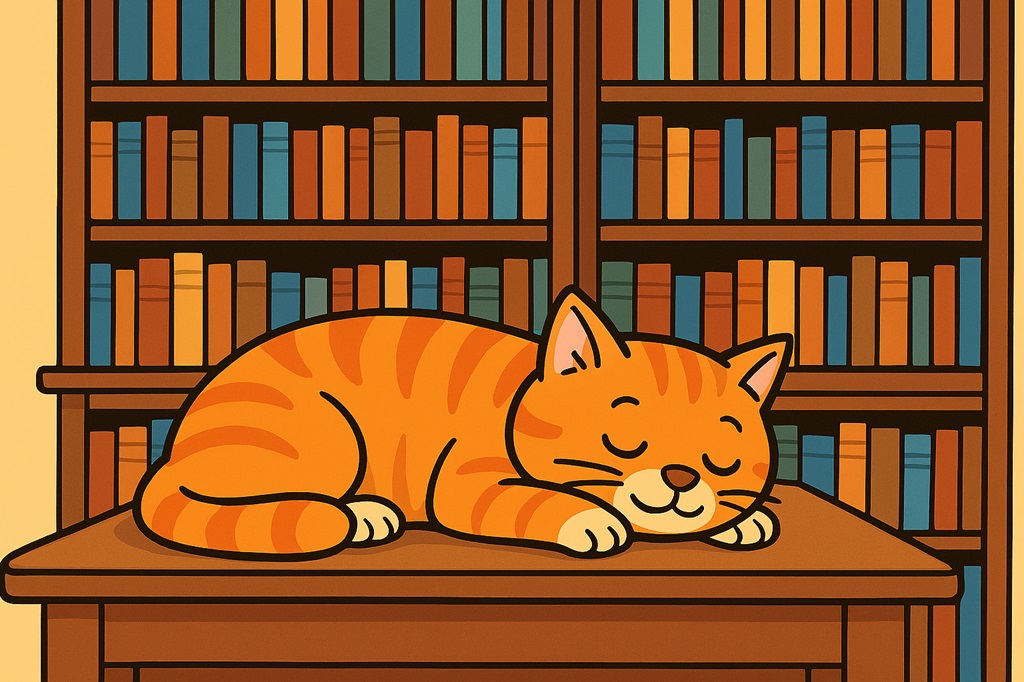
Note. Image generated using Copilot (Microsoft, 2025).
Indigenous Knowledges
Indigenous Knowledges are those which are held and developed by Aboriginal and Torres Strait Islander people in Australia or other First Nations people globally. IP Australia (2021) defines two distinct areas:
- Cultural Expressions - including language, stories, songlines, music, performance, visual arts, crafts, architecture, designs and symbols
- Knowledge - including know-how, practices, skills and innovations, often related but not limited to agricultural, scientific, technical, ecological, medicinal and biodiversity-related knowledge.
How you cite Indigenous Knowledge depends on whether the information is from a published or non-published source.
Indigenous authored sources
If you have read a book or journal article, watched a YouTube video or listened to a podcast created by an Indigenous person (the information was recorded in a format that can be retrieved) follow the standard guidelines provided in this guide to create your in-text citation and reference list entry, according to the source type (e.g. journal article, book, video etc.).
Non-Indigenous authored sources
Indigenous Knowledge may be communicated by non-Indigenous authors. Wherever possible, the author, the Indigenous person, and the appropriate community or language group should be referenced within your narrative or in your in-text citations (if an individual is not mentioned, include the community or language group alone). If the source does not provide this information, use the broader term ‘Indigenous Knowledge’ within the citation before the source details.
In-text example - Non-Indigenous authored - Known individual or language group
The Government policy of removing Aboriginal and Torres Strait Islander children from their parents continues to have a considerable impact, despite formally ending in 1969. “Stories such as this need to be told as we, as Aboriginal people, suffer a lot.” (Ryder, Ballardong Noongar, as cited by Clark, 2021, para. 12).
In-text example - Non-Indigenous authored - Unknown individual or language group
The Yugul Mangi Rangers suggest that burning is guided by “the old people” (Indigenous ancestors) and typically occurs directly after the rain. Knowledge is communicated orally and learned through experience (Indigenous Knowledge, as cited by McKemey et al., 2020, p. 1000).
Extra tips
- It may be appropriate to refer to an Indigenous Elder as Aunty or Uncle in your narrative if they are referred to in the source or if you have permission to do so. For example: Uncle Charles, Bundjalung, highlights the importance of stillness and listening to the lessons from Country (Moran & Moran, 2004, p. 56).
- Names of ethnic, national and other regional groups are capitalised, including adjectives associated with these names (e.g. Indigenous).
- In-text references for non-Indigenous authors should follow the format of Authors citing other authors.
Aboriginal and Torres Strait Islander peoples have an oral tradition, meaning their knowledges, beliefs and customs are passed down verbally or through other cultural expressions. If the information has been communicated with you directly (e.g. you have spoken to an Indigenous person directly) and you have permission to use it in your work, follow the guidelines for referencing a Personal Communication, but also include the Indigenous community or language group, if known. If the source of information is an Indigenous Elder or other Indigenous Knowledge Keeper, also include the name of the Elder or Knowledge Keeper.
For example, the in-text citation will be displayed as:
(I. Cumming, Whadjuk Noongar, personal communication, July 1, 2021).
Extra tip
- Some Elders and Knowledge Keepers will prefer to be listed under their Traditional Name rather than their legal name, sometimes even without listing a legal name. Whenever possible, confirm with the Elder or Knowledge Keeper.
Personal communication
Personal communications are not included in the reference list
- Personal communications may not be acceptable to include in your assessment – please check with your lecturer/tutor before doing so
- Personal communications are works which cannot be recovered by the reader. They include emails, text messages, online chats, letters, memos, personal (unpublished) interviews, telephone conversations, live speeches etc.
- Cite in text only. Give the initials as well as the surname of the communicator and provide as exact a date as possible
- Quotations from participants whom you interviewed as part of your research are treated differently than quotations from published works. See page 278 of the APA 7th manual for more information
“…” (T. S. Reed, personal communication, September 20, 2019).
According to P. M. Walker (personal communication, April 18, 2015) …
Data set
Reference components
Author Surname, Initial(s). (year). Title of data set in italics [Data set]. Publisher Name. https://doi.org/DOI or URL
Reference list example
Irino, T., & Tada, R. (2009). Chemical and mineral compositions from ODP site 127-797 [Data set]. PANGAEA. https://doi.org/10.1594/PANGAEA.726855
Australian curriculum
Reference components
Organisation name. (year). Title of curriculum document: Subtitle (Version number). URL
Reference list examples
Australian Curriculum, Assessment and Reporting Authority. (2015). Science: Sequence of content F-6 strand: Science understanding (Version 8.1). https://docs.acara.edu.au/resources/Science_-_Sequence_of_content.pdf
Australian Curriculum, Assessment and Reporting Authority. (2022). Humanities and social sciences: Civics and citizenship 7-10: Curriculum content 7-10 (Version 9.0). https://v9.australiancurriculum.edu.au/content/dam/en/curriculum/ac-version-9/downloads/humanities-and-social-sciences/civics-and-citizenship/humanities-and-social-sciences-civics-and-citizenship-curriculum-content-v9.docx
School Curriculum and Standards Authority. (2016). Mathematics - Scope and sequence - P-6 (Version 8.1). https://k10outline.scsa.wa.edu.au/home/teaching/curriculum-browser/mathematics-v8/overview/Maths_P-10_Scope-and-Sequence_Phase_1_March_2016.PDF
Extra tip
- Download the curriculum document for date and version information