Finding information
A search strategy is an organised way to look for information. It helps you find accurate and relevant information about your topic. A good search strategy includes using keywords and similar terms, combining them with words like AND and OR, and applying filters such as date, type of source, or language.
In brief, creating a search strategy will help you:
- Find useful keywords to begin your search
- Search effectively by using alternative terms, ANDs and ORs, and filters
- Try parallel searches if you are not finding relevant results.
Identifying keywords
Whether your assessment topic is broad or specific, you will need to find the main concepts in the question. These words or phrases describe your topic and become the keywords (or search terms) you will use to begin your search.
If you need help working out the keywords from your assessment topic, see understanding your question.
Will artificial intelligence ultimately benefit or harm humankind?
Our keywords may be:
- Artificial intelligence (AI)
- Benefit
- Harm
- Humans
Brainstorming your topic can also help you further develop the main concepts and keywords you can use for your search.
Explore the ways in which artificial intelligence (AI) has transformed various aspects of human life, from communication and healthcare to industry and entertainment. Discuss both the positive and negative implications of this transformation. Will artificial intelligence ultimately benefit or harm humankind?
Our keywords may be:
- Artificial intelligence (AI)
- Communication
- Healthcare
- Industry
- Entertainment
- Benefit
- Harm
Note: You may need to try different combinations of keywords when searching to find information on different parts of your topic.
Examples
- Artificial intelligence, Communication, Benefit, Harm
- Artificial intelligence, Healthcare, Benefit, Harm
Searching and reviewing your results
Start your search by typing the keywords from your topic into the Library catalogue or a suitable database. These tools often have filters (also called limits) that help you narrow down your results. You can filter by:
- Date (for example, only show items from the last 5 or 10 years)
- Type of resource (such as books or peer-reviewed journal articles)
- Language (for example, English)
Once you get your search results, look through the titles and abstracts (short summaries) of the items. This helps you quickly decide if they are useful for your topic. Sometimes, your first search may not give you the best or most relevant results, even if you used the right keywords.
Expanding and refining your search
To improve your search and find more relevant information, here are some useful strategies.
Use alternative terms
Concepts can be described in different ways. For example, the word harm might also be referred to as risk or disadvantage. Think about other words (alternative terms, related terms, or synonyms) that mean the same thing, as these can help you find more results. To find alternative keywords, try these methods:
- Look up your keyword in a thesaurus
- Search for the word or concept in Google or Google Scholar
- Read the abstracts (summaries) of useful articles from your first search to find other keywords, phrases, or subjects.
This table shows some alternative terms we could use for the sample assessment topic:
| Artificial intelligence | Benefits | Harm | Communication |
|---|---|---|---|
| Generative AI Machine learning Gen-AI |
Advantages Opportunities Job efficiency |
Disadvantages Privacy Job loss |
Conversational AI Content creation Virtual assistants |
Combining your search terms
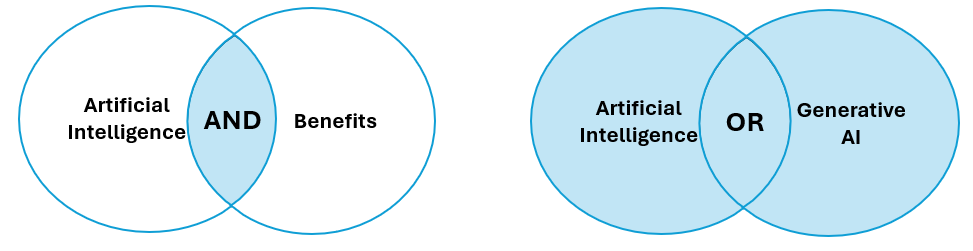
When you search in the Library catalogue or a database, you can combine your keywords using AND and OR to get better results.
-
AND makes your search more specific. It only shows results that include all the concepts you use. For example: Artificial intelligence AND communication will only show articles that mention both artificial intelligence and communication.
-
OR broadens your search. It shows results that include either of the keywords. For example: Artificial intelligence OR generative AI will show articles that mention either artificial intelligence or generative AI.
Other search tips
You can use the tips below when searching in the Library catalogue, databases, or even Google.
Phrase searching
Phrase searching helps you find two or more words that appear together in the exact order. This gives you fewer results, but they are usually more relevant. To do this, put double quotation marks around the phrase. For example, “artificial intelligence” will only show results where those two words appear together.
Truncation
Truncation helps you search for words with different endings. To use truncation, add an asterisk (*) after the last common part of the word. For example, communicat* will find results that include communicate, communication, communicating and communicated.
Example of a search strategy
By using these techniques, you can build a search strategy that works across different databases. You might need to do several searches using different combinations of keywords to find useful sources for each part of your topic.
Examples
-
“artificial intelligence” OR AI AND benefit OR job efficiency AND communication OR content creation
-
“artificial intelligence” OR AI AND harm OR job loss AND communication OR content creation
Still not finding what you need?
If you are getting too many or too few results, or if the results are not relevant, you may need to change your search strategy.
Try these tips:
- Add more concepts using AND (for example, artificial intelligence AND benefits AND university AND Australia)
- Use more specific terms (for example, job efficiency or virtual assistants instead of benefits)
- Make sure you are not using OR between different concepts (use AND instead)
- Use filters like resource type, date, subject, or language.
Try these tips:
- Check your spelling is correct
- Add more alternative keywords using OR
- Remove some concepts or use broader terms
- Make sure you are not using AND between similar keywords (use OR instead)
- Try searching in a different database.
If you are still not finding much information, try a parallel search. For example, if you are researching how AI is used by secondary school students and not finding much, you could search for how AI is used by university students instead. You can then use that information in your assessment by comparing the similarities and differences between university and high school students.