Getting started
Once you are confident that you understand your assessment question and what you need to do based on the marking rubric, it is time to start developing your ideas. These ideas can become the beginning of an assessment plan, which will help keep you on track and make it easier and faster to finish your assessment.
An assessment plan creates a roadmap that you can keep coming back to and update as you work through your assessment. It can be a broad overview or specific and detailed, whichever works best for you.
In brief, you can develop your ideas by:
- Brainstorming helps you develop your thinking in a visual way.
- Freewriting helps to develop your thinking on a question in a written way.
- Test searching is important to make sure there will be enough evidence to support your assessment, especially if you are developing your own question.
- Reviewing the result of these activities can be translated into an assessment plan.
To make the most of any of these methods, we suggest that you learn a bit about your topic first. If you feel lost or are not sure where to start, return to your lecture or class notes or do a general search on a search engine like Google or Wikipedia. This will help you to get background information and find ideas you might want to cover.
Brainstorming
Brainstorming helps you to visualise your thoughts on a topic and can be done at any point in the assessment journey. It helps you to evaluate what you already know, find areas to learn more about, and kick-start your thinking. It is particularly useful for group assessments as it works well as a group activity.
Brainstorming can be used to:
- Figure out what you already know about a topic
- Decide what areas that you would like to include in your assessment
- Summarise the relevant content that has been covered in classes
- Choose potential topics for paragraphs
- Find the links between different topics, ideas or areas.
Method
- Use a piece of paper or a program like GroupMap (Curtin provided) or TL Draw (no account required).
- Write your topic words/question in the centre of the page.
- Set yourself a timer for two - five minutes.
- Start the timer and record all your thoughts about the topic as quickly as possible. Don not worry about it being messy or if ideas aren not good – just follow the thoughts as far as they take you. The goal is to write down a lot of ideas, not the best ideas. Sometimes the wilder the idea, the more useful it can be.
- When the timer ends, step back and review your brainstorm. Look for:
- Areas of strength
- Areas that need more research
- Words that need to be defined
- Categories or ideas that relate to or complement each other.
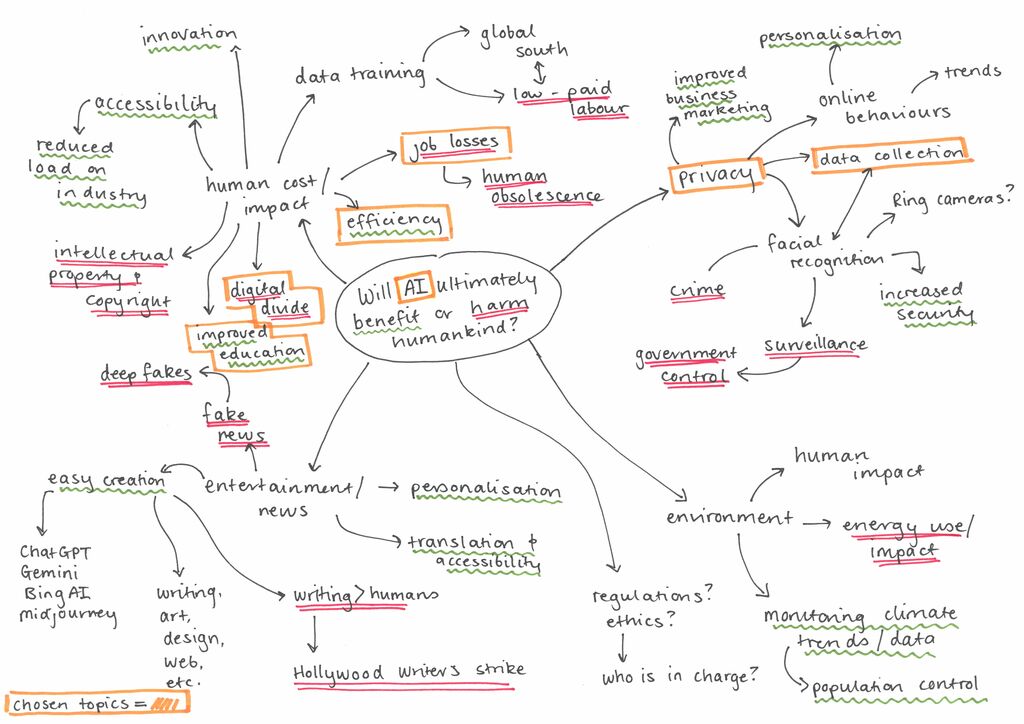
Top tips! If you are creating your own question, your brainstorm will help you to choose areas of focus from your broader topic. Your aim is to develop a question that is specific enough that you can get a manageable amount of relevant information, but not so specific that no research is available.
At the bottom of your brainstorm, write down a draft or potential research question. This can be improved more in the research phase, but it will help give you a direction as you begin test searching.
Freewriting
Freewriting is also known as stream of consciousness, and works like a brainstorm. To do it, set aside dedicated time to write ideas and thoughts as they come to you, without worrying about structure or organisation. It lets you to explore concepts in a free and flexible way and come up with ideas that can be later turned into into a the basis of an assessment.
Method
- Write your question at the top of a document (use a program like Word or Pages).
- Set a timer for 20 minutes. Use this time to write non-stop without pausing to edit or structure. The goal is to write down your thoughts about the topic in full, including any thoughts, ideas, questions or concepts related to the topic.
- Let your mind lead you from one idea to another. If something triggers a related thought, write it down even if it you are not sure it relates to your assessment question.
- When the 20 minutes is up, take time to look over and reflect on what you have written. Read through your notes, highlight key points, and group related concepts. Look for central or common themes in your freewriting.
- Based on your reflections, write a draft outline for your assessment.
Here is an example of what the freewriting process could look like:
Freewriting example [DOCX, 26.2kB]
Top tips! If you are creating your own question, freewriting may help you to find areas of focus from your broader topic. Your aim is to develop a question that is specific enough that you can get a manageable amount of relevant information, but not so specific that no research is available.
At the bottom of your brainstorm, write down a draft or potential research question. This can be improved more in the research phase, but it will help give you a direction as you begin test searching.
Test searching
Test searching is a quick, first search to easily find out if you will be able to find enough information on your topic. Using any concepts or ideas you have identified, do a quick search in the Library catalogue or Google Scholar using at least two concepts (make sure you are being specific, because using just one word does not usually get useful search results).
Top tips! If you are developing your own question, you can use the test search to find areas of focus in your broader topic that you might not be aware of. You can try checking out the Wikipedia page for your broader topic. Is there anything that interests you that you can add into your research?
Never search with a single concept, because your results will contain everything that has ever been published with those words - a lot of it won’t be relevant. Be more specific by including more concepts. They may come from your question, or from your brainstorming/freewriting exercises. Examples of concepts you could add include:
- By demographic (for example, among teenagers, among elderly Australians, among the LGBTQI+ population)
- By location (for example, in rural communities, in Australia, in the Global South)
- By industry (for example, entertainment, medicine, finance, mining)
- By time period (for example, in the 21st century, in the last five years, since the COVID pandemic, during lockdowns)
If you find too little information or do not find anything, you may need to modify your question or broaden your topic. For example, instead of “the impact of artificial intelligence on Hollywood screenwriters”, you could broaden your topic to “the impact of artificial intelligence on the entertainment industry”.
If you have completed your test search and you cannot find anything that looks relevant, do not worry! Discover strategies to help you improve your search in our Finding Information guide.
Assignment plan
Developing an assessment plan comes naturally after developing your ideas. Fill in the asessment plan template to work out the next stages of the assessment process.