Finding information
Scholarly sources
At university, you will need to use different types of sources for your assessments, particularly scholarly sources. These are carefully researched publications written by experts such as academics and researchers in a specific subject area. Their purpose is to share new research, ideas, and analysis, or to explain current thinking in that field.
In brief, writing assessments at university means using scholarly evidence
- You will need to find scholarly and trustworthy sources
- Common scholarly sources include journal articles, books and book chapters, and reports.
Journal articles
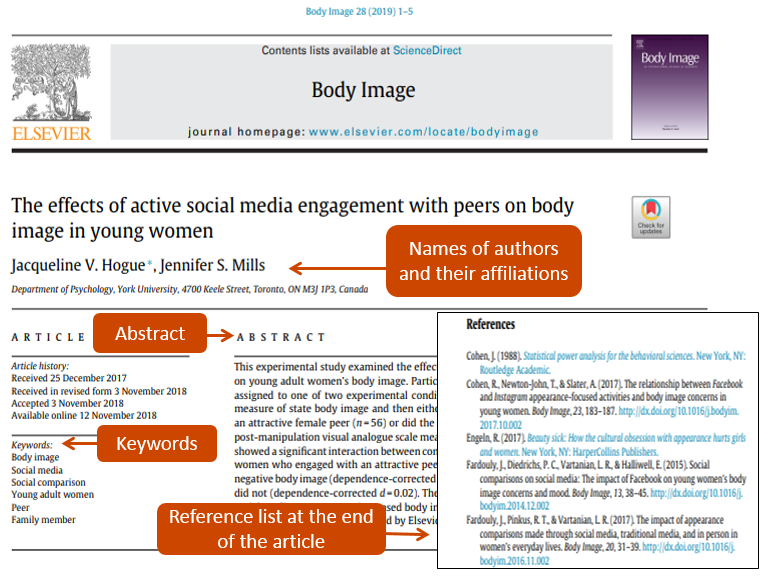
Journal articles are a type of scholarly source that focus on very specific topics. They are written by experts or researchers and include detailed research and evidence, supported by references to other studies.
Many journal articles are peer-reviewed or refereed. This means other experts in the same field check the article carefully before it is published. They look at how accurate, original, and high-quality the article is to make sure it meets academic standards.
Why use journal articles?
Journal articles can give you:
-
Detailed information on a specific part of a topic
-
The latest research findings (new research is often published in journals first)
-
Definitions of important concepts
-
Statistics and data
-
Lists of references that can help you find more related research.
See a journal article example below:
Books and book chapters
Books are also useful for academic research. They usually give a broad overview of a topic and often go into more detail than other sources. Books are divided into chapters or sections, so you can read only the parts that are most relevant to your assessment. Books can also explain well-known theories and give examples of important research in a subject area.
Why use books?
Books can give you:
-
Definitions of key concepts and terms
-
Detailed information about a topic
-
General background information (helpful if you are new to a topic)
-
Lists of other sources on the topic.
You can find tips on how to access ebooks in Specific resources: ebooks.
Reports
A report is a way of presenting information clearly and formally. Reports usually explain the who, what, where and why of a particular issue. They are often written by government departments, research groups, not-for-profit organisations, companies, and other organisations. Reports help explain the reasons behind decisions or actions.
Be careful when using some reports, especially if they were made for marketing. These might be biased and not fully reliable.
Why use reports?
Reports can give you:
-
Detailed descriptions of an issue, including possible solutions and recommendations
-
Unique information, especially about businesses or organisations
-
Statistics (especially in government reports).
You can find tips on how to locate reports in Specific resources: Reports.
Credible sources
You will also use other credible sources—these are trustworthy and accurate sources like well-known news outlets, trade journals, government and education websites, legal documents, and policy papers. Always check how reliable and accurate these sources are, because the strength of your assessment depends on the quality of the sources you use.
For help finding these types of sources, see Specific resources.
Tip: Your assessment instructions and marking rubric will often tell you what kinds of sources you need to use.