Gen-AI
Upskilling with Gen-AI
This section is all about practice. If you don’t have a tool of choice yet, review the common tool chart to choose what Gen-AI tool or tools you’d like to try out. Remember to always keep your privacy in mind before deciding to engage with a tool.
Then, check out different styles of prompting to help you achieve the desired output in the effective prompting section. You will also find a prompt library with prompts specifically designed to elicit meaningful and appropriate feedback on your academic writing.
Common Gen-AI tools
AI tools are designed for specific purposes, such as productivity or research, and it is important to understand their limits. Staying informed, testing different tools, and being adaptable helps you use them effectively as technology evolves.
This table lists examples of Gen-AI tools for creativity, productivity, and research. It is not a complete list—many other tools exist with different features. These examples are a starting point for exploring what is available. Inclusion does not mean Curtin recommends or endorses any tool.
| Gen-AI tool | Marketed for | Cost |
|---|---|---|
| ChatGPT (OpenAI) | Writing, coding, image generation, document processing, voice interactions, GPT assistants | $-$$$ |
| Claude (Anthropic) | Writing, understand images and uploaded documents, create files, interactive artifacts, execute code | $$-$$$ |
| Perplexity AI | Academic-style answers with citations, research support, summarising sources | $$-$$$ |
| Elicit | Research support for sciences, summarise academic papers, review literature | $-$$$ |
| Scite | Find, analyse, and cite academic literature, evaluate research claims | $-$$$ |
| Consensus | Natural language answers to research questions from peer-reviewed papers | $-$$$ |
| ResearchRabbit | Visualising research connections, tracking academic papers, discovering related work | $ |
| Adobe Firefly | Image and text effect generation, integrated with Adobe apps | $-$$$ |
| Midjourney | High-quality AI-generated digital art and imagery from text prompts | $-$$$ |
| Nano Banana | Emerging AI tool focused on image creation, style transfer, and experimental visual effects | $-$$ |
| Jasper AI | Marketing content, copywriting, blog and social media post generation | $$-$$$ |
| GitHub Copilot | AI code completion, code suggestions, programming help | $-$$ |
Note: Many providers offer free trials or limited free versions. For the latest and most accurate pricing, please refer to the official websites of each tool. Last updated December 2025.
Effective prompts
Getting useful results from Gen-AI tools depends on giving a clear and detailed message. This message is called a prompt. Prompt engineering means writing a message that helps the Gen-AI tool give the best answer. Sometimes, you will chat with the Gen-AI and do not need a structured prompt. But if you want a specific format or more detail, you will need to use prompt engineering.
There are several prompt engineering techniques that can help you get the most effective results:
Few-shot prompting gives the Gen-AI tool examples so it understands the task and what you expect. The Gen-AI tool forms its output around the examples and instructions you provide.
By providing two or more examples, the tool can recognise patterns and provide more accurate responses.
Example prompt
Classify the following symptoms into one of the categories: Common Cold, Flu, or Allergies. Here are some examples:
Examples:
- “I have a runny nose, sneezing, and itchy eyes.” = Allergies
- “I’ve had a fever, body aches, and chills for two days.” = Flu
- “My throat is sore, and I have a mild cough but no fever.” = Common Cold
New input: “I have a fever, fatigue, and a headache.”
Expected Gen-AI response:
Based on your new input, here’s the classification:
“I have a fever, fatigue, and a headache.” = Flu
These symptoms are commonly associated with the flu, especially when they occur together.
When to use this technique: Use this method when you have different types of information that need to be organised into categories you choose.
Chain of Thought (COT) prompting encourages the Gen-AI tool to explain its reasoning step by step before giving an answer. This method helps you see how the tool reached its conclusion.
Add the phrase “Let’s think step by step, including explanations” to your input. The tool will then break down its response and include details about the process.
Example prompt
Balance the following chemical equation. Let’s work it through step-by-step, including explanations about why each step is done.
Balance the reaction: Al + HCl → AlCl3 + H2
When to use this technique: Use this method when you want to understand the reasoning behind an answer or when solving complex problems, like maths or science problems, decision-making, or logical analysis, that need clear steps.
Prompt chaining encourages the Gen-AI tool to break down complex tasks into a series of smaller, easier prompts. After the first prompt, each new prompt adds more details to help the final result meet your goal. It works like an ongoing conversation with the tool.
Example prompt
Scenario: Create a comprehensive semester schedule that includes assignment due dates, class schedules, holidays, personal events, and work shifts.
- Prompt #1: Here is a list of key dates, class times, and events for the semester. Organise them into categories: Classes, Assignments, Holidays, Personal Events, and Work Shifts. INFORMATION: [Include details and dates for each]
- Prompt #2: Now, create a weekly schedule with time blocks, filling in classes, work shifts, holidays, and personal events. Make sure to leave time for study and personal activities.
- Prompt #3: Place the assignment due dates, holidays, and personal events onto the calendar, making sure to leave time for preparation and recovery.
- Prompt #4: Now, identify any gaps in your schedule where you can allocate study and revision time for exams and assignments.
When to use this technique: Use this method when the task is too complex for one prompt, generating structured content or when you need to refine the answer step by step.
CARE stands for Context-Action-Response-Example. When you write a prompt, you will include details under each of these headings to help Gen-AI understand what you need.
- CONTEXT: Explain the situation. Include your role, how experienced you are, where you are, and what project or task you are working on.
- ASK: Say clearly what you want Gen-AI to do. Include the role you want it to take, what kind of output you need, and the steps it should follow.
- RULES: Give any limits or instructions. This might include how long the response should be, what writing style to use, or what format you want.
- EXAMPLE: Share examples of what you want or do not want Gen-AI to produce. You can include good and bad examples. Sometimes, you might not need to give examples.
Example prompt
CONTEXT
I am a medical student at university and need to increase my experience interacting with patients.
ASK
Please act as a patient who has arrived at a GP clinic presenting with an illness. You will decide on this illness before our conversation but will not tell me what this is. We will roleplay a conversation mimicking a doctor’s appointment, where I will ask you questions about your symptoms.
RULES
Please provide all answers in a chat format as though we are having a conversation. Use an informal tone. You will not tell me whether I am correct until I provide a diagnosis following the phrase “OFFICIAL DIAGNOSIS”.
Let me know if you have understood this. Do you have any additional pieces of context or rules that will benefit my practice here? Let me know when you are ready, and we can begin.
When to use this technique: Use this method for roleplay situations, when you want Gen-AI to act like a tutor who explains difficult ideas or problems, etc.
Prompt library
This prompt library is designed to help you use Gen-AI tools to get feedback on your academic writing. It is not for generating or editing your content. The focus is on improving writing quality, not completing the entire assessment process.
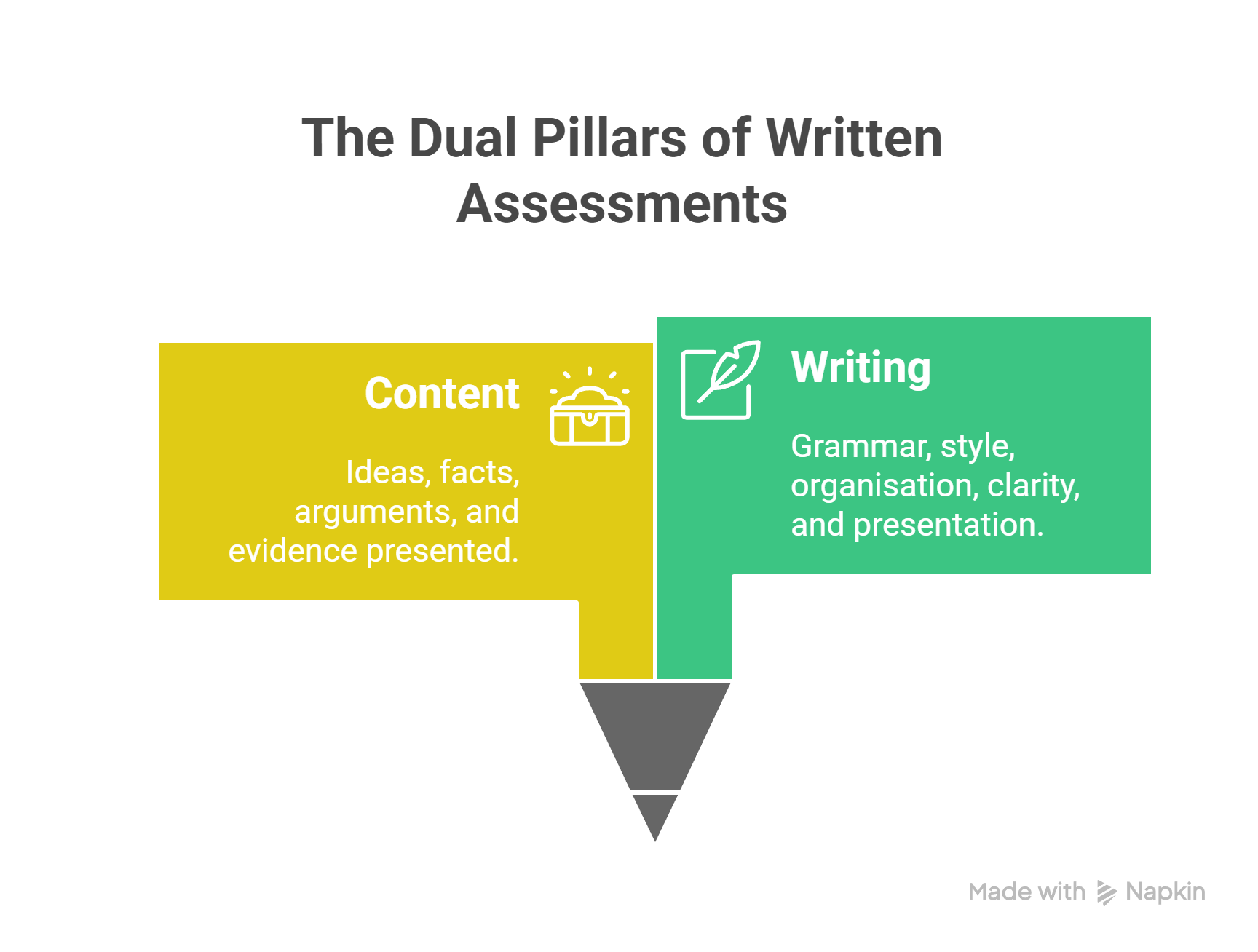
In academic writing, content and writing are connected but different.
- Content is your ideas, arguments, and evidence.
- Writing is how you present those ideas through grammar, style, organisation, and clarity.
A strong paper needs both, but they are separate skills that you can improve individually.
Before using this library, read the Use section of this guide. It explains how to use Gen-AI responsibly and avoid turning it into a shortcut.
How to use the prompt library
The prompts in this library should only be used after you have written a draft and only for feedback on writing, not for generating or editing content.
For more help with academic writing, visit the Academic Writing Guide.
Get started by trying out one of the options:
- Copy and paste a category of prompts based on what you want to improve in your text into your chosen Gen-AI tool; gather all feedback in a single chat
- Enter only the general feedback prompts in your chosen Gen-AI tool
Be sure to replace [text between brackets] with information relevant to you.
If the quality of responses decreases during the chat, start a new chat and give a short summary of the previous conversation.
Initial testing with free accounts of common Gen-AI tools showed that Claude Sonnet 4.5 provided the best quality responses and adhered to the prompt instructions well, followed by ChatGPT 5.0.
Make sure you understand how your data (everything you enter or is allowed to be accessed) will be used or stored by reviewing the Gen-AI tool’s privacy policy before getting started.
Gen-AI technology can produce unpredictable results. It is your responsibility to learn about these tools and use them according to Curtin’s Academic Integrity policy and your unit coordinator’s permissions.
-
(1) Provide an overall assessment of my [insert assessment type] for a [year level + degree level] unit, addressing four areas: referencing consistency, language clarity and precision, technical details (spelling/grammar/sentence structure), and document structure/flow. (2) For each area, provide balanced feedback on strengths and areas for improvement. (3) Use Australian English at a Year 10 high school level to explain feedback. (4) Do not make the corrections for me or change the content; focus only on how my writing can be improved. (5) Structure feedback logically and progressively using headings and dot point lists. (6) Do not make suggestions at the end for follow-up actions for the entire conversation. [Copy and paste your text here]
-
(1) Bold or highlight all the parts of my text (including the reference list if there is one) that have been flagged in the feedback you provided as incorrect or needing improvement. (2) Briefly label what each issue is in italics directly after. (3) Keep text formatted as it was in the original and provide the bolded-and-labelled version in proper paragraph form as originally provided. (4) Do not make corrections or change anything I have written.
-
(1) Break down the following feedback further: [copy and paste feedback you want more clarification on]. (2) Share a corrected example of this type of issue that is not from my writing. (3) Use Australian English at a Year 10 high school level to explain feedback. (4) Do not make the corrections for me or change the content; focus only on how my writing can be improved. (5) Structure feedback logically and progressively using headings and dot point lists.
See an example of these prompts used in the free version of Claude.
-
(1) Evaluate the organisational structure of my [insert assessment type] for a [year level + degree level] unit by examining: my introduction, my body sections, my conclusion, and transitions between sections. (2) Provide balanced feedback only on structure, my introduction, my body sections, my conclusion, and transitions between sections. (2) Provide balanced feedback only on structure based on what works well and where improvements are needed. (3) Use Australian English at a Year 10 high school level to explain feedback. (4) Do not make the corrections for me or change the content; focus only on how my writing can be improved. (5) Structure feedback logically and progressively using headings and dot point lists. (6) Do not make suggestions at the end for follow-up actions for the entire conversation. [Copy and paste your text here]
-
(1) Bold or highlight all the parts of my text (including the reference list if there is one) that have been flagged in the feedback you provided as incorrect or needing improvement. (2) Briefly label what each issue is in italics directly after. (3) Keep text formatted as it was in the original and provide the bolded-and-labelled version in proper paragraph form as originally provided. (4) Do not make corrections or change anything I have written.
-
(1) Break down the following feedback further: [copy and paste feedback you want more clarification on]. (2) Share a corrected example of this type of issue that is not from my writing. (3) Use Australian English at a Year 10 high school level to explain feedback. (4) Do not make the corrections for me or change the content; focus only on how my writing can be improved. (5) Structure feedback logically and progressively using headings and dot point lists.
See an example of these prompts used in the free version of Claude
-
(1) Review the technical accuracy of my [insert assessment type] for a [year level + degree level] unit by examining spelling, grammar, sentence structure and clarity, and punctuation usage. (2) Provide balanced feedback on what demonstrates attention to detail and what needs review. (3) Use Australian English at a Year 10 high school level to explain feedback. (4) Do not make the corrections for me or change the content; focus only on how my writing can be improved. (5) Structure feedback logically and progressively using headings and dot point lists. (6) Do not make suggestions at the end for follow-up actions for the entire conversation.
[Copy and paste your text here] -
(1) Bold or highlight all the parts of my text (including the reference list if there is one) that have been flagged in the feedback you provided as incorrect or needing improvement. (2) Briefly label what each issue is in italics directly after. (3) Keep text formatted as it was in the original and provide the bolded-and-labelled version in proper paragraph form as originally provided. (4) Do not make corrections or change anything I have written.
-
(1) Break down the following feedback further: [copy and paste feedback you want more clarification on]. (2) Share a corrected example of this type of issue that is not from my writing. (3) Use Australian English at a Year 10 high school level to explain feedback. (4) Do not make the corrections for me or change the content; focus only on how my writing can be improved. (5) Structure feedback logically and progressively using headings and dot point lists.
See an example of these prompts used in the free version of Claude
-
(1) Review the technical accuracy of my [insert assessment type] for a [year level + degree level] unit by examining spelling, grammar, sentence structure and clarity, and punctuation usage. (2) Provide balanced feedback on what demonstrates attention to detail and what needs review. (3) Use Australian English at a Year 10 high school level to explain feedback. (4) Do not make the corrections for me or change the content; focus only on how my writing can be improved. (5) Structure feedback logically and progressively using headings and dot point lists. (6) Do not make suggestions at the end for follow-up actions for the entire conversation.
[Copy and paste your text here] -
(1) Bold or highlight all the parts of my text (including the reference list if there is one) that have been flagged in the feedback you provided as incorrect or needing improvement. (2) Briefly label what each issue is in italics directly after. (3) Keep text formatted as it was in the original and provide the bolded-and-labelled version in proper paragraph form as originally provided. (4) Do not make corrections or change anything I have written.
-
(1) Break down the following feedback further: [copy and paste feedback you want more clarification on]. (2) Share a corrected example of this type of issue that is not from my writing. (3) Use Australian English at a Year 10 high school level to explain feedback. (4) Do not make the corrections for me or change the content; focus only on how my writing can be improved. (5) Structure feedback logically and progressively using headings and dot point lists.
See an example of these prompts used in the free version of Claude
(1) Evaluate my referencing practices of my [insert assessment type] for a [year level + degree level] unit using [insert referencing style if known] by examining consistency of referencing throughout, presence of in-text citations, completeness of the reference list, and formatting accuracy (capitalisation, punctuation, italicisation of titles). (2) Provide balanced feedback only on referencing based on what is done correctly and what needs review for accuracy and consistency. (3) Use Australian English at a Year 10 high school level to explain feedback. (4) Do not make the corrections for me or change the content; focus only on how my writing can be improved. (5) Structure feedback logically and progressively using headings and dot point lists. (6) Do not make suggestions at the end for follow-up actions for the entire conversation.
[Copy and paste your text here]
(1) Bold or highlight all the parts of my text (including the reference list if there is one) that have been flagged in the feedback you provided as incorrect or needing improvement. (2) Briefly label what each issue is in italics directly after. (3) Keep text formatted as it was in the original and provide the bolded-and-labelled version in proper paragraph form as originally provided. (4) Do not make corrections or change anything I have written.
(1) Break down the following feedback further: [copy and paste feedback you want more clarification on]. (2) Share a corrected example of this type of issue that is not from my writing. (3) Use Australian English at a Year 10 high school level to explain feedback. (4) Do not make the corrections for me or change the content; focus only on how my writing can be improved. (5) Structure feedback logically and progressively using headings and dot point lists.
See an example of these prompts used in the free version of Claude
Choose the first instruction of the prompt based on your assessment type (or closest equivalent), then add it to the rest of the prompt before entering it into the Gen-AI tool.
Annotated bibliography
(1) Analyse the critical thinking in my annotated bibliography by identifying evidence of scholarly evaluation, synthesis across sources, pattern recognition in the literature, comparative analysis between works, evidence-based source selection, and engagement with multiple scholarly perspectives.
Case study
(1) Analyse the critical thinking in my case study by identifying evidence of in-depth analysis, connections between theoretical concepts and real-world application, identification of key patterns or themes, comparison of alternative approaches, evidence-based conclusions, and consideration of multiple stakeholder viewpoints.
Essay
(1) Analyse the critical thinking in my essay by identifying evidence of logical reasoning, conceptual connections, thematic patterns, comparative analysis, evidence-based argumentation, and engagement with multiple perspectives.
Literature review
(1) Analyse the critical thinking in my literature review by identifying evidence of critical evaluation of research, synthesis of connections across studies, identification of gaps or trends in the literature, comparative analysis of methodologies or findings, evidence-based conclusions, and representation of diverse scholarly viewpoints.
Report
(1) Analyse the critical thinking in my report by identifying evidence of systematic analysis, logical connections between findings, pattern identification in data, comparative evaluation of options or outcomes, evidence-based recommendations, and consideration of multiple perspectives.
Reflective writing
(1) Analyse the critical thinking in my reflective writing by identifying evidence of self-analysis, connections between experience and theory, recognition of developmental patterns, comparison between initial and evolved perspectives, evidence-based insights, and acknowledgement of alternative viewpoints.
Other
(1) Analyse the critical thinking in my [discussion post/blog post/portfolio/creative assessment/group project/presentation] by identifying evidence of analytical reasoning, conceptual connections, thematic patterns, comparative perspectives, evidence-based contributions, and engagement with multiple viewpoints.
-
…(2) Provide balanced feedback only on critical thinking based on demonstrated skills and specific suggestions for demonstrating greater depth. (3) Use Australian English at a Year 10 high school level to explain feedback. (4) Do not make the corrections for me or change the content; focus only on how my writing can be improved. (5) Structure feedback logically and progressively using headings and dot point lists. (6) Do not make suggestions at the end for follow-up actions for the entire conversation.
[Copy and paste your text here] -
(1) Bold or highlight all the parts of my text (including the reference list if there is one) that have been flagged as incorrect or needing improvement. (2) Briefly label what each issue is in italics directly after. (3) Keep text formatted as it was in the original and provide the bolded-and-labelled version in proper paragraph form as originally provided. (4) Do not make corrections or change anything I have written.
-
(1) Break down the following feedback further: [copy and paste feedback you want more clarification on]. (2) Share an improved example of this type of issue that is not from my writing. (3) Use Australian English at a Year 10 high school level to explain feedback. (4) Do not make the corrections for me or change the content; focus only on how my writing can be improved. (5) Structure feedback logically and progressively using headings and dot point lists.
See an example of these prompts used in the free version of Claude
Please note: This prompt library is part of on ongoing project from Curtin Library and was last updated December 2025.