AGLC referencing
General rules for footnotes
Footnotes are used to:
- Acknowledge sources of information you have used in your assessments, and
- Provide information that allows the reader to find the sources that you used
The footnote number should appear directly after the full stop in the text of your assessment (a footnote number may appear directly after the relevant text if it is necessary for the sake of clarity, see rule 1.1.2).
Any direct quotes in your assessment must be directly followed by a footnote (unless their source has been provided in full in the text, see rule 1.1.1). You must also always include a footnote when you have paraphrased from a source.
You must put a full stop at the end of each footnote.
To cite a second reference in the same footnote, use a semicolon and space (see rule 1.1.3 for exceptions to this rule). For example:
1 Wong v Commonwealth (2000) 236 CLR 573, 200; Crimes Act 1958 (Vic) s 3.
Repeated footnotes
If a source directly following a footnote is the same then you can use ‘ibid’ (meaning ‘the same’). If the pinpoint reference is different then you can use ‘ibid’ and the new pinpoint with no comma between, for example, Ibid 65-67.
If a source has been referred to in an earlier footnote but is different to the one directly above it, you can use the author’s surname and a cross-reference in brackets to refer to that previous citation, for example, Jones (n 3). For cases and legislation you can use the short title or popular name rather than the author’s name, for example, Tasmanian Dam Case (n 12). The short title should follow rule 1.4.4.
Examples of using ibid and (n):
1 Eric Berendt, Freedom of Speech (Oxford University Press, 2nd ed, 2005) 163.
2 Ibid.
3 Ibid 174-5.
4 Catherine Macmillan, Mistakes in Contract Law (Hart Publishing, 2010) 38.
5 Administrative Decisions (Judicial Review) Act 1977 (Cth) s 37 (‘ADJR Act’).
6 MacMillan (n 4).
7 ADJR Act (n 5).
Discursive text in footnotes
Footnotes can contain more text than just the citation. This other text is called discursive text. When using discursive text in a footnote, the citation should appear after a colon at the end of that text, unless the citation appears in the discursive text, including relevant pinpoints. For example:
8 The scope of this legislation is confined to children as users of the internet: Enhancing Online Safety Act 2015 (Cth) s 5.
Inserting footnotes in Word
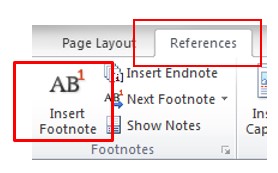
To add footnotes to your Word document:
- Position your cursor where the footnote should go in your Word document
- Click on the References tab
- Click on Insert Footnote
- Type in the reference for the source following the guidelines
Pinpoint citations
A pinpoint is a reference to a specific page or paragraph. A pinpoint to a page should appear as a number, while a pinpoint to a paragraph should appear as a number in square brackets. The pinpoint is placed at the end of the reference and for most resource types it should come after a space. For example:
HLA Hart, The concept of Law (Clarendon Press, 1970) 15.
For some resource types such as journal articles and cases you are need to place a comma before the pinpoint. For example:
Gordon Goldberg, ‘Confusions Concerning Common Count’ [2000] Restitution Law Review 189, 67.
Common resource types which need a comma before the pinpoint:
- Cases
- Journal articles
- Chapter in an edited book
- Gazettes
- Parliamentary debates
- Written correspondence
Always check the examples provided for your resource type to see if a comma is needed or not.
Quotations within the text
Short quotations (of three lines or less) should be written inside single quotation marks. For example:
Priestley JA stated that ‘there is a close association of ideas between the terms unreasonableness, lack of good faith and unconscionability.’12
Long quotations (of four lines or more) should appear indented from the left margin, in a smaller font size and without quotation marks. Legislative and treaty extracts, regardless of length may also appear this way. For example:
The Judge stated:
Thus elaborating, the first question is whether a financial benefit is given within the meaning of s 229 of the Corporations Act (in relation to the prohibition on related party benefits without member approval). The second question is whether the exception for arm’s length terms in s 210 of the Corporations Act is made out…23
Omissions, alterations and significant errors in quotes:
- Omissions from a quotation should be indicated by an ellipsis (…).
- If you need to alter a quotation in any way include the alteration in square brackets.
- If there is a significant error in the quotation you may use [sic].
Citing quoted material
AGLC prefers you to cite the original text if it is available. If this is impossible, then give as full a reference to the original text as you can and use the words ‘quoted in,’ ‘cited in,’ or ‘discussed in’ and give a full reference to the secondary text. For example:
Mason v Freedman [1958] SCR 483, quoted in Shelanu Inc v Print Three Franchising Corporation (2003) 64 OR (3d) 533, 556.