
Geometry-and-trigonometry-printable-guide-UniSkills.pdf
Geometry and trigonometry
Table of Contents
Introduction
Welcome to the Geometry and trigonometry module. This module builds on the geometry content covered in the Measurement and geometry page of the Numeracy fundamentals module, as well as providing an introduction to some key concepts in trigonometry.
You may wish to work your way through the entirety of the module in the order provided, or you may wish to jump to certain pages or sections of the module.
Your feedback on this module is very welcome and can be provided at any time on the feedback page, or alternatively for any questions about the module please contact Library-UniSkills@curtin.edu.au
What you will learn
- How to identify and classify different types of angles, polygons and three-dimensional shapes, and how to identify lines of symmetry.
- How to use Pythagoras’ theorem and trigonometric ratios.
- How and when to use the sine rule and cosine rule.
- How to calculate the perimeter and area of various two-dimensional shapes, including the circumference of circles.
- How to calculate the surface area, volume and density of various three-dimensional shapes.Geometry
Geometry is the branch of mathematics that explores the properties of shapes, angles and lines. This page provides an introduction to the topic, while subsequent pages provide information on further properties of triangles, as well as on calculating perimeter and area of two-dimensional shapes and surface area, volume and density of three-dimensional shapes.
In brief, it covers the following:
- Different types of angles
- Different types of polygons
- Key properties of circles, and the relationship between their circumference, diameter and radius
- Different types of three-dimensional shapes
- How to determine if a shape has one or more lines of symmetry
</div>
Angles
An angle is the amount of rotation between two lines that intersect at a point. For example, there is an angle between the lines \(AB\) and \(AC\) in the diagram below, and we can refer to this as either \(\angle CAB\) or \(\angle A\)
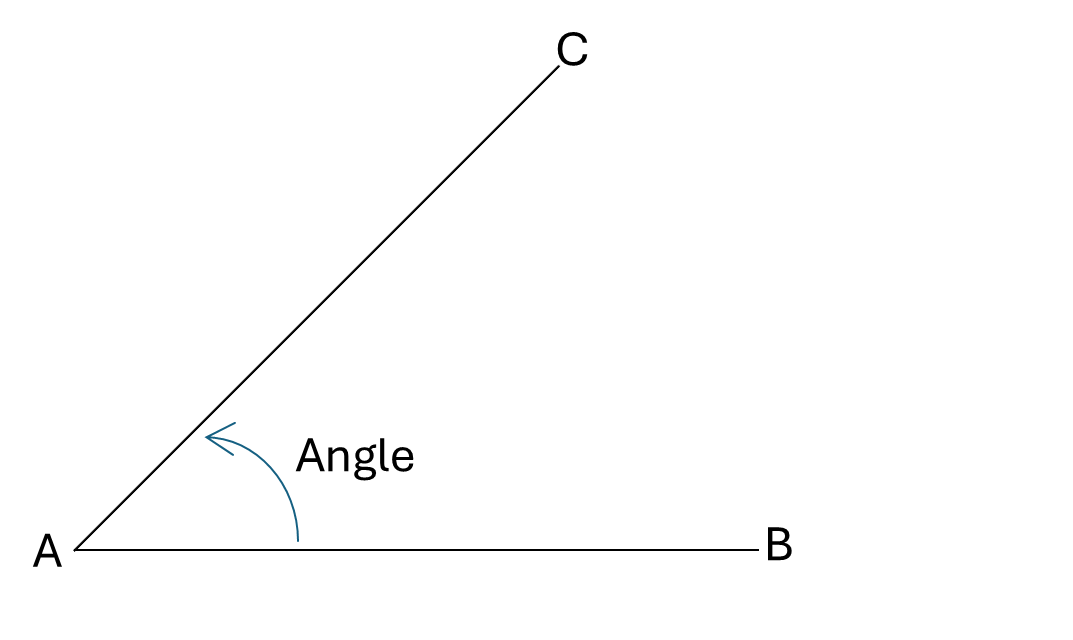
Angles are commonly measured in degrees, denoted by \(^\circ\), whereby one full rotation is equal to \(360^\circ.\) Note that angles can also be measured in radians, where \(\pi\,\textrm{rad} = 180^\circ\) and \(2\pi\,\textrm{rad} = 360^\circ,\) however only degrees will be used in this module.
There are names for different angles depending on their size, with some of the most common ones to be aware of as follows:
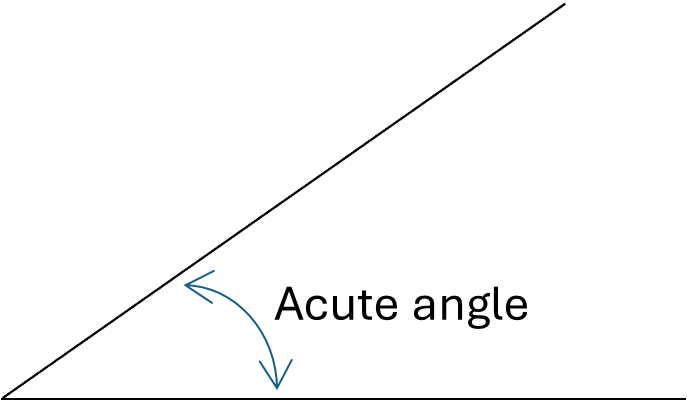
Acute angles are angles that are less than \(90^\circ\)
 </div>
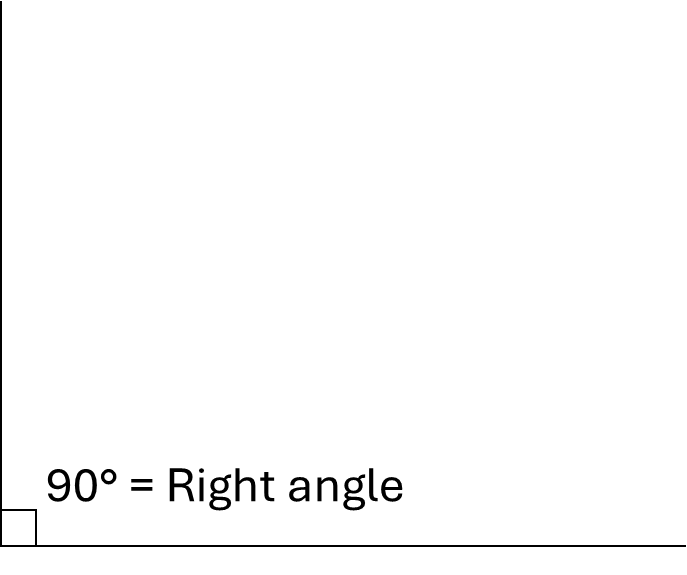
Right angles are angles that are equal to \(90^\circ\) (note the little square used to represent this)
 </div>
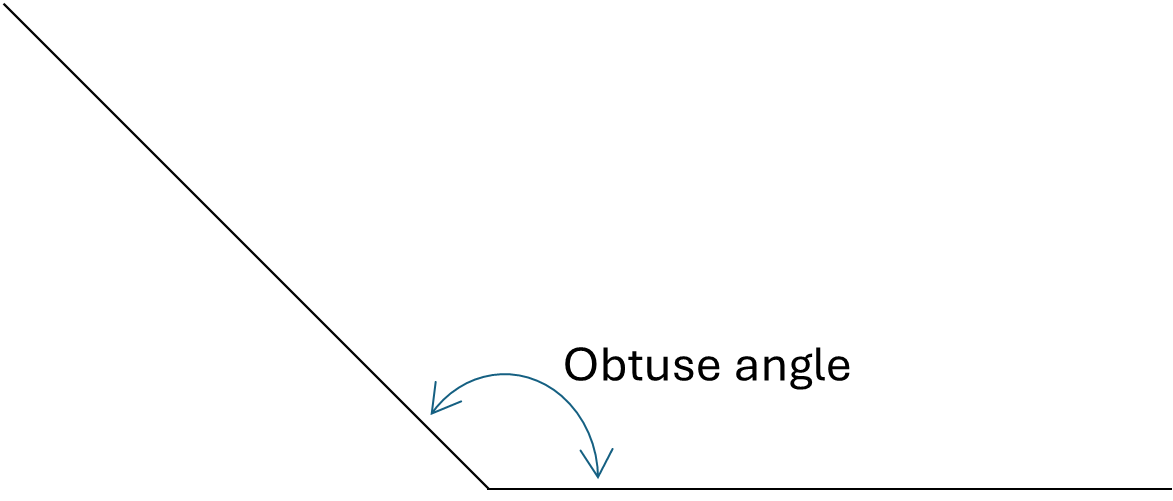
Obtuse angles are angles that are greater than \(90^\circ\) but less than \(180^\circ\)
 </div>
\(\)
Furthermore, angles can also be classified according to their sum. Two of the most common examples of this are as follows:
Complementary angles are two angles that sum to \(90^\circ\)
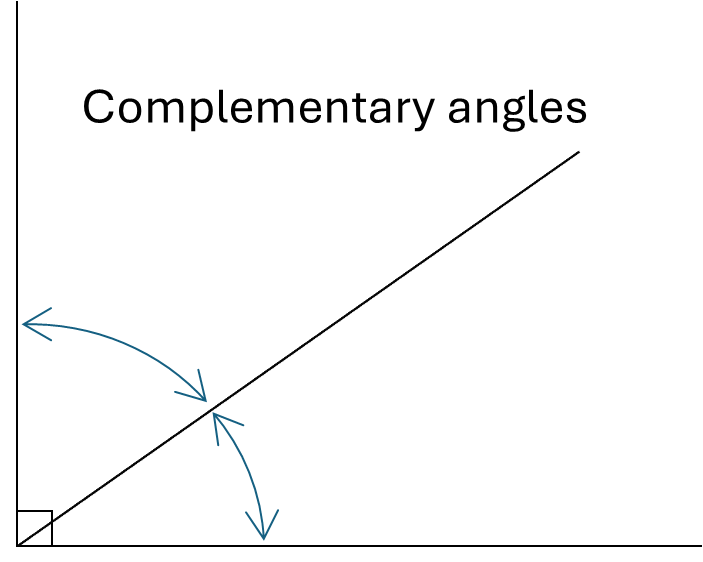
If one angle is known, its complementary angle can be found by subtracting it from \(90^\circ\)
</div>
Supplementary angles are two angles that sum to \(180^\circ\)
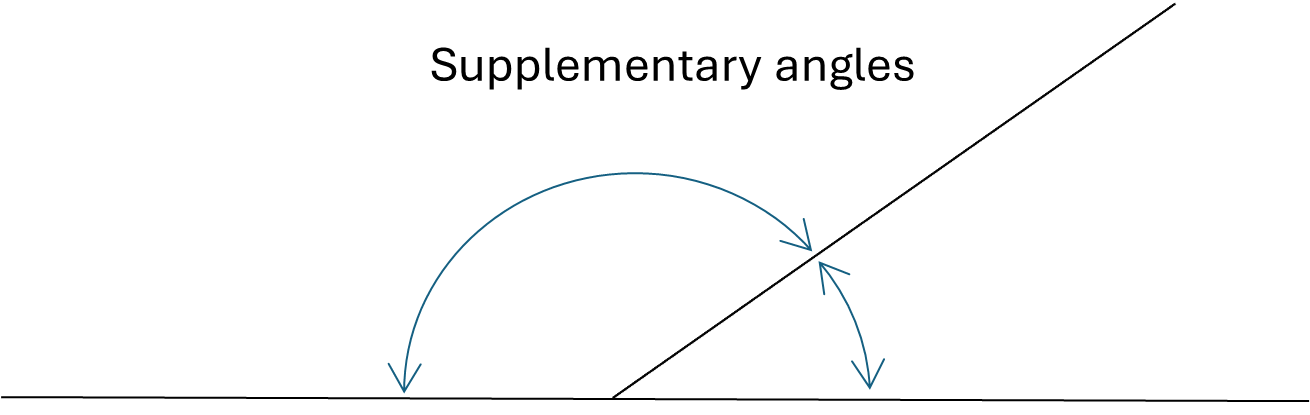
If one angle is known, its supplementary angle can be found by subtracting it from \(180^\circ\)
</div>
\(\)
Check your understanding of different types of angles by completing one or both of the following activities:
1. Determine the supplementary angle of \(115^\circ\)
The supplementary angle of \(115^\circ\) is \(65^\circ\) since \(180^\circ - 115^\circ = 65^\circ\)
2. Determine the complementary angle of \(42^\circ\)
The complementary angle of \(42^\circ\) is \(48^\circ\) since \(90^\circ - 42^\circ = 48^\circ\)
Polygons Two-dimensional shapes that are bounded by straight lines are called polygons. Furthermore, note that when all the sides of a polygon are the same length and all angles are equal it is called a regular polygon. Details of some common types of polygons are listed in the table below:
| Polygon name | Number of sides | Number of angles | Sum of angles |
|---|---|---|---|
| Triangle | \(3\) | \(3\) | \(180^\circ\) |
| Quadrilateral | \(4\) | \(4\) | \(360^\circ\) |
| Pentagon | \(5\) | \(5\) | \(540^\circ\) |
| Hexagon | \(6\) | \(6\) | \(720^\circ\) |
| Heptagon | \(7\) | \(7\) | \(900^\circ\) |
| Octagon | \(8\) | \(8\) | \(1080^\circ\) |
| Nonagon | \(9\) | \(9\) | \(1260^\circ\) |
| Decagon | \(10\) | \(10\) | \(1440^\circ\) |
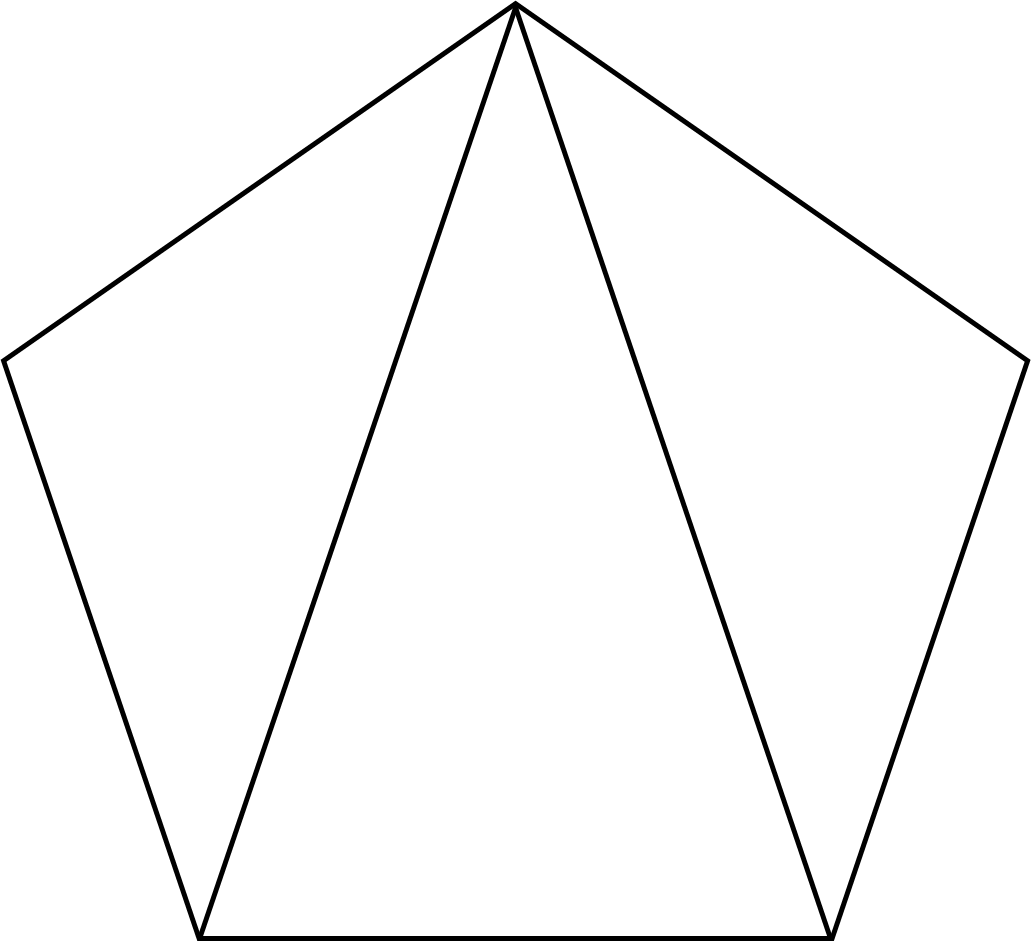
In order to calculate the sum of the internal angles of a polygon, as listed in the table, you can split the polygon into triangles and then multiply the number of triangles formed by \(180^\circ\) (since this is the sum of the angles in a triangle). For example, a pentagon splits into three triangles, as shown below, and \(3 \times 180^\circ = 540^\circ\)
\(\)
Alternatively, you can use the formula \((2n - 4) \times 90^\circ\) to calculate the sum of the angles, where \(n\) is the number of sides of the polygon. For example, the formula can be evaluated to give the same sum of angles for a pentagon as follows:
Check your knowledge of different types of polygons by completing one or both of the following activities:
1. How many triangles can you split an octagon into?
\(1080^\circ \div 180^\circ = 6\) triangles (or you could draw a diagram to calculate)
2. What is the sum of the angles of a 12 sided polygon?
\((2 \times 12 - 4) \times 90^\circ = 20 \times 90^\circ = 1800^\circ\) (or you could draw a diagram to calculate)
For details of how to calculate the perimeter and area of some of the polygons listed, see the Perimeter and area page of this module. In addition, see the Trigonometry page if you would like further information about the properties of triangles.
Circles A circle is a shape created by a continuous curved line which is always the same distance away from a central point. This distance (from the centre of the circle to the outside) is called the radius, while the diameter is the distance from one side of the circle to the other when passing through the centre (i.e. it is double the radius). Finally, the circumference is the distance around the outside of the circle.
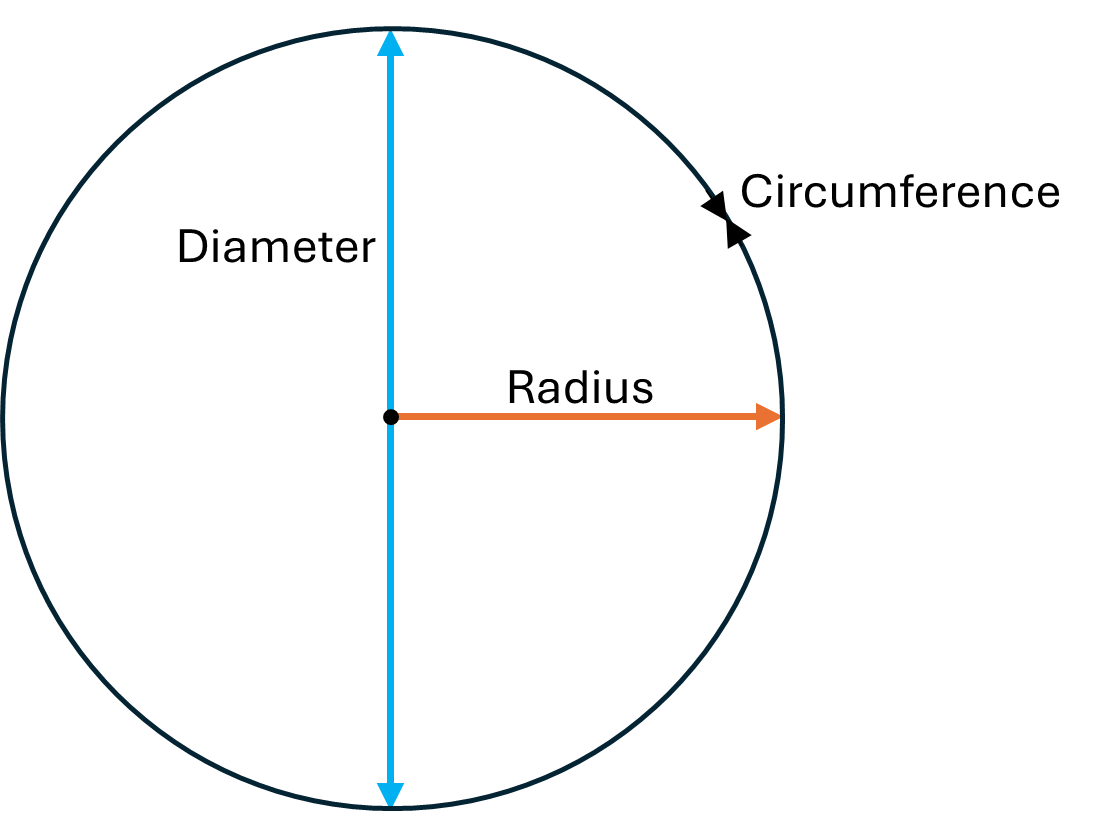
Regardless of the size of the circle, the ratio of the circumference to the diameter is always the same. It is equal to an irrational number called pi (written as \(\pi\)) which is approximately \(3.14\) (note that irrational means that the decimal places in pi go on forever without recurring):
\[\pi = \frac{circumference}{diameter}\]Given this, the circumference of a circle can be calculated if the diameter or radius is known, and vice versa, using the following formulas (where \(c\) represents the circumference, \(d\) the diameter and \(r\) the radius):
\(c = \pi d\)
\(c = 2 \pi r\)
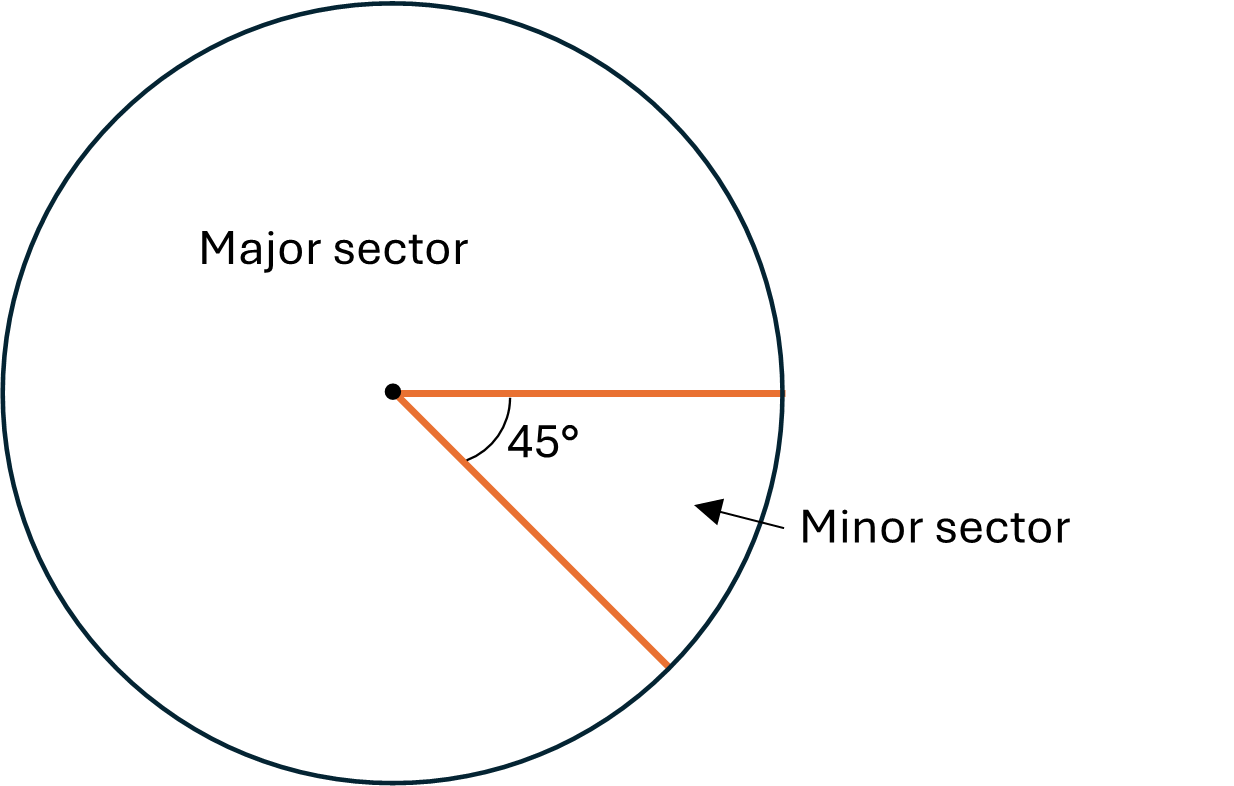
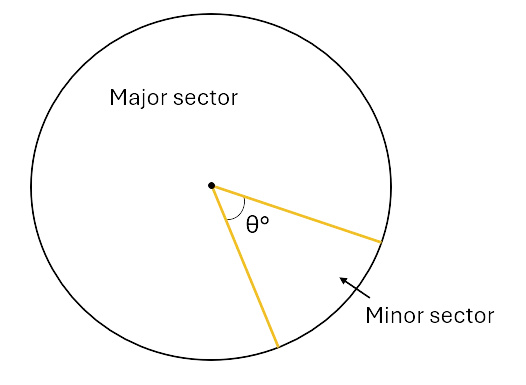
Note that the ‘slice’ of a circle bounded by two radii and an arc of the circumference is called a sector. If the central angle of the sector (i.e. the angle formed by the two radii) is less than \(180^\circ\) it is termed a minor sector, if it is equal to \(180^\circ\) it is a semicircle, and if it is more than \(180^\circ\) it is a major sector.
\(\) Check your understanding of the properties of circles by completing one or both of the following activities:
1. What is the circumference of a circle with radius \(14cm\), rounded to the nearest centimetre?
\[2 \times \pi \times 14 = 88cm\]2. What is the diameter of a circle with circumference \(8m\), rounded to one decimal place?
\[8 \div \pi = 2.5m\]For details of how to calculate the area of a circle or the perimeter or area of a sector of a circle, see the Perimeter and area page of this module.
Three-dimensional shapes Some common examples of three-dimensional shapes include cubes, prisms, pyramids, cylinders, spheres and cones. These shapes are detailed below, while information about how to calculate the surface area and volume of each is provided in the Surface area, volume and density page of this module.
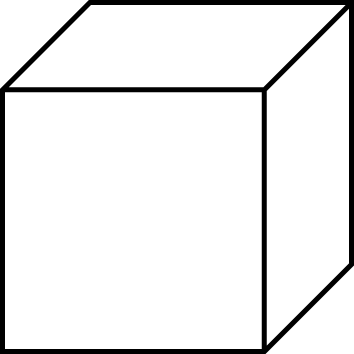
Cubes A cube is a three-dimensional shape with six identical square faces, each one perpendicular to its adjacent faces. It is a special type of prism.
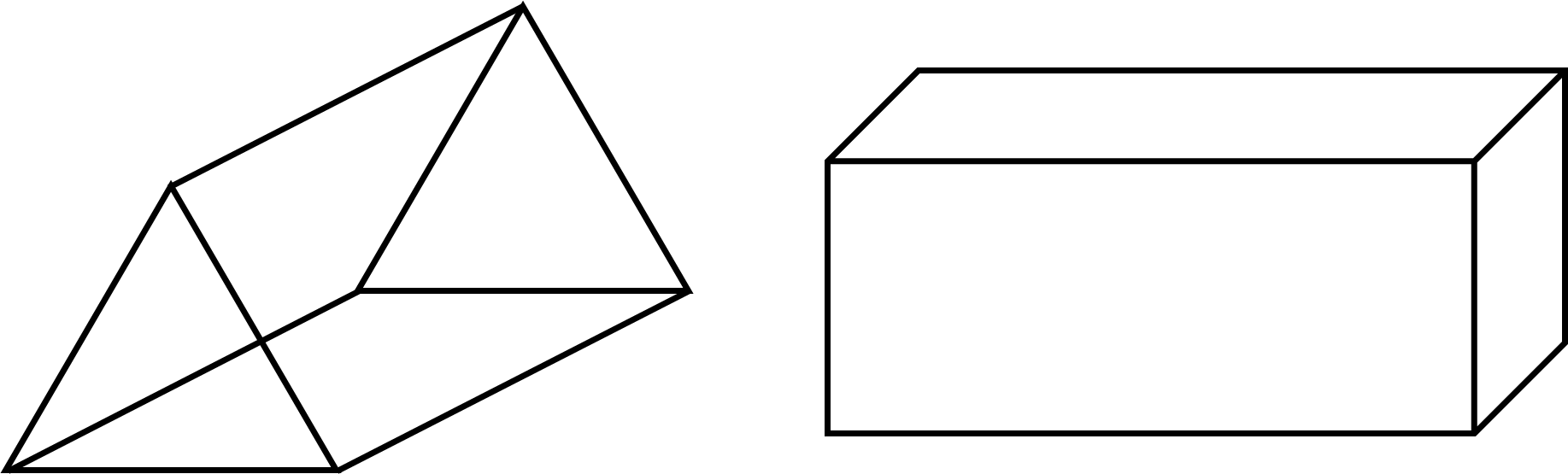
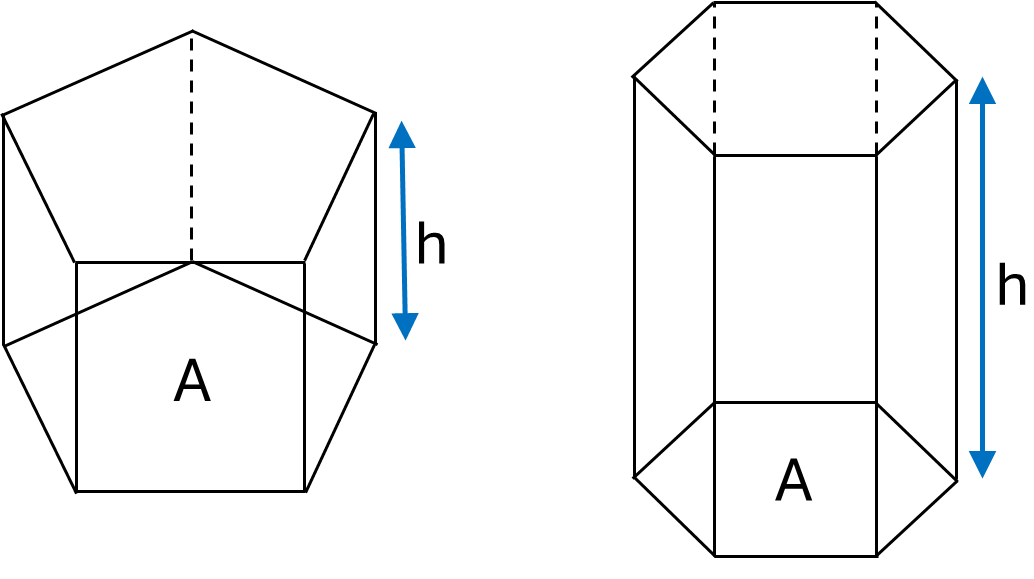
Prisms A prism is a three-dimensional shape with identical polygon bases (top and bottom faces) and square, rectangle or parallelogram lateral faces (sides). If the bases of a prism are regular polygons the prism is a regular prism, and in this case it is generally named after the polygon. For example, a prism with triangular bases is called a triangular prism, while a prism with rectangular bases is a rectangular prism (also known as a cuboid). Furthermore, note that if either of the bases are missing it is referred to as an open rather than a closed prism.
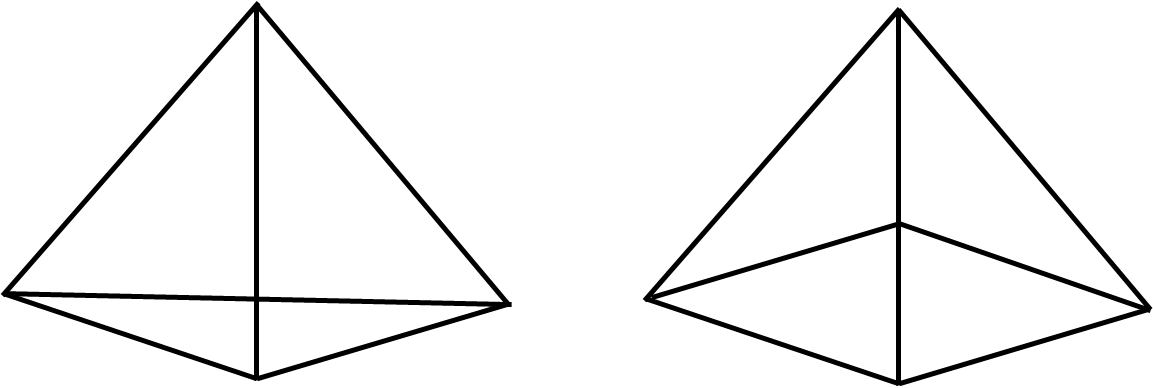
Pyramids A pyramid is a three-dimensional shape with a polygon base and triangular sides, which meet at a point at the top called the apex. If the base of a pyramid is a regular polygon the pyramid is a regular pyramid, and in this case it is generally named after the polygon. For example, a pyramid with a triangular base is called a triangular pyramid (also known as a tetrahedron, or a regular tetrahedron if all faces are equilateral triangles), while a pyramid with a square base is a square pyramid.
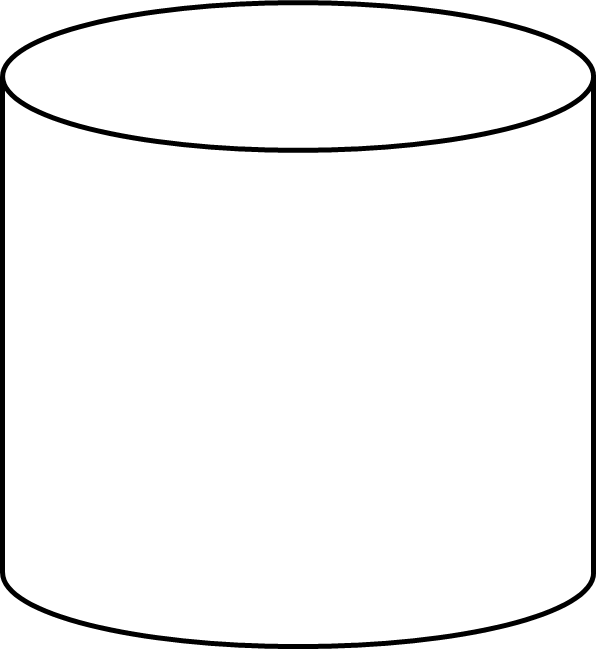
Cylinders A cylinder is a three-dimensional shape consisting of two identical flat circular ends connected by a curved side. Note that if either of these circular ends are missing, it is referred to as an open rather than a closed cylinder.
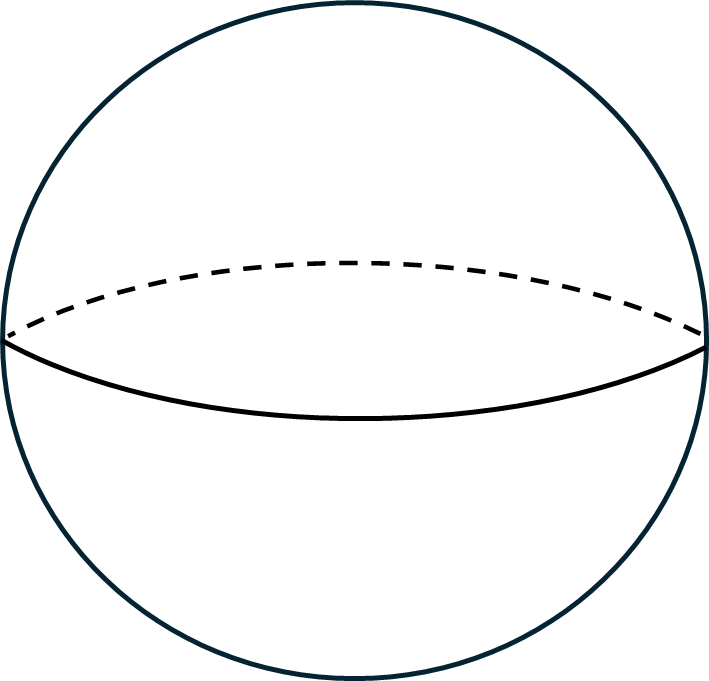
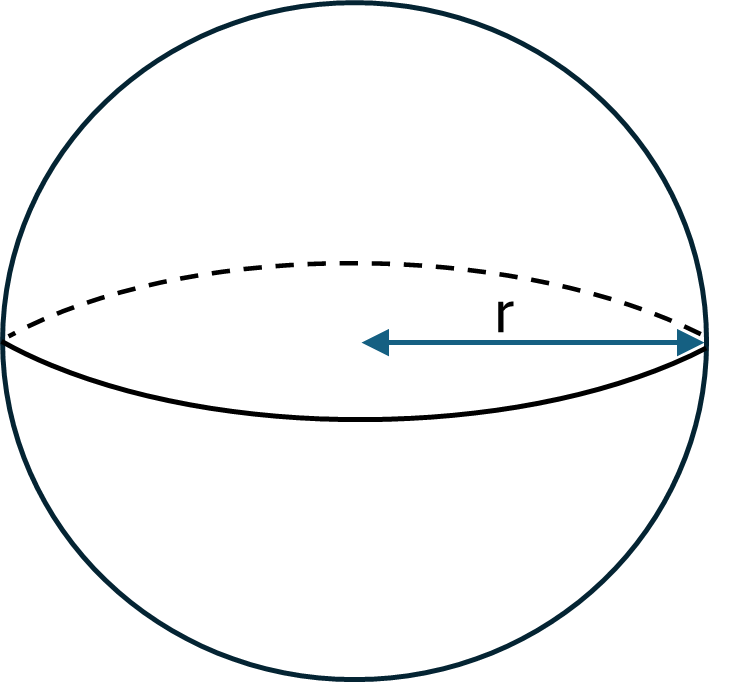
Spheres A sphere is a three-dimensional shape with a curved surface which is always the same distance away from a central point. This distance (from the centre of the sphere to the outside) is called the radius, while the diameter is the distance from one side of the sphere to the other when passing through the centre (i.e. it is double the radius).
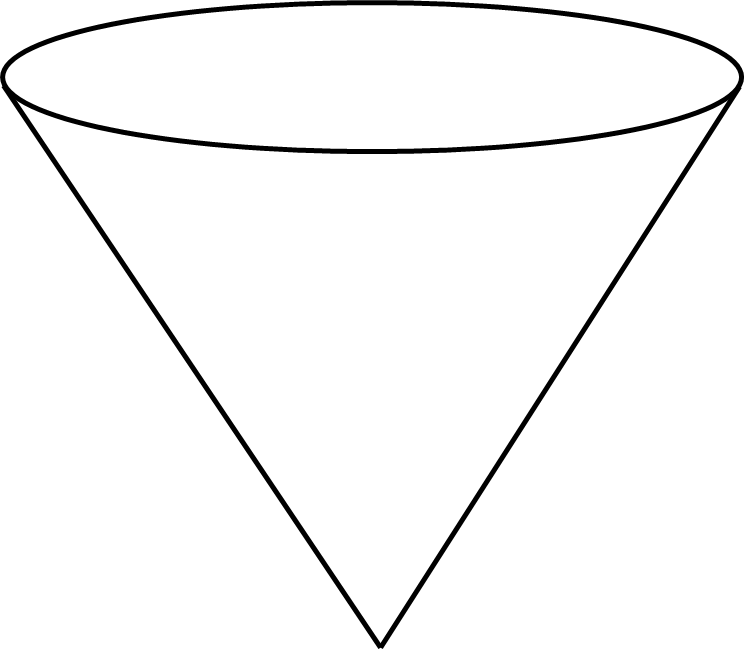
Cones A cone is a three-dimensional shape with a circular base and a continuous curved surface that tapers to a point called the apex.
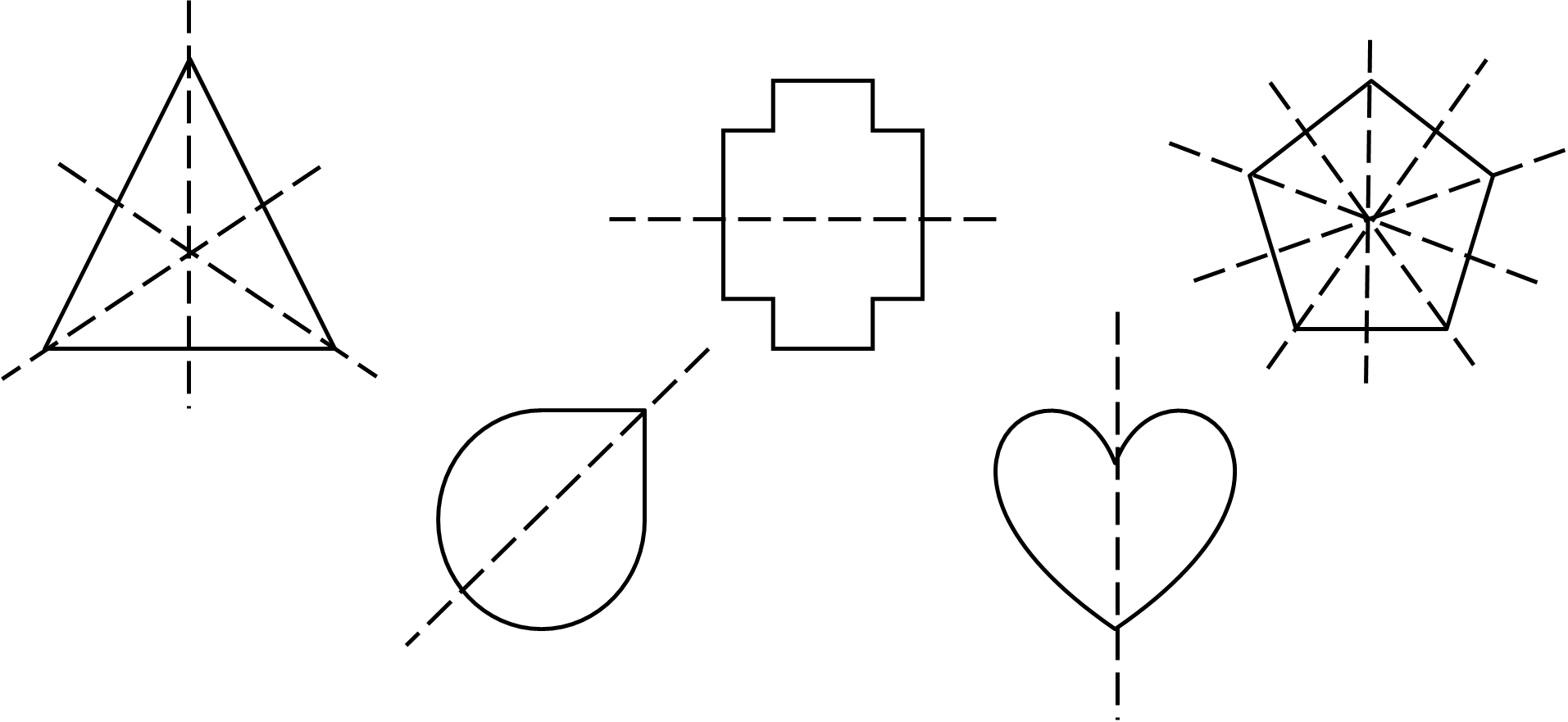
Lines of symmetry If there is at least one line that divides a two-dimensional shape into two identical halves, then that shape is said to have reflection symmetry or line symmetry. The line that divides the figure into two mirror image halves is called the line of symmetry, and this can be in any direction (note that a three-dimensional shape needs to be divided in half by a plane of symmetry rather than a line of symmetry, but this is not covered here). Furthermore, shapes can have more than one line of symmetry, and in particular the number of lines of symmetry in a regular polygon is equal to the number of sides.
Consider the examples of shapes with reflection symmetry below. The dashed lines are the lines of symmetry; note that the triangle has three, while the pentagon has five:
\(\) Check your understanding of lines of symmetry by completing one or both of the following activities:
1. How many lines of symmetry does a regular heptagon have?
Seven, as the number of lines of symmetry is equal to the number of sides.
2. How many lines of symmetry does a circle have?
A circle has infinitely many lines of symmetry, as any straight line passing through the centre is a line of symmetry.
Trigonometry
This page addresses key concepts within trigonometry, which is the study of triangles and their angles.
In brief, it covers the following:
- Different types of triangles
- Pythagoras’ theorem
- The definition of similar triangles, and how to identify them
- The sine, cosine and tangent trigonometric ratios
- The sine rule
- The cosine rule
- Which formula to use when working with triangles
</div>
Triangles
A triangle is a figure that has three sides. Generally, the angles of a triangle are represented using capital letters, and the sides are represented by lower case letters. Side a will always be opposite angle A, side b will be opposite angle B, and side c will be opposite angle C.
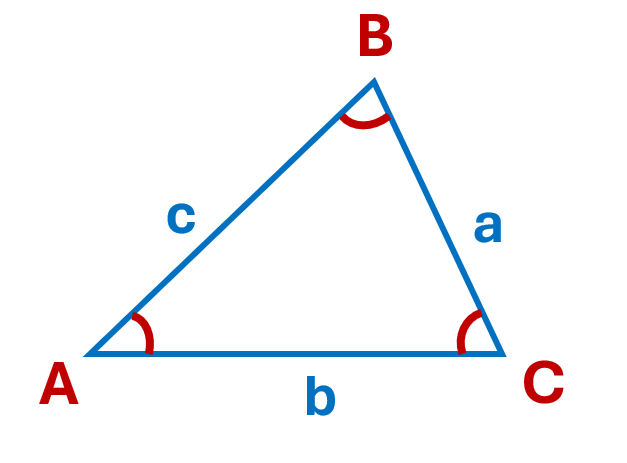
If the sides aren’t labelled, we can refer to them as AB, BC, and AC. The angles may also be referred to as \(\angle A\), \(\angle B\) and \(\angle C\). Each angle may also be referred to in relation to the labelled points of the triangle. For example, \(\angle A\) could also be \(\angle BAC\), \(\angle B\) could also be \(\angle ABC\), and \(\angle C\) can be written as \(\angle ACB\). If this is the case, notice the angle you are working with will always be at the letter in the middle.
The sum of the angles inside any triangle will always be \(180^\circ\).
There are six types of triangles:
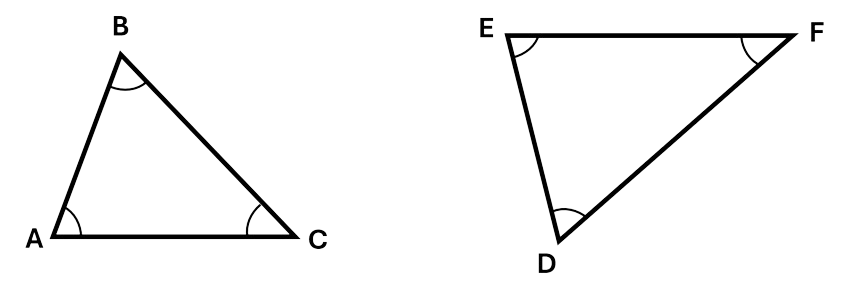
Acute triangles contain angles that are each less than \(90^\circ\).
</div>
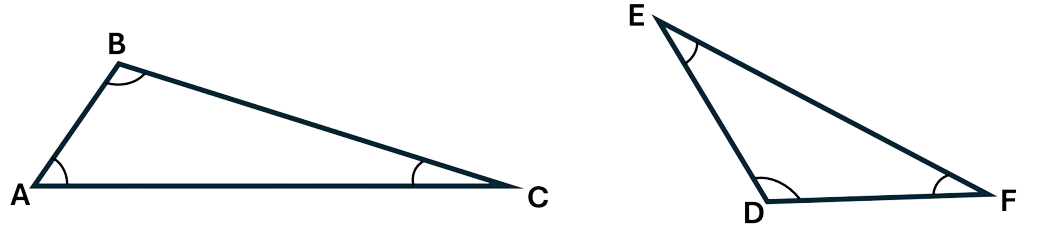
Obtuse triangles contain one angle that is more than \(90^\circ\). The other two angles will be acute angles. You can see in the below triangles that angles B and D are both more than \(90^\circ\), while A, C, E and F are all acute angles.
</div>
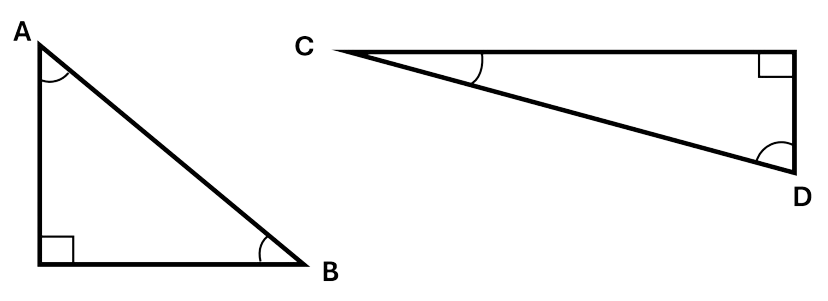
Right-angled triangles contain an angle that is equal to \(90^\circ\). This angle is usually marked by a little square in that corner.
</div>
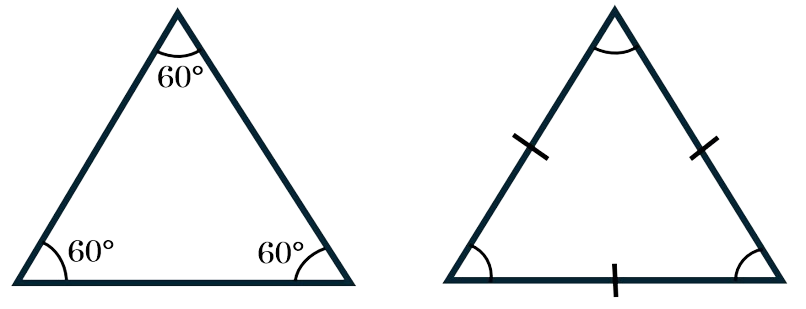
All angles within an equilateral triangle are the same value, and all sides are the same length. As all angles within a triangle add up to \(180^\circ\), each angle in an equilateral triangle will be \(60^\circ\).
</div>
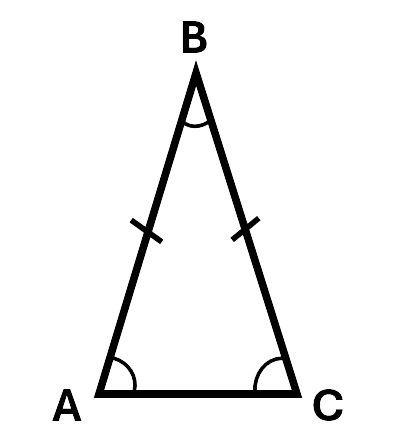
Isosceles triangles have two equal sides and two equal angles. The equal sides below are shown using lines on each matching side.
</div>
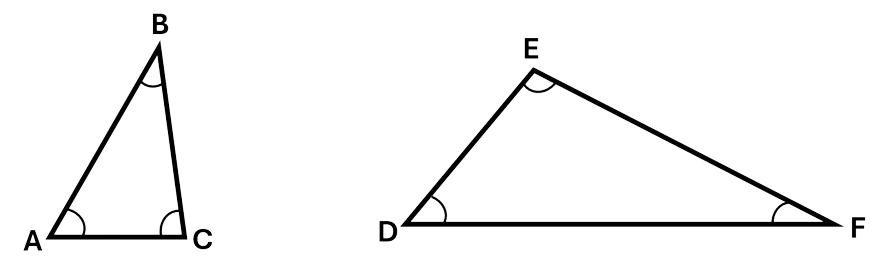
In scalene triangles all the angles are different sizes and all of the sides are different lengths. Acute, obtuse, and right-angled triangles can all be scalene triangles as well, as seen below. The triangle on the left is both a scalene triangle and an acute triangle, as all the angles are less than \(90^\circ\), while the triangle on the right is both scalene and obtuse as angle E is larger than \(90^\circ\).
</div>
Check your understanding of different types of triangles by working through the activity:
Pythagoras’ theorem
Pythagoras’ theorem shows us that the values of all the sides in a right-angled triangle are related. Given the triangle below:
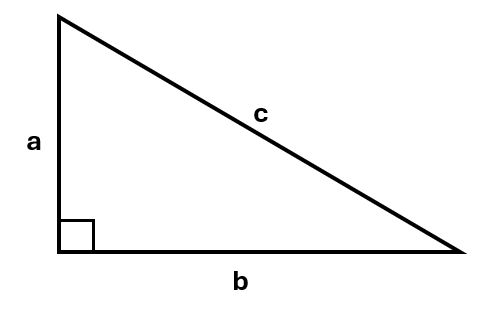
Pythagoras’ theorem tells us that:
\[a^2 + b^2 = c^2\]In the formula, the side c is always the hypotenuse.
</div>
If we know the values of two of the sides, we can use Pythagoras’ theorem to find the unknown third side.
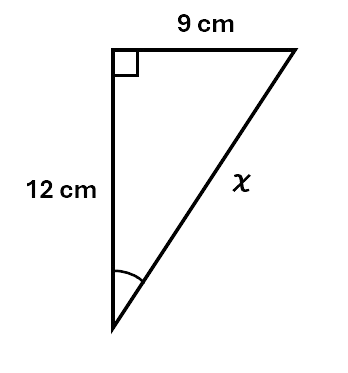
Example 1: Given the triangle below, find the value of \(\chi\).
Solution:
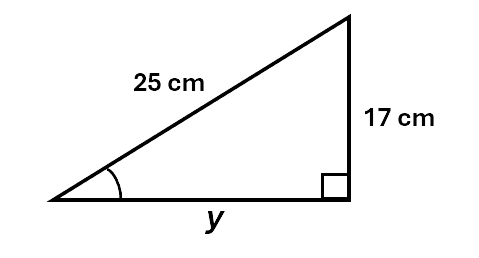
\[\begin{aligned} a^2 + b^2 &= c^2 \\\ 9^2 + 12^2 &= \chi^2 \\\ 81 + 144 &= \chi^2 \\\ 225 &= \chi^2 \\\ \sqrt{225} &= \chi \\\ \chi &= 15cm \\\ \end{aligned}\]Example 2: Given the triangle below, find the value of y to 2 decimal places.
Solution:
\[\begin{aligned} a^2 + b^2 &= c^2 \\\ a^2 &= c^2 - b^2 \\\ y^2 &= 25^2 - 17^2 \\\ y^2 &= 336 \\\ y &= \sqrt{336} \\\ y &= 18.33cm \\\ \end{aligned}\]Note: We can rearrange our equations using algebra.
</div>
Check your understanding of Pythagoras’ theorem using the questions below.
Similar triangles
Two triangles are considered similar if they have the same shape, in terms of having the same angles. However, they don’t necessarily need to be the same size (if they are actually the same size, this is a special kind of similar triangle called a congruent triangle). To establish that two triangles are similar you need to show that one of the following criteria are met (as then the rest will follow):
- Two pairs of corresponding angles are equal
- Three pairs of corresponding sides are proportional
- Two pairs of corresponding sides are proportional and the corresponding angles between them are equal
You could think of similar triangles as either an enlargement or reduction of each other.
Example 1:
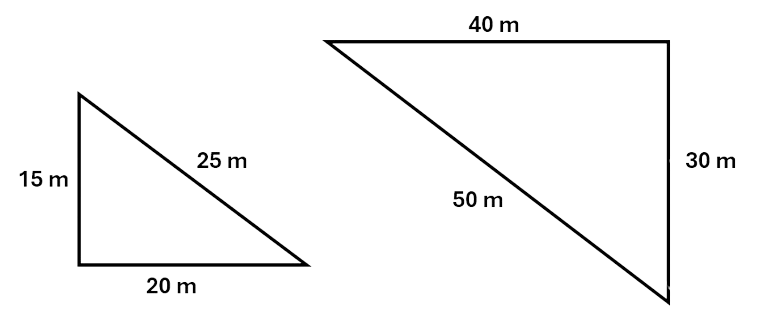
The two triangles below are similar as their corresponding sides are proportional (the sides of the smaller triangle are half the size of the larger triangle). You could rotate the triangle on the right to make it look the same as one on the left.
Example 2:
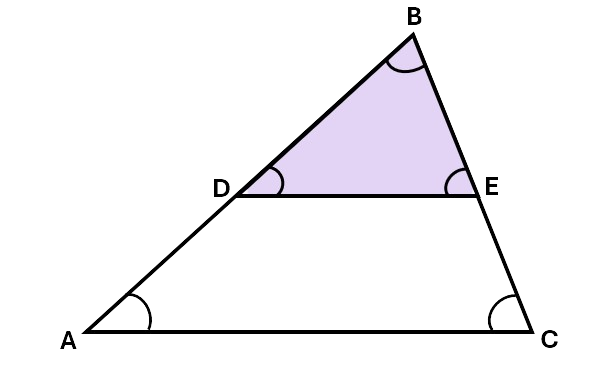
The two triangles below are similar triangles as their corresponding angles are equal in size. Both the large triangle and the smaller, purple, triangle share the \(\angle B\). In addition, as lines \(DE\) and \(AC\) are perpendicular, \(\angle A\) and \(\angle D\) are equal, and \(\angle C\) and \(\angle E\) are equal.
Example 3:
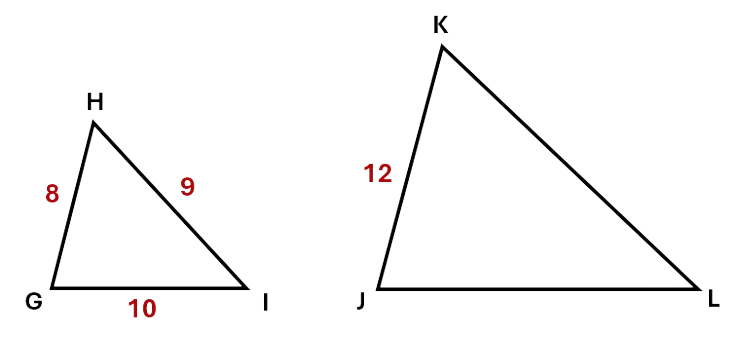
Given the two triangles below are similar, find the value of lines \(JL\) and \(KL\).
Solution:
To find line \(JL\):
\[\begin{aligned} \frac{GH}{JK} &= \frac{GI}{JL} \\\ \frac{8}{12} &= \frac{10}{JL} \\\ 8 \times JL &= 120 \\\ JL &= 15 \\\ \end{aligned}\]To find \(KL\):
\[\begin{aligned} \frac{GH}{JK} &= \frac{HI}{KL} \\\ \frac{8}{12} &= \frac{9}{KL} \\\ 8 \times KL &= 108 \\\ JL &= 13.5 \\\ \end{aligned}\]Note: We can rearrange our equations using algebra.
</div>
You can check your understanding of similar triangles by working through the questions below.
Trigonometric ratios
There are six trigonometric functions that we can use to show us the relationship between the acute angles in a right-angled triangle and the length of its sides. You are likely to only need to use three of these functions. They are:
- Sine (\(\sin\))
- Cosine (\(\cos\))
- Tangent (\(\tan\))
While using trigonometric functions, the angle you are using in the right-angled triangle is represented by the symbol \(\theta\), known as theta.
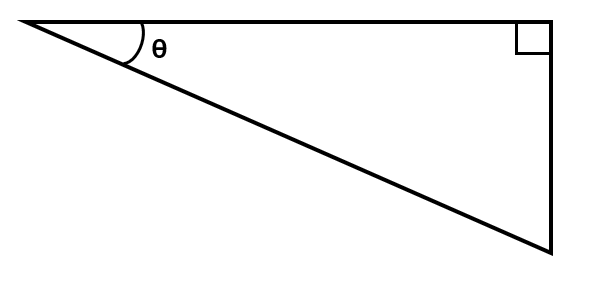
Each side of the right-angled triangle has a name. The longest side, that is always opposite the right angle, is known as the hypotenuse. The other two sides are called the opposite and the adjacent sides. The opposite side is always the side that sits opposite the angle we are using in our calculation. The adjacent side is the side that sits next to the angle, along with the hypotenuse.
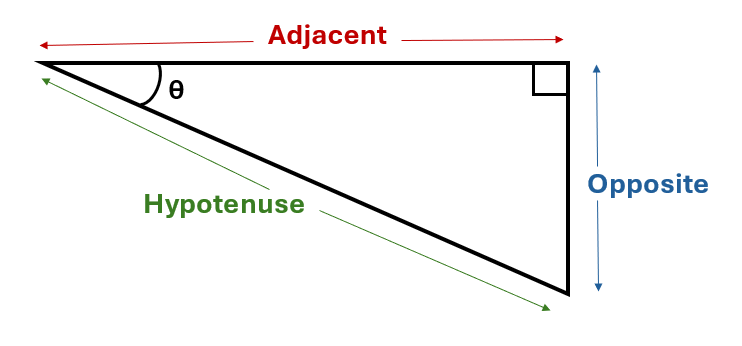
We can use trigonometric functions to calculate the trigonometric ratios of an angle with respect to the sides of a right-angled triangle. To find the sine ratio of the angle, we divide the value of the side opposite to the angle by the value of the hypotenuse. To find the cosine ratio of the angle, we divide the value of the adjacent side to the angle by the hypotenuse. To find the tangent ratio of the angle, we divide the value of the side opposite the angle by the side adjacent to the angle.
These rules are written:
\[\sin\theta = \frac{opp}{hyp}\] \[\cos\theta = \frac{adj}{hyp}\] \[\tan\theta = \frac{opp}{adj}\]</div>
You can use the acronym SOHCAHTOA to help you remember which sides are used with each function:

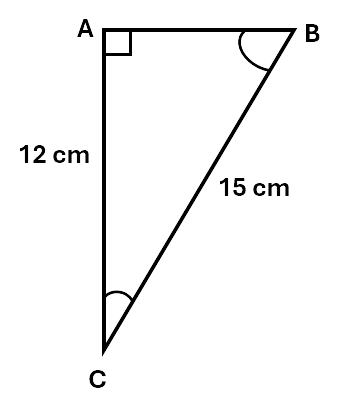
Example: Given the triangle below, find the values of angles B and C to two decimal places.
Solution: For \(\angle B\):
First, work out which side is the opposite and which is the adjacent. The longest side, opposite the right angle, is always the hypotenuse.
Side AC is opposite angle B. Side AB is adjacent. The hypotenuse is BC. We don’t know the value of AB, so we’re going to use the sine function.
\[\sin\theta = \frac{opp}{hyp}\] \[\sin B = \frac{12}{15}\] \[\sin B = 0.8\]We can then use the inverse sine function on a calculator (sometimes called arc sine) to find the angle whose sine is equal to \(0.8\):
\[\begin{aligned} B &=\sin^{-1} 0.8 \\\ B &= 53.13^\circ \\\ \end{aligned}\]We can now find \(\angle C\) in two different ways:
One way is by using a trigonometric function. This time, AC is the adjacent side. As we know the values of the adjacent and hypotenuse, we’re going to use the cos function.
\[\begin{aligned} \cos\theta &= \frac{adj}{hyp} \\\ \cos C &= 0.8 \\\ C &= \cos^{-1} 0.8 \\\ C &= 36.87^\circ \\\ \end{aligned}\]Another way to find \(\angle C\) is by using the fact that all angles in any triangle add up to \(180^\circ\).
\[180 - 90 - 53.13 = 36.87^\circ\]</div>
Check your understanding of how to use trigonometric ratios by working through the questions below.
Sine rule
The sine rule can be used in any triangle where a side and its opposite angle are known.
When we’re given a triangle, for example:
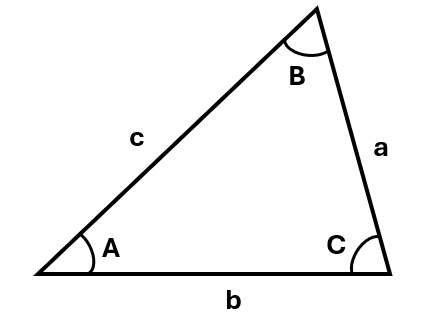
We can find the value of a side of a triangle using the sine rule:
\[\frac{a}{sin\;A} = \frac{b}{sin\;B} = \frac{c}{sin\;C}\]To find the value of an angle, rearrange the sine rule so that the angles are on the top:
\[\frac{sin\;A}{a} = \frac{sin\;B}{b} = \frac{sin\;C}{c}\]</div>
To use the sine rule you will need to know at least one pair of a side with its opposite angle, and you will only need to use two parts of the sine rule, not all three.
Example 1: Find the value of K to two decimal places.
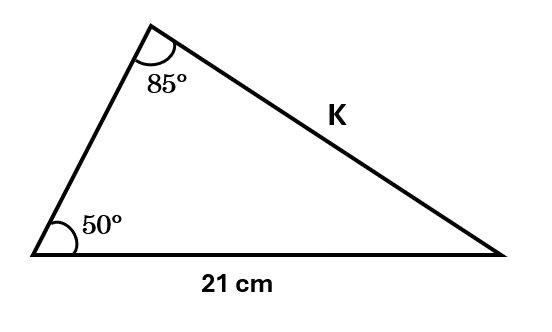
Solution:
\[\begin{aligned} \frac{a}{sin\;A} &= \frac{b}{sin\;B} \\\ \frac{K}{sin\;50^\circ} &= \frac{21}{sin\;85^\circ} \\\ K &= \frac{21\,sin\;50^\circ}{sin\;85^\circ} \\\ K &= 16.15cm \\\ \end{aligned}\]Example 2: Find the value of \(\angle \theta\) to two decimal places.
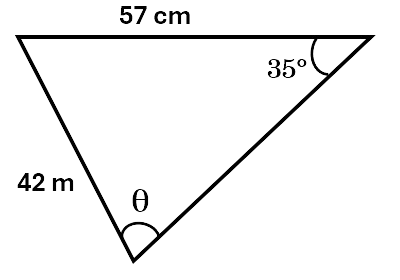
Solution:
\[\begin{aligned} \frac{sin\;A}{a} &= \frac{sin\;B}{b} \\\ \frac{sin\;\theta}{57} &= \frac{sin\;35^\circ}{42} \\\ sin\;\theta &= \frac{57\,sin\;35^\circ}{42} \\\ sin\;\theta &= 0.778425 \\\ sin^{-1} 0.778425 &= 51.116 \\\ \theta &= 51.12^\circ \\\ \end{aligned}\]</div>
Check your understanding of the sine rule by working through the questions below.
Cosine rule
The cosine rule is used in any triangle when relating all three sides to one angle. Consider the triangle below:
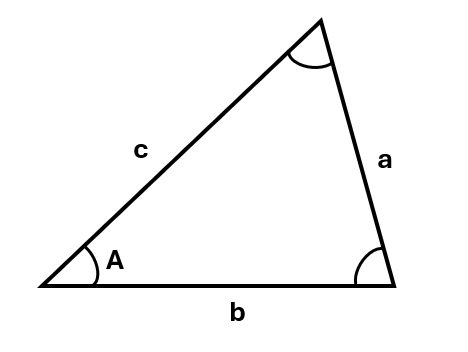
The cosine rule tells us:
\(a^2 = b^2 + c^2 - 2bc\) \(cos\;A\)
To find the value of the angle rather than the value of a side, we can rearrange the formula:
\[cos\;A = \frac{b^2 + c^2 - a^2}{2bc}\]</div>
Remember that the \(\angle A\) will always be opposite side a.
Example 1: Find the value of a, to one decimal place.
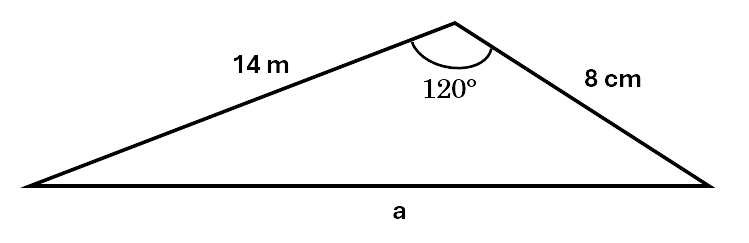
Solution:
\[\begin{aligned} a^2 &= b^2 + c^2 - 2bc\;cos\;A \\\ a^2 &= 8^2 + 14^2 - 2 \times 8 \times 14cos\;120^\circ \\\ a^2 &= 64 + 196 - 224 \times (-0.5) \\\ a^2 &= 372 \\\ a &= \sqrt 372 \\\ a &= 19.3 m \\\ \end{aligned}\]Example 2: Find the value of \(\angle \theta\) to two decimal places.
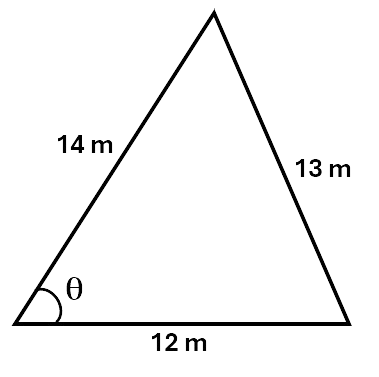
Solution:
\[\begin{aligned} cos\;A &= \frac{b^2 + c^2 - a^2}{2bc} \\\ cos\;\theta &= \frac{12^2 + 14^2 - 13^2}{2 \times 12 \times 14} \\\ cos\;\theta &= \frac{12^2 + 14^2 - 13^2}{2 \times 12 \times 14} \\\ cos\;\theta &= \frac{171}{336} \\\ cos\;\theta &= 0.50893 \\\ \theta &= cos^{-1}\,0.50893 \\\ \theta &= 59.41^\circ \\\ \end{aligned}\]</div>
Check your understanding by working through the questions below.
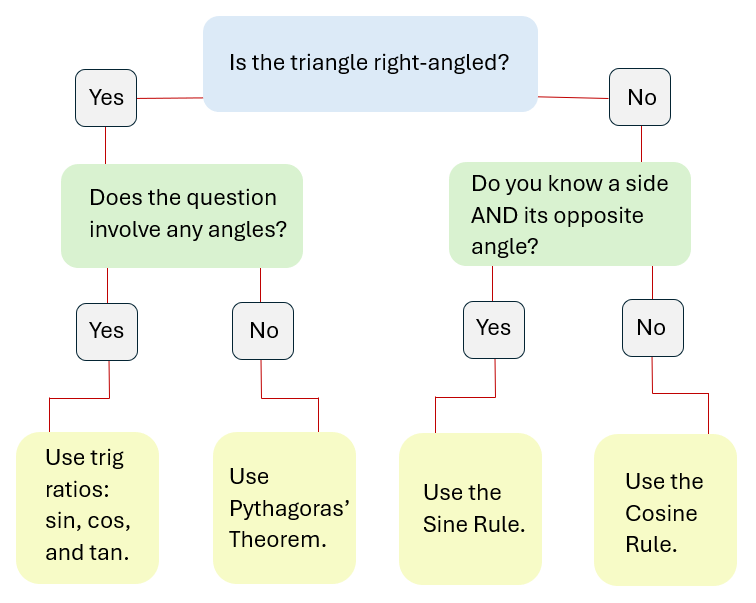
What formula should I use?
 Perimeter and area
This page explains how to calculate the perimeter and area of two-dimensional shapes.
In brief, it covers the following:
- The definition of perimeter, and how to calculate this for polygons
- The definition of circumference, and how to calculate this as well as the perimeter of circle sectors
- The definition of area, and how to calculate this for some common polygons as well as for circles and sectors
</div>
Perimeter
Perimeter is the distance around any two-dimensional shape. In this section we will focus on the perimeter of polygons, while the perimeter of circles is covered in the Circumference section.
To calculate the perimeter of a polygon we simply add together the values of the various sides.
Example:
Calculate the perimeter of the shape below.
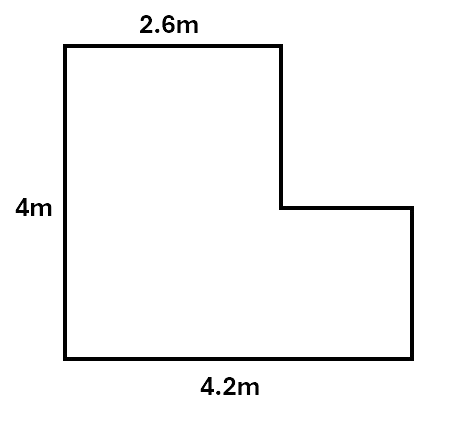
Solution:
To calculate the perimeter we need to add up the value of each side. To do this for the shape above, we first need to determine the values of the three sides that are not labelled.
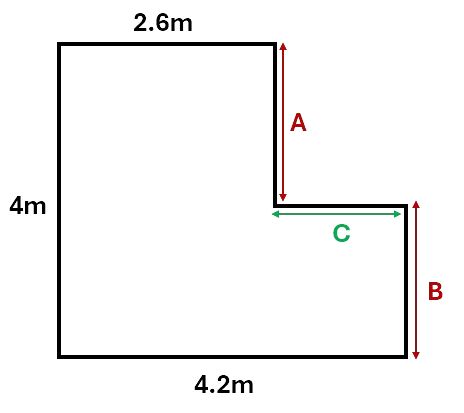
From the image above, we can see that sides A and B together will give us another \(4m\). We can find side C by subtracting \(2.6\) from \(4.2\), therefore C is \(1.6m\).
So the perimeter of the shape will be:
\[P = 2.6 + 4 + 4.2 + 4 + 1.6 = 16.4m\]</div>
Check your understanding of perimeter by working through the questions below.
Polygons with two perimeters
Sometimes you will encounter polygons with both an internal and an external perimeter, such as the external walls or concrete footings of a building:
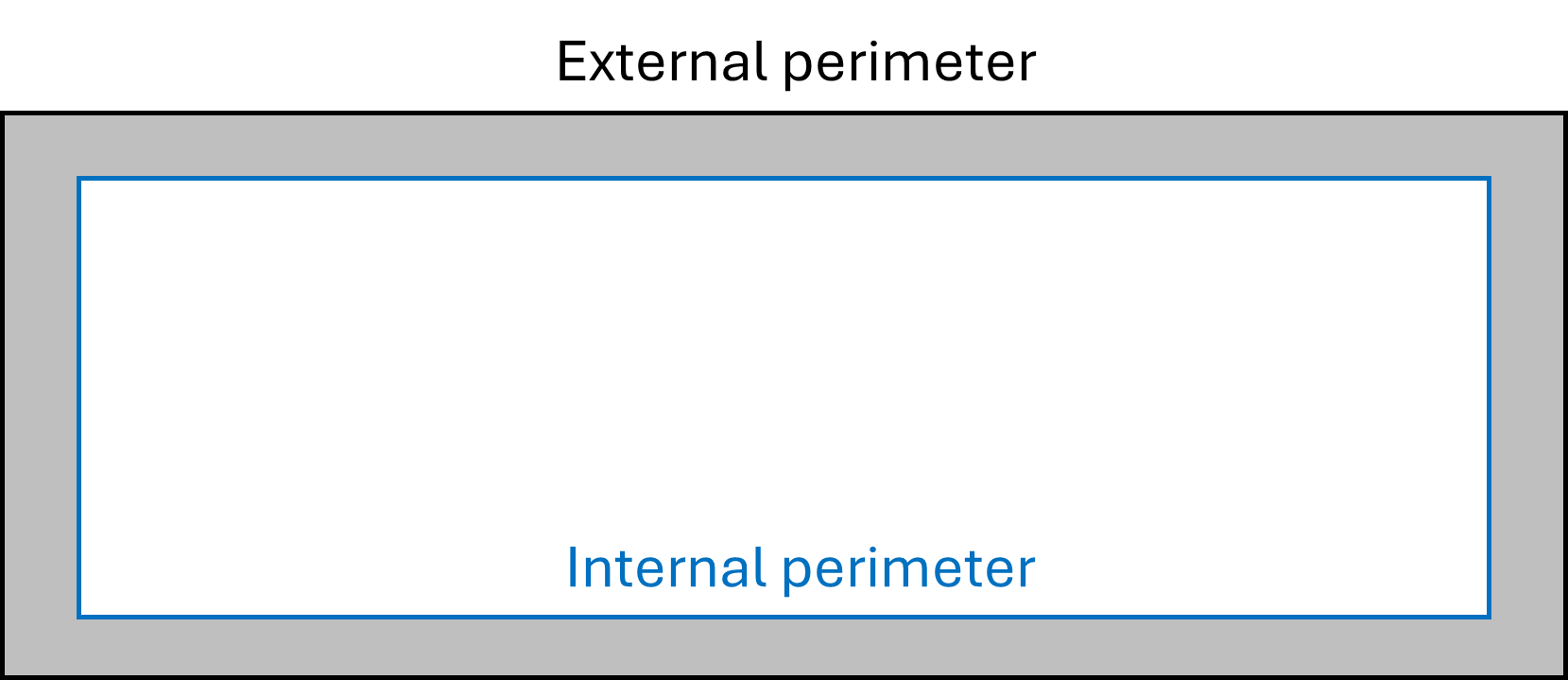
To find one perimeter given the other you need to know the thickness of the wall or footing. For example, to find the external perimeter we will need to know the thickness measurement as well as the internal perimeter, and to find the internal perimeter we will need to know the thickness measurement as well as the external perimeter.
The two perimeters of a shape will be:
\[\begin{aligned} External\;perimeter &= internal\;perimeter\;+ \\\ & 2 \times the\;wall\;thickness \times the\;number\;of\;corners \\\ \end{aligned}\] \[\begin{aligned} Internal\;perimeter &= external\;perimeter\;- \\\ & 2 \times the\;wall\;thickness \times the\;number\;of\;corners \\\ \end{aligned}\]</div>
You may also need to find the average of the two perimeters, or the mean girth. How you do this will depend on the information you have.
If you know the values of both the external and internal perimeters:
\(Mean\;girth = (external\;perimeter + internal\;perimeter) \div 2\)
</div>
If you know the thickness of the wall and the external perimeter:
\[\begin{aligned} Mean\;girth &= external\;perimeter\;-\\\ & the\;wall\;thickness \times the\;number\;of\;corners \\\ \end{aligned}\]</div>
If you know the thickness of the wall and the internal perimeter:
\[\begin{aligned} Mean\;girth &= internal\;perimeter\;+\\\ & the\;wall\;thickness \times the\;number\;of\;corners \\\ \end{aligned}\]</div>
Example 1:
A rectangular brick wall has thickness \(120\,mm\) and internal perimeter \(48\,m\). Calculate the external perimeter.
Solution:
\[\begin{aligned} 120\,mm &= 0.12\,m \\\ External\;perimeter &= internal\;perimeter\;+ \\\ & 2 \times the\;wall\;thickness \times the\;number\;of\;corners \\\ &= 48 + 2 \times 0.12 \times 4 \\\ &= 48.96\,m \\\ \end{aligned}\]Example 2:
A square room has an external perimeter of \(33.4\,m\) and a thickness of \(0.18\,m\). Calculate the mean girth of the perimeters of this room.
Solution:
\[\begin{aligned} Mean\;girth &= external\;perimeter\;- \\\ & the\;wall\;thickness \times the\;number\;of\;corners \\\ &= 33.4 - 0.18 \times 4 \\\ &= 32.68\,m \\\ \end{aligned}\]</div>
Check your understanding of two perimeter polygons by working through the following questions.
Circumference
The perimeter of a circle is called the circumference of the circle.
We can calculate the circumference of a circle using the formula:
\[C = 2 \pi r\]Where \(r\) is the radius, or half the diameter, of the circle.
</div>
Example:
If a circle has a diameter of 34cm, calculate it’s circumference to two decimal places.
Solution:
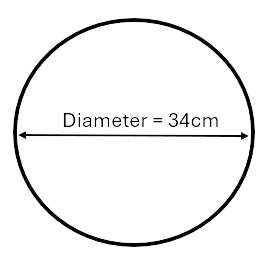
</div>
Check your understanding of circumference by working through these questions.
Sectors
We can also find the perimeter of a sector of a circle. To do this we need to find the length of the arc and then add the two radii that form the sides of the sector.
To find the arc length of a sector we use:
\[Arc\;length = \frac{\theta}{360} \times 2\pi r\]So to find the perimeter of a sector we have:
\[Perimeter = \frac{\theta}{360} \times 2\pi r + 2r\]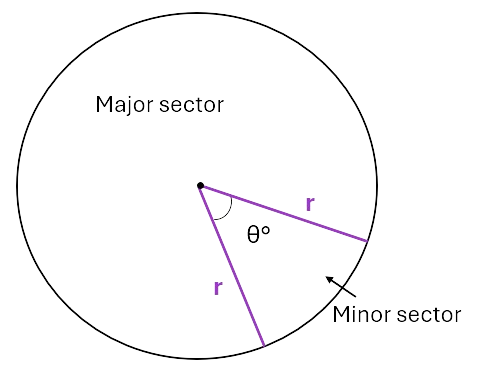
</div>
Example:
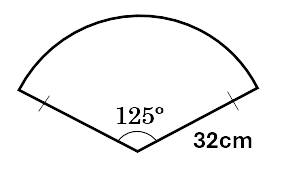
Find the perimeter of the shape below. Give the answer to one decimal place.
Solution:
\[\begin{aligned} &= \frac{\theta}{360} \times 2\pi r + 2r \\\ &= \frac{125}{360} \times 2 \times \pi \times 32 + 2 \times 32 \\\ &= 133.8cm \\\ \end{aligned}\]</div>
Check your understanding of sector perimeters by working through the questions below.
Area
The area of a two-dimensional shape is how much space it takes up on a surface. It is measured in \(m^2\) (as the base unit of measurement; other derived units of measurement such as \(cm^2\) or \(mm^2\) may also be used as appropriate). The formula used to calculate the area of a shape will depend on the type of shape in question.
Triangles
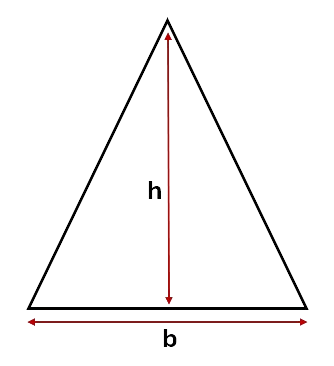
To calculate the area of a triangle we use the formula:
\[Area = \frac{b \times h}{2}\]which can also be written as:
\[Area = \frac{1}{2} b \times h\]Where b is the value of the base of the triangle, and h is the height of the triangle.
</div>
Example 1:
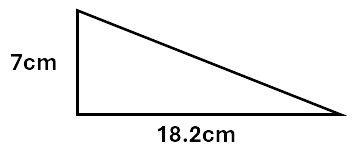
Calculate the area of the triangle.
Solution:
\[\begin{aligned} Area &= \frac{1}{2} b \times h \\\ &= \frac{1}{2} \times 18.2 \times 7 \\\ &= 63.7cm^2 \\\ \end{aligned}\]Example 2:
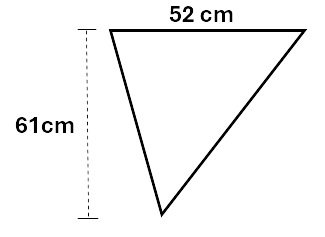
Calculate the area of the triangle below.
Solution:
\[\begin{aligned} Area &= \frac{b \times h}{2} \\\ &= \frac{52 \times 61}{2} \\\ &= 1\,586cm^2 \\\ \end{aligned}\]</div>
Check your understanding of the area of triangles by working through the questions below.
Quadrilaterals
A quadrilateral is any shape with four sides. However, not all quadrilaterals use the same formula for area.
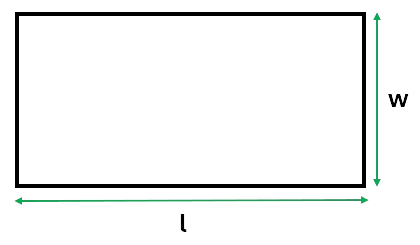
For a rectangle we use:
\[Area = l \times w\]Where l is the length of the rectangle, and w is the width.
</div>
Example:
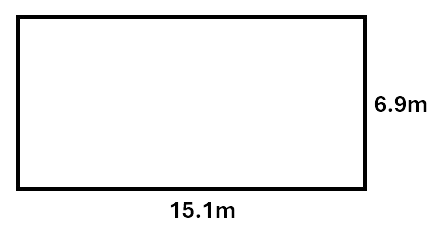
Calculate the area of the rectangle.
Solution:
\[\begin{aligned} Area &= l \times w \\\ &= 15.1 \times 6.9 \\\ &= 104.19m^2 \\\ \end{aligned}\]</div>
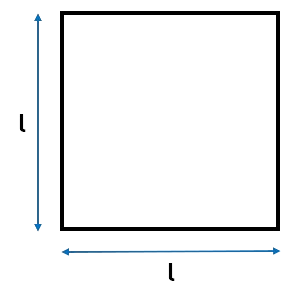
A square is similar, however the length and the width is the same, so we use the formula:
\[Area = l^2\]As l is the length on all sides.
</div>
Example:
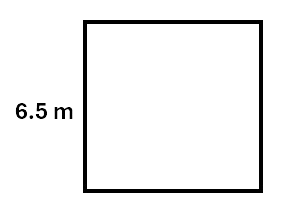
Calculate the area of a square with a length of \(6.5\,m\)
Solution:
\[\begin{aligned} Area &= l^2 \\\ &= 6.5^2 \\\ &= 42.25\,m^2 \\\ \end{aligned}\]</div>
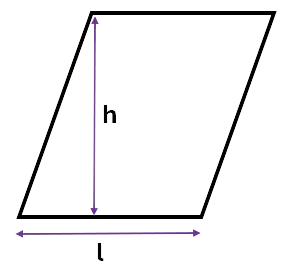
To find the area of a parallelogram we use:
\[Area = l \times h\]Where l is the length of the shape, and h is the height.
</div>
Example:
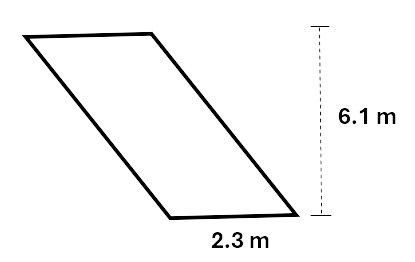
Calculate the area of the parallelogram.
Solution:
\[\begin{aligned} Area &= l \times h \\\ &= 2.3 \times 6.1 \\\ &= 14.03\,m^2 \\\ \end{aligned}\]</div>
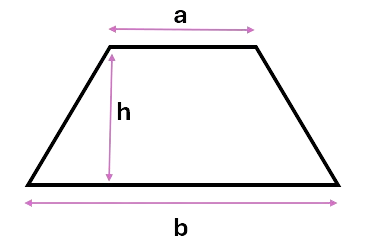
For the area of a trapezium we use the formula:
\[Area = \frac{1}{2} (a + b) \times h\]Where a is the length of the top side, b is the length of the bottom, and h is the height of the trapezium.
</div>
Example:
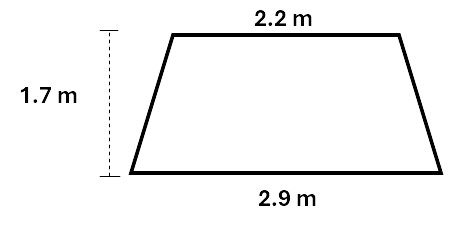
Calculate the area of the trapezium. Give the answer to one decimal place.
Solution:
\[\begin{aligned} Area &= \frac{1}{2} (a + b) \times h \\\ &= \frac{1}{2} (2.2 + 2.9) \times 1.7 \\\ &= 4.3 m^2 \\\ \end{aligned}\]</div>
Check your knowledge of the area of quadrilaterals by working though the following questions.
Circles
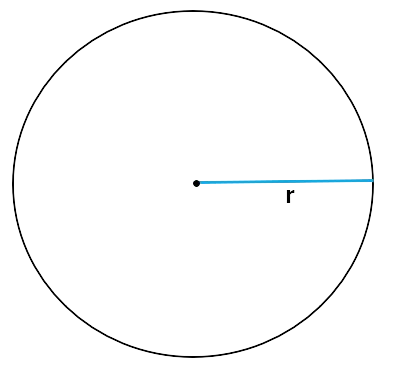
The area of a circle is calculated using the formula:
\[Area = \pi r^2\]Where r is the radius of the circle.
</div>
Example:
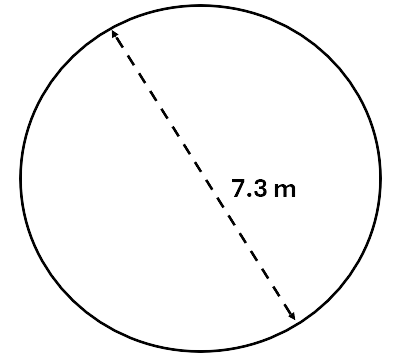
Calculate the area of a circle that \(7.3\,m\) wide to two decimal places.
Solution:
We know the diameter of the circle is \(7.3\,m\), so we first need to halve this to find the radius:
\[r = 7.3 \div 2 = 3.65\]Therefore:
\[\begin{aligned} Area &= \pi\;r^2 \\\ &= \pi \times 3.65^2 \\\ &= 41.85\,m^2 \\\ \end{aligned}\]</div>
Sectors
We can also find the area of sectors within a circle using the formula:
\[Area = \pi r^2 \times \frac{\theta}{360}\]Where r is again the radius of the circle, and \(\theta\) is the angle of the sector.
</div>
Example:
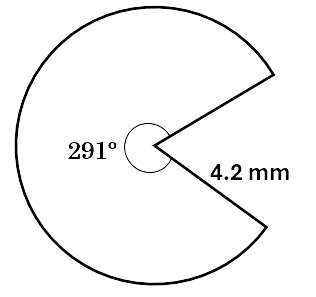
Calculate the area of the shape below. Give the answer to one decimal place.
Solution:
\[\begin{aligned} Area &= \pi r^2 \times \frac{\theta}{360} \\\ &= \pi \times 4.2^2 \times \frac{291}{360} \\\ &= 44.8\,mm^2 \\\ \end{aligned}\]</div>
Check your knowledge of the area of circles and sectors by working through the following questions.
Surface area, volume and density
This page explains how to calculate the surface area, volume and density of three-dimensional shapes.
In brief, it covers the following:
- The definition of surface area, and how to calculate this for some common three-dimensional shapes
- The definition of volume, and how to calculate this for some common three-dimensional shapes
- The definition of density, and the relationship between this and mass and volume
</div>
Surface area The surface area of a three-dimensional shape is the total area of its surface. It is measured in \(m^2\) (as the base unit of measurement; other derived units of measurement such as \(mm^2\) may also be used as appropriate). The formula used to calculate the surface area of a shape will depend on the type of shape in question, as demonstrated in the following sections.
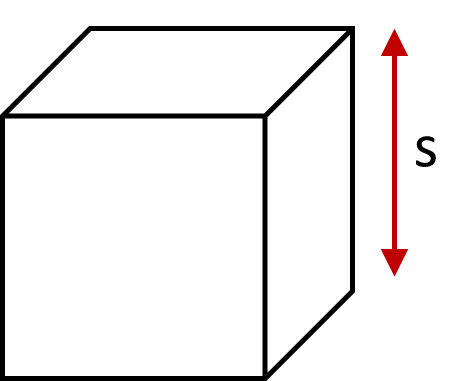
Cubes The surface area of a cube is equal to six times the area of one square side, as shown in the following formula.
Formula for a cube:
\[Surface\textrm{ }area = 6s^2\]Where \(s\) is the length of one side.
 </div>
Example: Calculate the surface area of a cubic concrete block with side length \(300mm\)
Solution: Using the formula for surface area with this measurement gives:
\[Surface\textrm{ }area = 6 \times 300^2 = 540 000mm^2\]It would then be better to convert this to \(m^2\), as follows:
\[540 000 \div 1000^2 = 0.54m^2\]Alternatively, you could convert \(300mm\) to \(0.3m\) first and then calculate the surface area using that measurement to give the same result.
</div>
Check your understanding of how to calculate the surface area of cubes by completing the following activity:
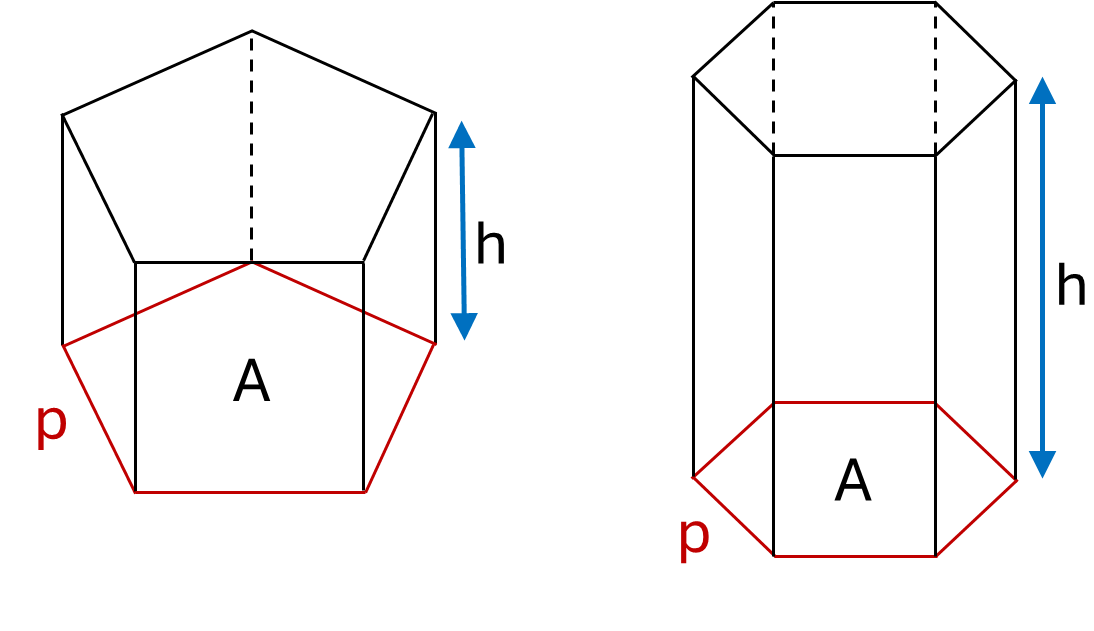
Prisms The surface area of a closed prism is calculated by adding together the area of the bases and the area of the sides, which can be done in different ways depending on the type of prism. This section covers one general formula that can be used for all closed prisms, along with specific formulas for calculating the surface area of triangular and rectangular prisms.
Formula for any closed prism:
\[Surface\textrm{ }area = 2A + (h \times p)\]Where \(A\) is the area of the base, \(p\) is the perimeter of the base and \(h\) is the height of the prism.
 </div>
Example: Calculate the surface area of a hexagonal prism column with base area \(0.1m^2\), base perimeter \(1.2m\) and height \(3m\).
Solution: Using the formula for surface area with these measurements gives:
\[Surface\textrm{ }area = 2 \times 0.1 + (3 \times 1.2) = 3.8m^2\]</div>
\(\)
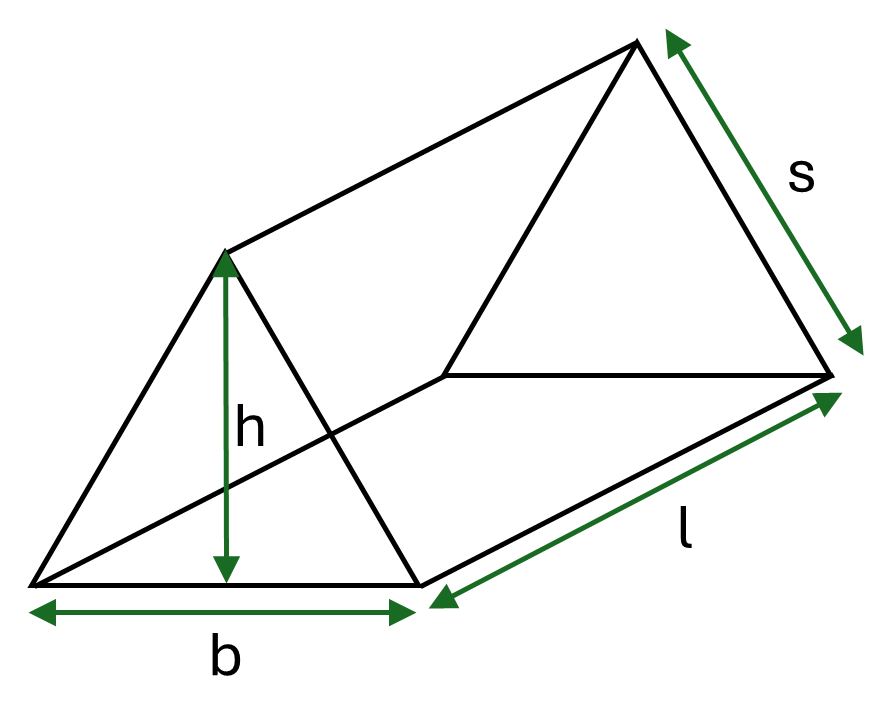
When the prism is a triangular prism you may wish to use a specific formula instead. This formula adds together the area of the triangular bases and the area of the three rectangular lateral faces (two of which are the same size).
Formula for a triangular prism:
\[Surface\textrm{ }area = bh + 2ls + lb\]Where \(b\), \(h\) and \(s\) are the base, height and side length of the triangles respectively, and \(l\) is the length of the prism.
 </div>
Example: Calculate the surface area of a timber triangular prism which has triangles with base \(63.6mm\), height \(31.8mm\) and side length \(45mm\) and which has length \(2.5m\).
Solution: First we should convert all the units to the same measurement. We will give our final answer in \(m^2\), so we will convert all measurements to \(m\) (although note that you could convert the one measurement that is in \(m\) to \(mm\) here and then convert to \(m^2\) at the end instead if preferred).
\[b = 63.6 \div 1000 = 0.0636m\] \[h = 31.8 \div 1000 = 0.0318m\] \[s = 45 \div 1000 = 0.045m\]We can then use these measurements in the formula to give the following:
\[Surface\textrm{ }area = 0.0636 \times 0.0318 + 2 \times 2.5 \times 0.045 + 2.5 \times 0.0636 = 0.386m^2\]</div>
\(\)
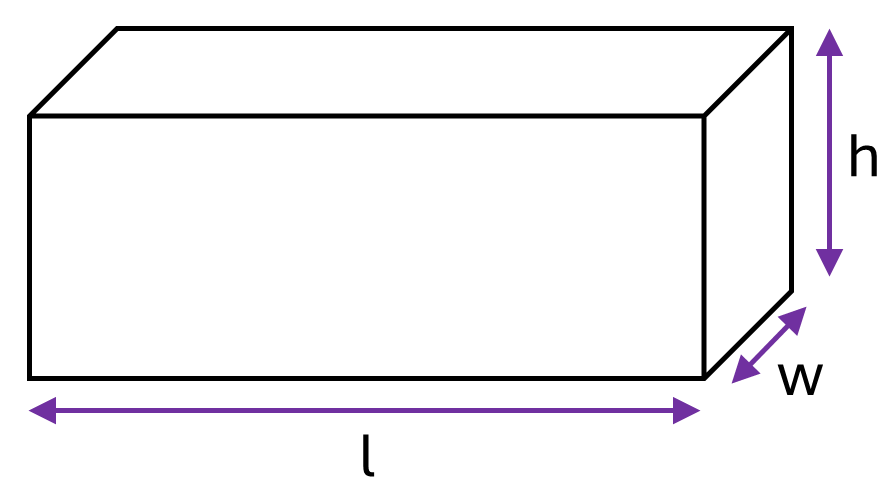
Similarly, when the prism is a rectangular prism you may wish to use a specific formula instead of the general formula.
This formula adds together the area of each pair of rectangular sides (one pair of bases and two pairs of lateral faces).
Formula for a rectangular prism:
\[Surface\textrm{ }area = 2lh + 2lw + 2wh\]Where \(l\) is the length of the prism, \(w\) is the width and \(h\) is the height.
</div>
Example: Calculate the surface area of a timber rectangular prism which is \(1.2m\) long, \(0.03m\) wide and \(0.05m\) high.
Solution: Using the formula with these measurements gives:
\[Surface\textrm{ }area = 2 \times 1.2 \times 0.05 + 2 \times 1.2 \times 0.03 + 2 \times 0.03 \times 0.05 = 0.195m^2\]</div>
Check your understanding of how to calculate the surface area of prisms by completing the following activity:
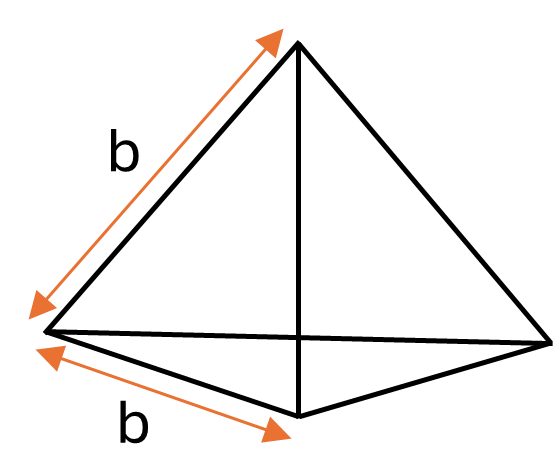
Pyramids Formulas to calculate the surface area of regular tetrahedrons and square pyramids are covered in this section. Note that the formula for the regular tetrahedron can be derived using Pythagoras’ theorem, which shows that the area of an equilateral triangle with side length \(b\) is \(\frac{\sqrt{3}}{4}b^2\)
Formula for a regular tetrahedron:
\[Surface\textrm{ }area = \sqrt 3 b^2\]Where \(b\) is the length of the sides of the equilateral triangles.
 </div>
Example: Calculate the surface area of a regular tetrahedron with side length \(0.6m\)
Solution: Using the formula with this measurement gives:
\[Surface\textrm{ }area = \sqrt{3} \times 0.6^2 = 0.624m^2\]</div>
\(\)
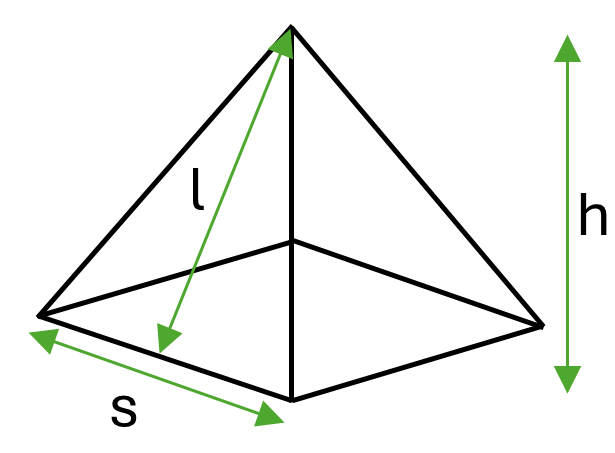
If you have a square pyramid instead, the surface area is the sum of the area of the square base and the area of the four sides, as shown in the following formula.
Formula for a square pyramid:
\[Surface\textrm{ }area = s^2 + 2sl\]Where \(s\) is the length of the sides of the square and \(l\) is the slant height of the sides of the pyramid.
Alternatively, if you don’t know the slant height of the sides but know the perpendicular height of the pyramid you can use the following formula (which makes use of Pythagoras’ theorem to derive the slant height):
\[Surface\textrm{ }area = s^2 + 2s\sqrt{\frac{s^2}{4}+h^2}\]Where \(s\) is the length of the sides of the square and \(h\) is the perpendicular height of the pyramid.
 </div>
Example: Calculate the surface area of a square pyramid with square side length \(30mm\) and perpendicular height \(50mm\).
Solution: Using the formula with these measurements gives:
\[Surface\textrm{ }area = 30^2 + 2 \times 30 \times \sqrt{\frac{30^2}{4}+50^2} = 4032.09mm^2\]</div>
Check your understanding of how to calculate the surface area of pyramids by completing the following activity:
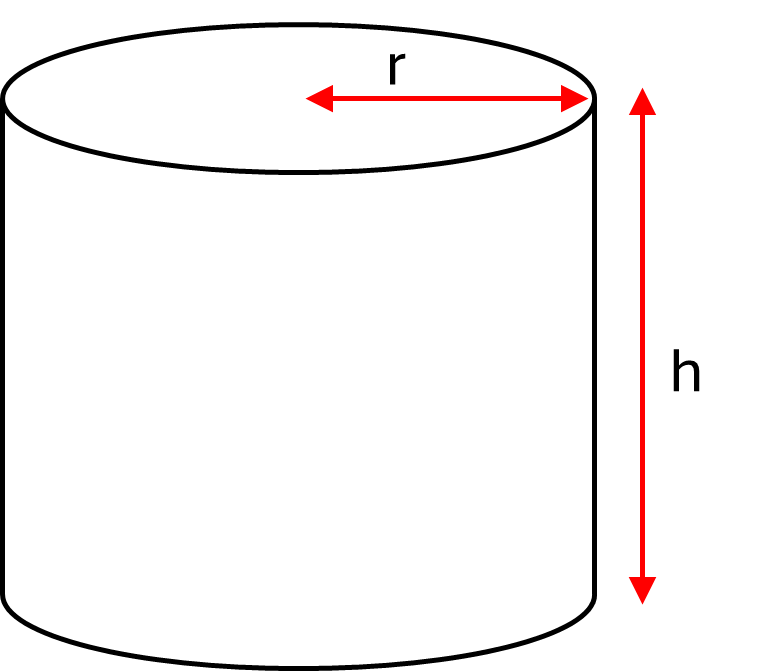
Cylinders The surface area of a closed cylinder is equal to the area of the two circles on the ends, plus the area of the side. This side, when flattened out, is a rectangle with length equal to the circumference of the circles and width equal to the height of the cylinder. Therefore formulas for the circumference and area of circles are utilised in the formula for the surface area of a cylinder, as shown below.
Formula for a cylinder:
\[Surface\textrm{ }area = 2 \pi r^2 + 2 \pi rh\]Where \(r\) is the radius and \(h\) is the height of the cylinder. Note that you can also write this formula as \(2 \pi r (r + h)\)
 </div>
Example: Calculate the surface area of a cylindrical column with radius \(0.15m\) and height \(2.5m\)
Solution: Using the formula for surface area with these measurements gives:
\[Surface\textrm{ }area = 2 \times \pi \times 0.15^2 + 2 \times \pi \times 0.15 \times 2.5 = 2.498m^2\]</div>
Check your understanding of how to calculate the surface area of cylinders by completing the following activity:
Spheres Archimedes proved that the surface area of a sphere is equal to the surface area of the open (at both ends) cylinder that fits perfectly around the sphere. In other words, the cylinder with radius equal to the radius of the sphere, and height equal to twice the radius of the sphere (i.e. to the diameter of the sphere).
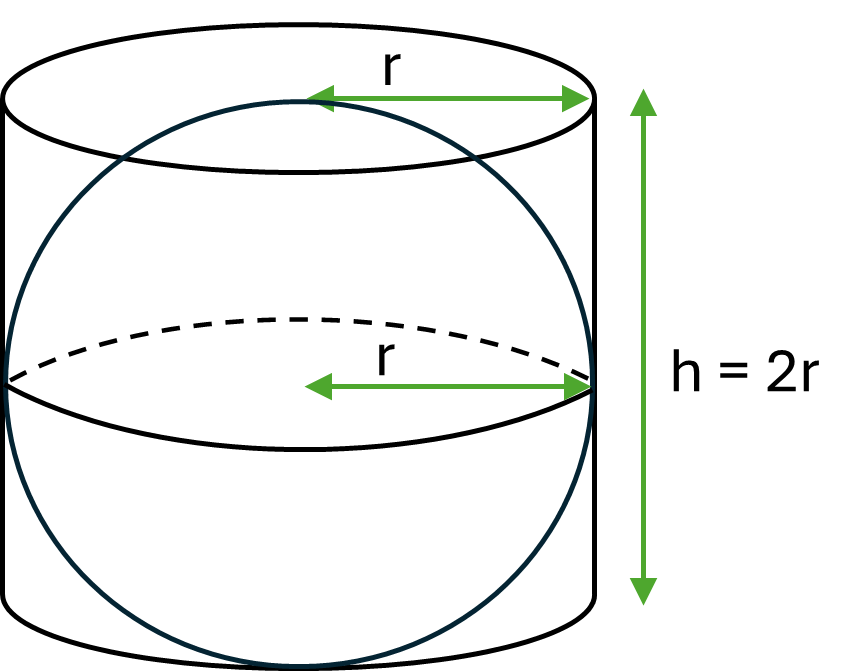
Therefore the formula for the surface area of a sphere is the same as the second part of the formula for the surface area of a cylinder (i.e. \(2 \pi rh\)), with \(2r\) substituted in for the height. This results in the simplified formula shown below.
Formula for a sphere:
\[Surface\textrm{ }area = 4 \pi r^2\]Where \(r\) is radius of the sphere.
 </div>
Example: Calculate the surface area of a sphere with diameter \(0.7m\)
Solution: First note that the radius of this sphere is \(0.35m\) (i.e. half the diameter). Using the formula for surface area with this measurement gives:
\[Surface\textrm{ }area = 4 \times \pi \times 0.35^2 = 1.539m^2\]</div>
Check your understanding of how to calculate the surface area of spheres by completing the following activity:
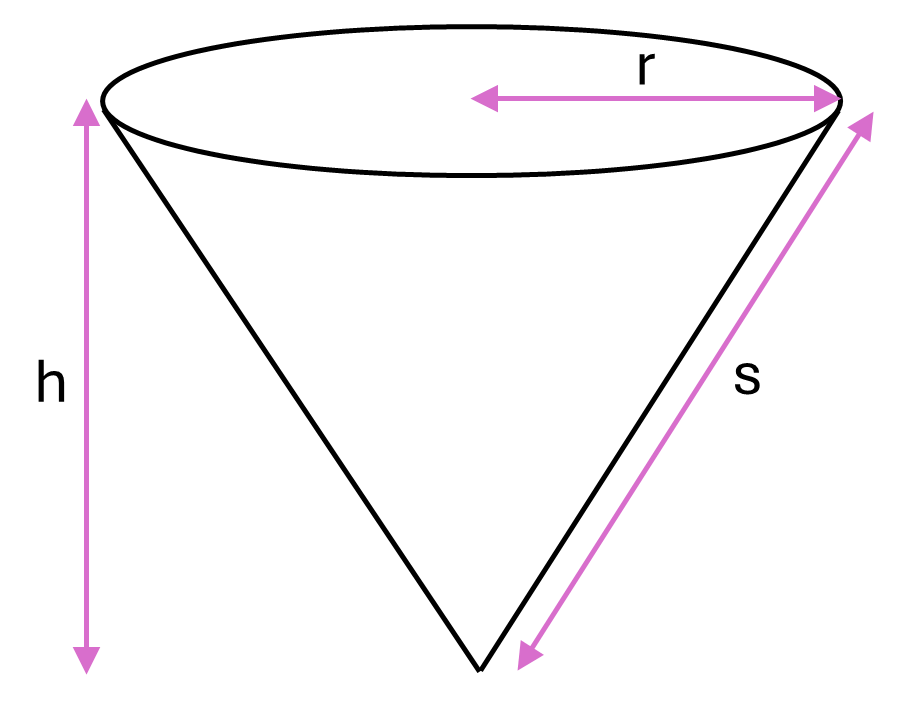
Cones The surface area of a cone is equal to the area of the circular base plus the area of the curved surface, the latter of which can be calculated by thinking of it as being opened out to form a sector. Formulas for the area and arc length of sectors can therefore be used to derive the following formula for the surface area of a cone.
Formula for a cone:
\[Surface\textrm{ }area = \pi r^2 + \pi rs\]Where \(r\) is the radius of the base of the cone and \(s\) is the slant height. Note that you can also write this formula as \(\pi r (r + s)\)
Alternatively, if you don’t know the slant height but know the perpendicular height of the cone you can use the following formula (which makes us of Pythagoras’ theorem to derive the slant height):
\[Surface\textrm{ }area = \pi r^2 + \pi r \sqrt{h^2 + r^2}\]Where \(r\) is the radius of the base of the cone and \(h\) is the perpendicular height. Note that you can also write this formula as \(\pi r (r + \sqrt{h^2 + r^2})\)
 </div>
Example: Calculate the surface area of a cone with perpendicular height \(0.7m\) and base diameter \(0.3m\)
Solution: First note that the radius of the base of this cone is \(0.15m\) (i.e. half the diameter). Using the formula for surface area with this measurement gives:
\[Surface\textrm{ }area = \pi \times 0.15^2 + \pi \times 0.15 \times \sqrt{0.7^2 + 0.15^2} = 0.408m^2\]</div>
Check your understanding of how to calculate the surface area of cones by completing the following activity:
Volume The volume of a three-dimensional shape is the amount of space it takes up. It is measured in \(m^3\) (as the base unit of measurement; other derived units of measurement such as \(mm^3\) may also be used as appropriate). The formula used to calculate the volume of a shape will depend on the type of shape in question, as demonstrated in the following sections.
Cubes The volume of a cube can be calculated by multiplying the length by the width and height. Since these are all the same this equates to raising the length of one side to the power of three, as shown in the following formula.
Formula for a cube:
\[Volume = s^3\]Where \(s\) is the length of one side.
</div>
Example: Calculate the volume of a cubic concrete block with side length \(300mm\)
Solution: Using the formula for volume with this measurement gives:
\[Volume = 300^3 = 27 000 000mm^3\]It would then be better to convert this to \(m^3\), as follows:
\[27 000 000 \div 1000^3 = 0.027m^3\]Alternatively, you could convert \(300mm\) to \(0.3m\) first and then calculate the surface area using that measurement to give the same result.
</div>
Check your understanding of how to calculate the volume of cubes by completing the following activity:
Prisms The volume of a prism is calculated by multiplying the area of the base by the height of the prism. This section covers one general formula that can be used for all prisms, along with specific formulas for calculating the volume of triangular and rectangular prisms.
Formula for any prism:
\[Volume = Ah\]Where \(A\) is the area of the base and \(h\) is the height of the prism.
 </div>
Example: Calculate the volume of a hexagonal prism column with base area \(0.1m^2\) and height \(3m\).
Solution: Using the formula for volume with these measurements gives:
\[Volume = 0.1 \times 3 = 0.3m^3\]</div>
\(\)
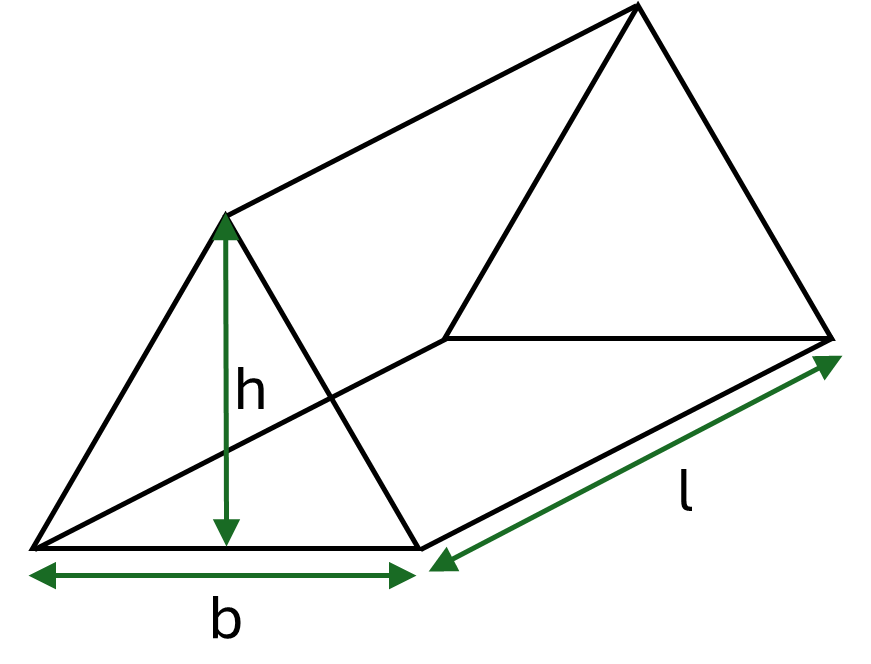
When the prism is a triangular prism the formula can also be written using dimensions for the base length and height of the triangles, as shown in the following formula.
Formula for a triangular prism:
\[Volume = \frac{1}{2}bhl\]Where \(b\) and \(h\) are the base length and height of the triangles respectively, and \(l\) is the length of the prism.
 </div>
Example: Calculate the volume of a timber triangular prism which has triangles with base \(63.6mm\) and height \(31.8mm\) and length \(2.5m\).
Solution: First we should convert all the units to the same measurement. We will give our final answer in \(m^3\), so we will convert all measurements to \(m\) (although note that you could convert the one measurement that is in \(m\) to \(mm\) here and then convert to \(m^3\) at the end instead if preferred).
\[b = 63.6 \div 1000 = 0.0636m\] \[h = 31.8 \div 1000 = 0.0318m\]We can then use these measurements in the formula to give the following:
\[Volume = \frac{1}{2} \times 0.0636 \times 0.0318 \times 2.5 = 0.0025m^3\]</div>
\(\)
Similarly, when the prism is a rectangular prism you may wish to use a formula that uses the dimensions for the length, width and height, as shown in the following formula.
Formula for a rectangular prism:
\[Volume = l \times w \times h\]Where \(l\) is the length of the prism, \(w\) is the width and \(h\) is the height.
</div>
Example: Calculate the volume of a timber rectangular prism which is \(1.2m\) long, \(0.03m\) wide and \(0.05m\) high.
Solution: Using the formula with these measurements gives:
\[Volume = 1.2 \times 0.03 \times 0.05 = 0.0018m^3\]</div>
Check your understanding of how to calculate the volume of prisms by completing the following activity:
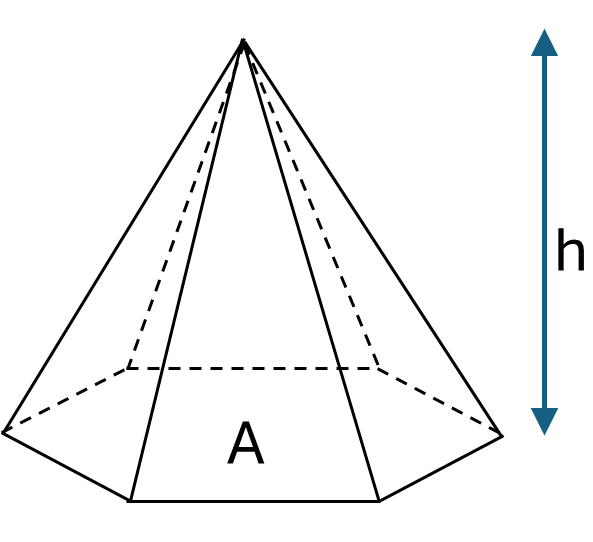
Pyramids This section covers one general formula that can be used to calculate the volume of all pyramids, along with specific formulas for calculating the volume of regular tetrahedrons and square pyramids.
Formula for any pyramid:
\[Volume = \frac{1}{3}Ah\]Where \(A\) is the area of the base and \(h\) is the height of the pyramid.
 </div>
Example: Calculate the volume of a pyramid with base area \(0.35m^2\) and height \(0.4m\).
Solution: Using the formula for volume with these measurements gives:
\[Volume = \frac{1}{3} \times 0.35 \times 0.4 = 0.047m^3\]</div>
When the pyramid is a regular tetrahedron you may wish to use a specific formula instead. This formula can be derived using Pythagoras’ theorem, which shows that the area of an equilateral triangle with side length \(b\) is \(\frac{\sqrt{3}}{4}b^2\) and the height of a prism with side length \(b\) is \(\frac{\sqrt{6}}{3}b\)
Formula for a regular tetrahedron:
\[Volume = \frac{b^3}{6\sqrt{2}}\]Where \(b\) is the length of the sides of the equilateral triangles.
</div>
Example: Calculate the volume of a regular tetrahedron with side length \(0.6m\)
Solution: Using the formula with this measurement gives:
\[Volume = \frac{0.6^3}{6\sqrt{2}} = 0.025m^3\]</div>
\(\)
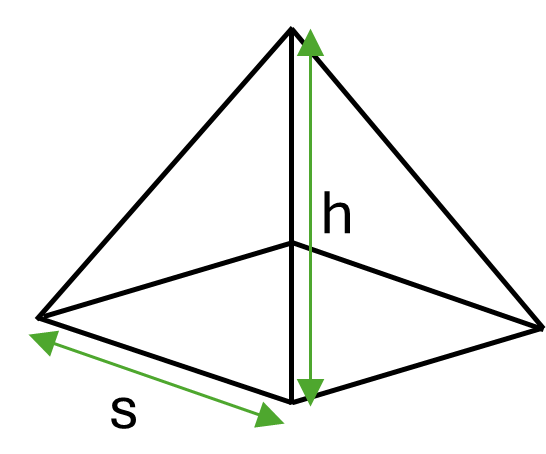
If you have a square pyramid instead, you can adjust the general formula for volume to incorporate the formula for the area of the square base, as shown in the following formula.
Formula for a square pyramid:
\[Volume \frac{1}{3}s^2h\]Where \(s\) is the length of the sides of the square and \(h\) is the perpendicular height of the pyramid.
 </div>
Example: Calculate the volume of a square pyramid with square side length \(30mm\) and perpendicular height \(50mm\).
Solution: Using the formula with these measurements gives:
\[Volume = \frac{1}{3} \times 30^2 \times 50 = 15 000mm^3\]</div>
Check your understanding of how to calculate the volume of pyramids by completing the following activity:
Cylinders The volume of a cylinder is calculated by multiplying the area of the circular base by the height of the cylinder, as shown in the following formula.
Formula for a cylinder:
\[Volume = \pi r^2h\]Where \(r\) is the radius and \(h\) is the height of the cylinder.$$
</div>
Example: Calculate the volume of a cylindrical column with radius \(0.15m\) and height \(2.5m\)
Solution: Using the formula for volume with these measurements gives:
\[Volume = \pi \times 0.15^2 \times 2.5 = 0.177m^3\]</div>
Check your understanding of how to calculate the volume of cylinders by completing the following activity:
Spheres The volume of a sphere is equal to four thirds times \(\pi\) times the radius of the sphere cubed, as shown in the following formula.
Formula for a sphere:
\[Volume = \frac{4}{3} \pi r^3\]Where \(r\) is radius of the sphere.
</div>
Example: Calculate the volume of a sphere with diameter \(0.7m\)
Solution: First note that the radius of this sphere is \(0.35m\) (i.e. half the diameter). Using the formula for volume with this measurement gives:
\[Volume = \frac{4}{3} \times \pi \times 0.35^3 = 0.180m^3\]</div>
Check your understanding of how to calculate the volume of spheres by completing the following activity:
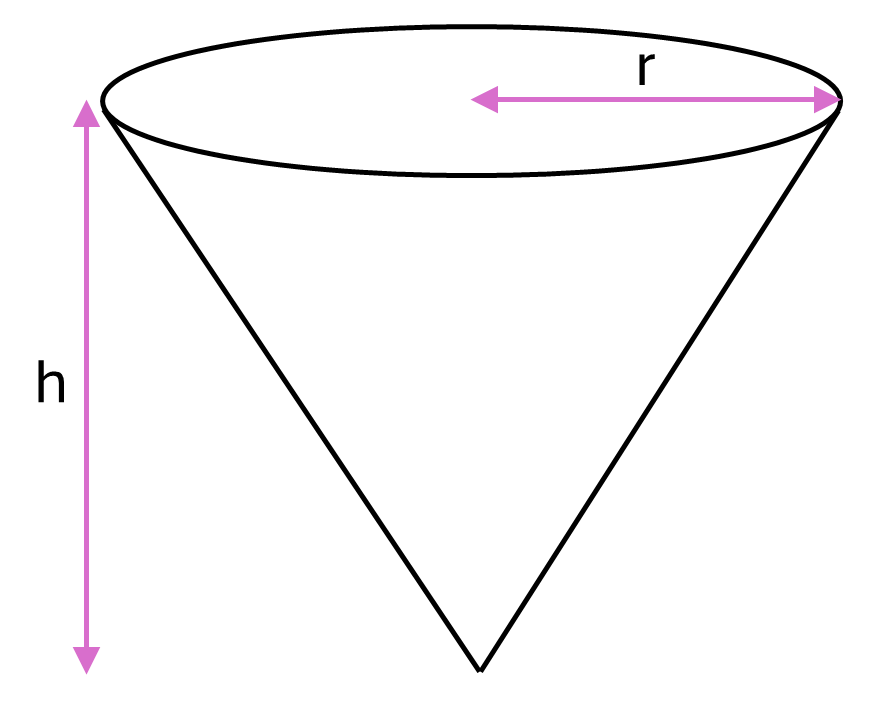
Cones The volume of a cone is equal to one third times the area of the circular base times the height of the cone, as shown in the following formula.
Formula for a cone:
\[Volume = \frac{1}{3} \pi r^2 h\]Where \(r\) is the radius of the base of the cone and \(h\) is the perpendicular height.
 </div>
Example: Calculate the volume of a cone with perpendicular height \(0.7m\) and base diameter \(0.3m\)
Solution: First note that the radius of the base of this cone is \(0.15m\) (i.e. half the diameter). Using the formula for volume with this measurement gives:
\[Volume = \frac{1}{3} \times \pi \times 0.15^2 \times 0.7 = 0.016m^3\]</div>
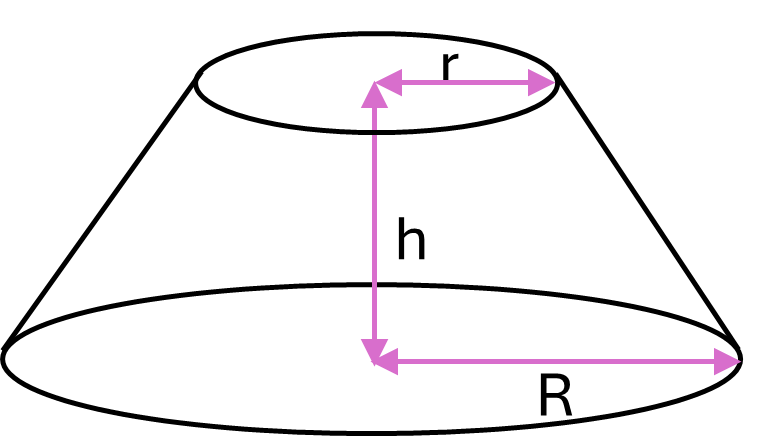
If you cut the top off a cone, parallel to the base, the part that is left is called the frustum of the cone. To find the volume of this three-dimensional shape, you can use the following formula.
Formula for the frustum of a cone:
\[Volume = \frac{1}{3} \pi h(r^2 + rR + R^2)\]Where \(r\) is the radius of the top of the frustum of the cone, \(R\) is the radius of the base of the frustum of the cone and \(h\) is the perpendicular height.
 </div>
Example: Calculate the volume of a frustum of a cone with perpendicular height \(1.3m\), top radius \(0.2m\) and base radius \(0.45m\).
Solution: Using the formula for volume with these measurement gives:
\[Volume = \frac{1}{3}\times \pi \times 1.3 \times (0.2^2 + 0.2 \times 0.45 + 0.45^2) = 0.453m^3\]</div>
Check your understanding of how to calculate the volume of cones by completing the following activity:
Volumes in construction Sometimes in construction you will need to calculate the volume of a three-dimensional enclosed shape, such as the external walls or concrete footings of a building. In this case the average of the internal and external perimeters (known as the mean girth) should be used for the length measurement. This is then multiplied by the width and depth of the wall or footing to find the volume.
Example: A concrete footing has width \(380mm\), depth \(400mm\) and internal perimeter \(48m\). Calculate the volume of concrete required.
Solution: In order to calculate the volume of concrete required we first need to calculate the mean girth. As detailed in the Perimeter and area page of this module, we can do this as follows (note \(380mm\) has been converted to \(0.38m\)):
\[Mean\textrm{ }girth = 48 + 4 \times 0.38 = 49.52m\]The volume can then be calculated as follows (note \(400mm\) has been converted to \(0.4m\)):
\[Volume = 49.52 \times 0.38 \times 0.4 = 7.527m^3\]</div>
Check your understanding of volumes in construction by completing the following activity:
Density The density of a three-dimensional shape is the amount of matter (or ‘stuff’) it contains per unit volume. Objects with more matter per unit volume (i.e. with a higher density) are said to be more dense than those with less (for example, gold is more dense than wood).
Density can be calculated by dividing the mass of an object by its volume, as shown in the following formula. These measurements are usually in \(kg\) and \(m^3\) respectively, resulting in a density measured in \(kg/m^3\), but other units of measurement can also be used:
\[Density = \frac{Mass}{Volume}\]Note that you can rearrange this formula to calculate the mass or volume from the two other measurements as required. In addition, note that the density of building materials can also be obtained from various references as needed (for example, from Australian Standards and manufacturer data).
Example 1: Determine the density of a rectangular prism concrete block with dimensions \(1.2m\) by \(0.6m\) by \(0.4m\) and with mass \(691kg\)
Solution: Using the formula for the volume of a rectangular prism first gives:
\[Volume = 1.2 \times 0.6 \times 0.4 = 0.288m^3\]Using this value in the formula for density then gives:
\[Density = \frac{691}{0.288} = 2399.31kg/m^3\]Example 2: Determine the mass of a rectangular prism concrete block with dimensions \(0.5m\) by \(0.4m\) by \(0.25m\) given the concrete has a density of \(2200kg/m^3\)
Solution: Using the formula for the volume of a rectangular prism first gives:
\[Volume = 0.5 \times 0.4 \times 0.25 = 0.05m^3\]Rearranging the formula for density and using this value then gives:
\[Mass = Density \times Volume = 2200 \times 0.05 = 110kg\]Example 3: Determine the volume of a concrete block with density \(2300kg/m^3\) and mass \(200kg\)
Solution: Rearranging the formula for density and using these measurements gives:
\[Volume = \frac{Mass}{Density} = \frac{200}{2300} = 0.087kg/m^3\]</div>
Check your understanding of density by completing the following activity:
H5P interactive activityFeedback
If you would like to provide feedback on this module please do so by answering some or all of the questions in the form below. Alternatively for any questions about the module please contact Library-UniSkills@curtin.edu.au
We review this feedback regularly, and take your suggestions on board to improve the module. Thank you for your feedback!
Explore more here
About UniSkills
UniSkills was created and is maintained by Curtin University Library. To report issues with UniSkills contact Library Help.
Twemoji icons by Twitter, Inc and other contributors, licensed under a CC-BY 4.0 licence.
Except where otherwise noted, UniSkills content in all it’s forms (website, PDFs etc) are licensed under a Creative Commons Attribution ShareAlike 4.0 International Licence. We ask that you attribute any use of the content as created by Curtin University Library with a link to the Library website.
This license does not extend to other Curtin University and Curtin University Library webpages, or to Curtin branding and trademarks. Curtin University’s copyright information is available on the Curtin website.