
Communication,-Culture-and-Indigenous-Perspectives-in-Business-printable-guide-UniSkills.pdf
Communication, Culture and Indigenous Perspectives in Business
Table of Contents
Introduction
This guide has been developed to help you with your research for the unit MGMT1002 Communication, Culture and Indigenous Perspectives in Business. Use the menu above to access information that will help you with your assignments and read on for some helpful definitions and tips.

What you will learn
- Tips to help you search effectively
- Strategies to help you with finding references for your assessments
- Information to help you improve your reading, writing and referencing
- Where to get help
Common terms explained
Before you get started with your research, it is important that you understand the nature of the resources you will be using and the meaning of some of the academic terminology that you will encounter, especially if you are a new student. Below is a list of common terms to help you get started.
Journal articles
Journal articles report on specific research or studies, focusing on current developments in a particular field. More so than books, they are where to turn if you wish to discover the recent thinking for a specific discipline.
Journal
Journal articles are published in journals, essentially magazines, but for an academic audience. A journal will be published multiple times per year and is organised by volume (and sometimes issue).
Peer reviewed, academic or scholarly journals
Prior to being published, a peer-reviewed, academic or scholarly journal article must go through a quality control process. Assessed, either by a panel of experts or an editor who is considered an expert in the field, the article is reviewed and approved for publication. Peer reviewed or scholarly journals are considered highly credible sources because of this process.
Databases
Databases are online indexes which provide access to books and journal articles, as well as newspaper articles, theses and a lot more. Some of the largest databases, such as ProQuest and ScienceDirect are multidisciplinary, which means they cover a range of subject areas. Others, like Business Source Ultimate, are much more specific focusing on a particular discipline. You’ll find a full list on the Databases page.
Library catalogue
The library catalogue is a search tool that contains the library’s physical collection (all the physical books, videos and other items that you can find in the library), as well as links through to the online resources (journal articles, eBooks and more) which are held in the databases.
Searching effectively
Identify the keywords

When you perform a search, your results are tied to the keywords that you use. It is therefore important that you use the right words in your search so that you find the right information. Look at your topic or research question and identify the key concepts related to your topic.
Search tip! When identifying keywords/concepts, ignore any directive verbs in your question like ‘compare’, ‘analyse’ or ‘define’. These are instructions for how you should write your assignment and should not form the basis of your search.
</div>
Start your search
Using the keywords you’ve identified, try a search in the Library Catalogue or appropriate databases. Keep in mind that you should restrict your search to the type of material you want to find. You’ll find options to Refine where you can specify if you want to find journal articles, newspaper articles and other types of sources.
See the links to the different assessments (available in the guide menu above) for further tips on where and how to search.
</div>
Identify alternative keywords

Authors often use different terms or words to describe the same concepts. It is important that you search using a range of alternative terms related to the main concepts from your topic as this can help you find relevant resources. You can find alternative terms in a number of ways:
Use a thesaurus or brainstorm with others
For certain words, using a thesaurus can be a powerful way of identifying related terms on which to search. Consider the keyword “Manager”. Using an online thesaurus we are given a number of suggestions:
- Administrator
- Executive
- Director
Talking over your keywords with friends, family or colleagues can also be a great way to identify alternative terms that cover your concepts.
Use Google and Wikipedia
A thesaurus might not work well for more technical or subject specific language so it is best to look at tools such as Wikipedia or general Internet searching for an overview of the concept in an attempt to identify alternative keywords. For example, if you were interested in finding alternative terms for the concept of “Indigenous Australians”, you could look it up on Wikipedia and you will find the following suggestions:
- Aboriginal and Torres Strait Islander peoples
- Indigenous Australians
- First Nations
- First Peoples of Australia
IMPORTANT NOTE: For this assignment, you have been instructed not to use Wikipedia as a reference. You can use it to identify alternative terms for searching purposes, but you should not be taking information from Wikipedia and using it in your assignment!
Use keywords from relevant articles
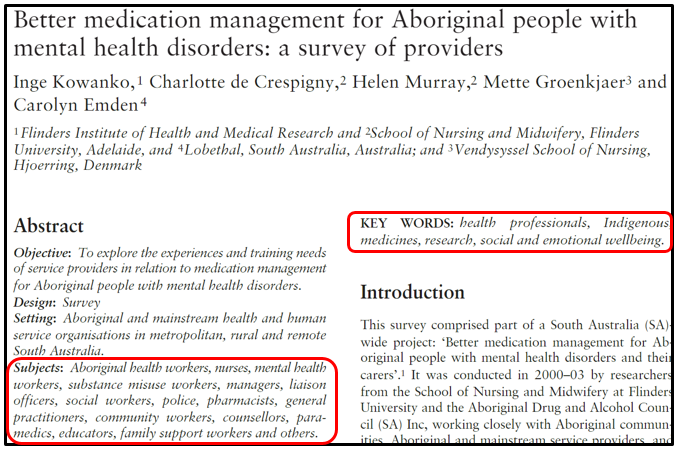
Using the keywords from your question, you may find a few relevant articles within the library catalogue or databases. If you do, you can use these articles to identify the keywords or subject headings which have been applied. Most articles will list the suggestions under headings like Keywords or Subjects (see the journal article below).
Connect your search terms with AND and OR
When searching in the library catalogue and databases, you can combine your keywords using AND and OR.
-
AND is used to combine different search concepts. It narrows your search, instructing the catalogue or database to find only items that contain both of your terms. For example, sustainable development goals AND business ethics will only return records containing both the terms.
-
OR is used to combine similar keywords. It broadens your search, instructing the catalogue or database to find items that contain either of your terms. For example, corporate social responsibility OR social performance will locate all records containing either of these terms.
How do I know if a source is academic?
The following points can help you decide if a source is academic:
- Authors - are the author names given? Are they affiliated with an educational or research institution or government agency? Do they provide their educational qualifications?
- Audience - is it written for an academic audience (scholars, researchers)? Does it use specialised or discipline specific language?
- Purpose - why has the source been written? Is it to report on or summarise research on a topic?
- References - does it provide references to support the research? Assessment one - Case study
Assessment one: Case study
Details of your assessment can be accessed from your Blackboard unit. Using the menu on the left, navigate to Assessments > Assessment 1: Case Study.
You are required to write an essay response (1000-1200 words) to the following:
- What are some important protocols that non-Indigenous businesses can use when working with Aboriginal and Torres Strait Islander peoples?
- Supply Nation was established to address key issues with procurement by Australian Federal Government Agencies. What is the motivation behind Supply Nation and where does it come from?
The information sources to support your assessment are listed below. The sources include scholarly journal articles, books and book chapters, news articles, and government and industry reports.
For this assessment, you are not required to search for or include sources beyond those provided in the source list below. This curated list of sources has already been assessed for relevance to the topic and the quality and veracity of information. Read the assessment questions and the marking rubric carefully. These will give you information that will help you when you are selecting from the list and critically reading the sources provided below. </div>
Academic Sources
Journal articles, books and book chapters are key scholarly sources that are required in your assessment. Journal articles are usually written by experts or researchers and provide detailed analyses of research, together with supporting evidence, in the form of references. They tend to be more recent than books. Books and book chapters provide definitions, a general overview and often in-depth coverage of a topic.
---Somerville, Wendy, Vahri McKenzie, Lisa Fuller, Naomi Joy Godden, Ashley Harrison, Renae Isaacs-Guthridge, and Bethaney Turner. 2023. “‘Kind Regards’: Negotiating Connection to Country and Place Through Collective Storying.” Australian Journal of Environmental Education 39 (3): 336-348. https://doi.org/10.1017/aee.2023.24.
---Fredericks, Bronwyn, and Eden Bywater. 2024. “Country Under Concrete: Enduring Indigenous Connections to Country Amidst Development.” M/C Journal 27 (5). https://doi.org/10.5204/mcj.3087.
---Birch, David. 2010. “Indigenous People.” In The A to Z of Corporate Social Responsibility, edited by Wayne Visser, Dirk Matten, Manfred Pohl, and Nick Tolhurst, 232-234. Newark: John Wiley and Sons. https://ebookcentral.proquest.com/lib/curtin/reader.action?docID=564916&ppg=266.
---
Langton, Marcia. 2023. The Welcome to Country Handbook: A Guide to Indigenous Australia. South Yarra: Hardie Grant Explore. https://ebookcentral.proquest.com/lib/curtin/detail.action?docID=30620011.
Foley, Dennis. 2013. “Jus Sanguinis: The Root of Contention in Determining What is an Australian Aboriginal Business.” Indigenous Law Bulletin 8 (8): 25-29. https://www.austlii.edu.au/cgi-bin/viewdoc/au/journals/ILB/2013/39.html.
---Hudson, Sara. 2016. “Awakening the ‘Sleeping Giant’: The Hidden Potential of Indigenous Businesses.” Policy: A Journal of Public Policy and Ideas 32 (1): 3-9. https://search.informit.org/doi/10.3316/ielapa.022041249224047.
_Note: If the link doesn't work, search for the article title in the [Library catalogue](https://catalogue.curtin.edu.au/) to access._ ---Finau, Glenn, Diane Jarvis, Natalie Stoeckl, Silva Larson, Daniel Grainger, Michael Douglas, Ewamian Aboriginal Corporation et al. 2023. “Accounting for Indigenous Cultural Connections to Land: Insights from Two Indigenous Groups of Australia.” Accounting, Auditing, & Accountability Journal 36 (9): 370-389. https://doi.org/10.1108/AAAJ-08-2022-5971.
---Heard, Isaac, Peter E. D. Love, Michael C. P. Sing, and Veronica Goerke. 2017. “Learning to Build Relationships for a Better Australia: Indigenous Reconciliation in Action in the Construction and Resource Sectors.” Construction Innovation 17 (1): 4-24. https://doi.org/10.1108/CI-06-2015-0032.
Industry / Reports
A report is a specific format for communicating information, usually covering the who, what, where and why of a particular issue. They are typically produced by government departments, research groups, not-for-profit organisations, companies, and others, and will communicate the context behind decision-making.
---
Australian Government. 2023. Aboriginal and Torres Strait Islander Peoples. Australian Government. https://www.stylemanual.gov.au/accessible-and-inclusive-content/inclusive-language/aboriginal-and-torres-strait-islander-peoples.
Supply Nation. 2024. First Nations Businesses Succeeding Internationally. Canberra, ACT: Australian Government. https://www.austrade.gov.au/en/news-and-analysis/publications-and-reports/first-nations-businesses-succeeding-internationally?utm_source=linkedin&utm_medium=social&utm_campaign=first-nations-international-trade-report&utm_content=social-media-toolkit.
Supply Nation. 2018. The Sleeping Giant: A Social Return on Investment Report on Supply Nation Certified Suppliers. Sydney, NSW: Supply Nation. https://supplynation.org.au/wp-content/uploads/2018/08/Sleeping-Giant-Report.pdf.
Supply Nation. 2018. Indigenous Business Growth: Working Together to Realise Potential. Sydney, NSW: Supply Nation. https://supplynation.org.au/wp-content/uploads/2018/10/Building-Indigenous-Growth-Report.pdf.
Dhawura Ngilan Business and Investor Initiative. 2024. A Guide For Businesses and Investors: Dhawura Ngilan (Remembering Country): A Vision for Aboriginal and Torres Strait Islander Heritage. Dhawura Ngilan Business and Investor Initiative. https://culturalheritage.org.au/wp-content/uploads/2024/03/DNBII_BusinessesInvestorsGuide.pdf.
Note: The above link is no longer working but the document can be requested at [https://culturalheritage.org.au/resource/dhawura-ngilan-business-and-investor-guide/](https://culturalheritage.org.au/resource/dhawura-ngilan-business-and-investor-guide/). ---
Dhawura Ngilan Business and Investor Initiative. 2024. Principles For Businesses and Investors: Dhawura Ngilan (Remembering Country): A Vision for Aboriginal and Torres Strait Islander Heritage. Dhawura Ngilan Business and Investor Initiative. https://culturalheritage.org.au/wp-content/uploads/2024/03/DNBII_PrinciplesGuide.pdf.
METRONET. 2018. Gnarla Biddi: Metronet’s Aboriginal Engagement Strategy. Perth, WA: METRONET. https://www.metronet.wa.gov.au/Portals/31/Project%20Documents/Gnarla%20Biddi/METRONET%20Aboriginal%20Engagement%20Strategy.pdf.
</div>
News Sources
News and other media sources provide up-to-date reporting on events as they are occurring, while journal articles and books may take more time to move through the publication process. News sources can present issues in the context of when they occurred and sometimes seek comment or opinions from representatives of both sides of an argument, providing multiple points of view about an issue. Ensure you consider news sources carefully for evidence of bias.
---Burns, Clare JM, Cindy Shannon, Deborah Delaney, and Luke Houghton. 2023. “Listen! The Simple Thing the Finance Sector Can Do For Indigenous Customers That Can Change People’s Lives.” The Conversation, March 31, 2023. https://theconversation.com/listen-the-simple-thing-the-finance-sector-can-do-for-indigenous-customers-that-can-change-peoples-lives-195565.
---Charles, Bronte, and Rudi Maxwell. 2024. “How Will AI Affect Aboriginal and Torres Strait Islander Culture?” NITV, September 27, 2024. https://www.sbs.com.au/nitv/article/how-will-ai-affect-aboriginal-and-torres-strait-islander-culture/dwhzc75a1.
---Curtin, Nicole, Steven Bird, and Tracy Woodroffe. 2021. “‘More Than a Word’: Practicing Reconciliation Through Indigenous Knowledge-Sharing in Tourism.” The Conversation, May 27, 2021. https://theconversation.com/more-than-a-word-practising-reconciliation-through-indigenous-knowledge-sharing-in-tourism-158563.
---
City of Vincent. 2022. “Vincent Embraces NAIDOC Week Theme Get Up! Stand Up! Show Up!” City of Vincent. https://www.vincent.wa.gov.au/news/vincent-embraces-naidoc-week-theme-get-up!-stand-up!-show-up!/11769.
Foster, Brendan. 2024. “Aboriginal Elders Give WA Council Green Light to Return Park to Indigenous Name.” National Indigenous Times, February 15, 2024. https://nit.com.au/15-02-2024/9817/aboriginal-elders-give-wa-council-green-light-to-change-park-back-to-original-indigenous-name.
Enus, Anton, Rhiannon Elston, Elizabeth Close, Patricia Adjei, and Rebecca Wessels. 2019. “An Aboriginal Business Is Helping to Protect the Right of Artists and Their Work, With Estimates That 80% of All Indigenous Artifacts Sold Are Inauthentic.” SBS World News Australia, July 6, 2019. https://search.informit.org/doi/10.3316/TVNEWS.TSM201907060137.
METRONET. 2023. “Noongar Culture and Language Celebrated Through Place Names at New Stations.” METRONET. https://www.metronet.wa.gov.au/news/latest-news/category/gnarla-biddi/noongar-culture-and-language-celebrated-through-place-names-at-new-stations.
Bloch, Aaron. 2021. “Australia Post Launches Traditional Place Names Packaging.” National Indigenous Times, July 8, 2021. https://nit.com.au/08-07-2021/2137/australia-post-launches-traditional-place-names-packaging.
---
Australia Post. 2022. “Australia Post Welcomes Release of Inaugural Indigenous Employment Index.” Media release, June 2, 2022. https://newsroom.auspost.com.au/article/australia-post-welcomes-release-of-inaugural-indigenous-employment-index.
</div> </div>
It is important to employ good reading techniques, including assessing your sources for quality and credibility before deciding whether to include them in your assignment. Check out our guide on Evaluating sources and lateral reading for tips. </div>
Assessment two - Presentation
Assessment 2: Individual presentation
You are required to create a presentation investigating the ethical and sustainability issues faced by a major company and evaluating the performance of the company in responding to these issues. You are presenting to a government agency tasked with understanding and reporting on companies in relation to the United Nations (UN) Sustainable Development Goals (SDG’s).
Selecting and finding background information on your company
You will need to use a range of reliable and credible sources when considering the performance of the company. Below are some tips on sources to search.
Company websites
The company’s website can help you establish their current sustainability goals or social performance and how they portray themselves. Instructions on what to look for are in the library’s Finding Company & Industry resources guide under Company’s own website. Remember to check their locations and turnover.
Library databases
There are a range of library databases that can assist to find information such as company reports and profiles, which may include:
- turnover and financials
- ownership structures
- company history
- information on the industry the company operates in
Find a comprehensive list of these databases in our Finding Company & Industry resources guide.
Orbis
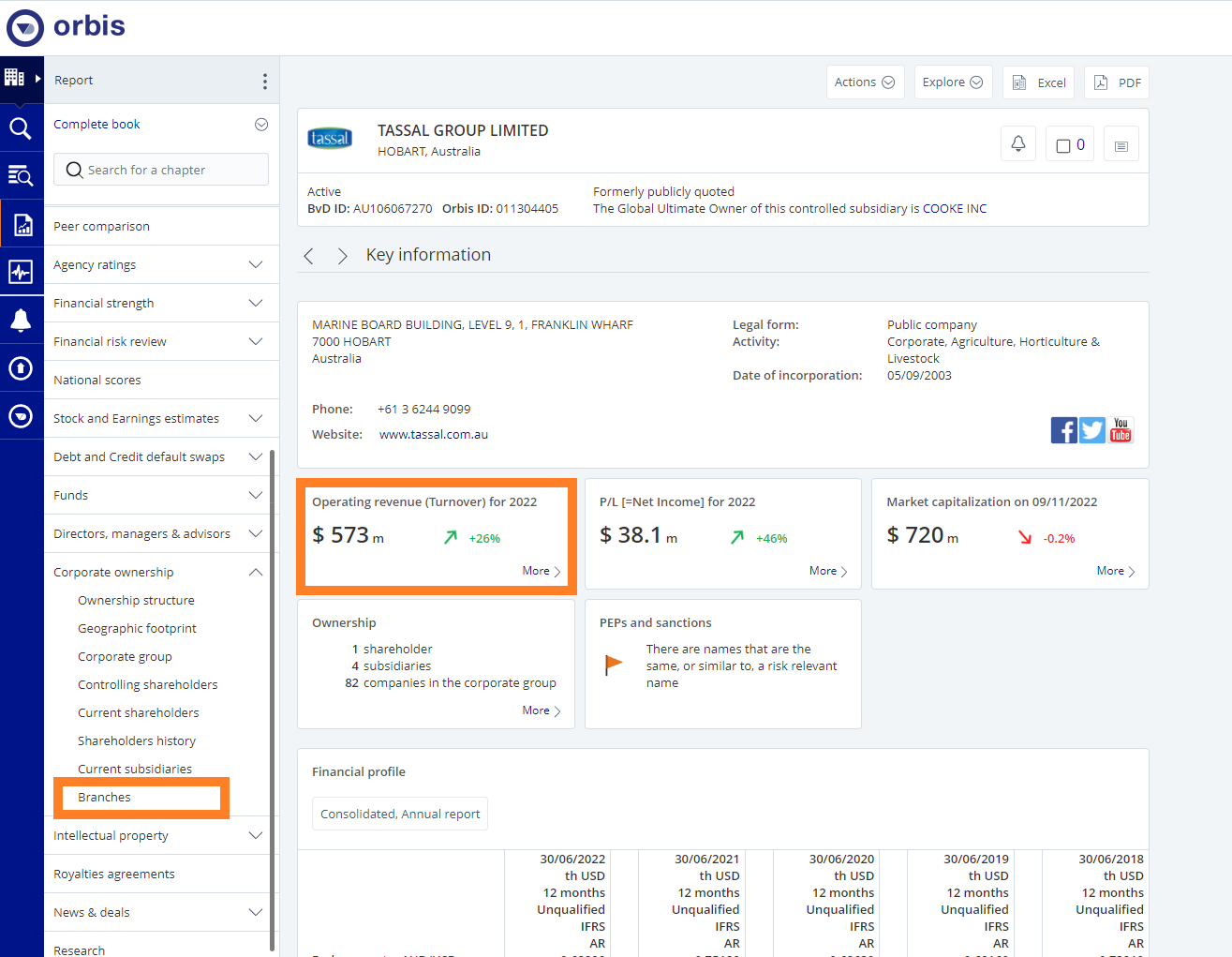
We recommend using the Orbis database to find relevant company information. This includes information to establish whether it’s a major company with revenue above 100 million AUD, and operations in three or more countries.
If you have a company in mind, type its name in the Find a company search box at the top of the page. You will be presented with key information about the company. To find out if its revenue is above 100 million AUD, check under Operating revenue. To find its operations in other countries, navigate to Corporate ownership, and look under Branches. Be sure to explore the other information available from the left-hand menu, including news information.
If you’re not sure which company to select, you can create a search using the following tips:
Limit by turnover
- Under Add a search step click Financials
- Click Key financials & employees on the right
- Enter the minimum operating revenue of 100 (million is the default) in the value field
- Update the currency to AUD at the top right
- Check Include estimates
- Click OK to add to your search
Limit by multiple operations
- Under Add a search step click Ownership
- Click Branches and headquarters
- Click Headquarters on the right
- Enter 3 in the Minimum field for Number of branches
- Click OK to add to your search
Explore the other search steps for more limits to apply, for example Activities and industry or Location. Each search step will be added at the top of the screen, click VIEW RESULTS to see the list of companies.
News sources
News sources can be useful for locating information about companies as well as their social performance. Note that there can be some bias in reporting so consider news sources carefully when using for your assignments.
Finding secondary sources
Now that you know a bit more about the company and how it may be addressing the United Nations (UN) Sustainable Development Goals (SDG’s), you need to find secondary sources that critically confirm or refute its claims.
Search the databases for relevant secondary sources including journal articles, news articles and reports. These may directly relate to your selected company or more broadly address the sustainability and ethical issues faced by businesses.
Recommended databases: Business Source Ultimate, ProQuest, Library catalogue
Recommended source types: Journal articles, Reports, Newspaper articles
Recommended keywords:
- [Your company name] AND corporate social responsibility OR social performance OR responsible business OR ethics
- [Your company name] AND sustainability
- Sustainable development goals AND business ethics
Did you know? When searching in Business Source Ultimate or ProQuest you can limit your search results to academic or scholarly journals. To do this, perform your search, then select from the options in the left hand menu on the search results page.
Evaluating sources
It is important that you evaluate the information you find to ensure the sources you are using are credible. A key consideration when deciding whether to include a source in your assessment is whether the author and the information is credible. As you critically read a text, ask yourself the following questions:
-
Who? Perform an assessment of the author or organisation responsible for the information. Are they suitably qualified to be writing on the topic? Is there evidence of any bias or a conflict of interest?
-
Why? Why was the content created? Is its purpose to inform, persuade, entertain or sell a product? Only giving one side of the story or using emotive or incendiary language could suggest a goal to persuade or manipulate a reader.
-
When? The timeliness of the information is important and many assessment briefs will note a timeframe of publication that is acceptable. You need to know when the information was published or updated and consider this relative to the claims made by a company. Have they only recently updated their policy?
When you are evaluating a source you may need to validate the author’s claims and conclusions by looking for confirmation or support elsewhere on the Internet, a technique known as lateral reading. Watch the video below to learn more about using lateral reading to evaluate information.
</div>
Assessment three - Written reflection
Assessment 3: Written reflection
You are required to produce a written reflection of your learning in this unit this semester across three different aspects, including:
- Indigenous culture, history and the challenges facing Indigenous Australians
- Corporate Social Responsibility (CSR) and the impact it has had on your understanding of responsible business decision-making
- Your behaviour, actions and emotions in relation to your learning.
Reflective Writing
This assessment is a critical reflection on your learning, required to be written in the first person. This helps to focus on your personal experience. Reflective writing tasks at university are a common means of assessment and developing these skills will give you an advantage for future tasks. Remember that you need to analyse your experiences and demonstrate self-awareness throughout your reflection.
The following resources provide information about the reflective writing process, including some do’s and don’ts.
Indigenous Culture, history and challenges facing Indigenous Australians
For part one of this assessment you are required to critically reflect on your understanding and perspectives on Indigenous culture, history and the challenges facing Indigenous Australians.
You should use the sources for assessment one as well as your research and notes for the assessment one case study and your case study submission and feedback.
You must use learning materials from the unit as evidence to support your answer. Refer to the Source List in the Assessment instructions for details about which sources will be most appropriate, for example, assessment feedback, learning materials, published sources from sources for assessment one or otherwise. View the flowchart below to help you decide if you need to reference your source. </div>
Corporate Social Responsibility
For part two of this assessment you are required to critically reflect on your understanding about Corporate Social Responsibility (CSR) and the impact it has had on your understanding of responsible business decision-making.
You should refer to the sources that you located for assessment two as well as your research and notes for the assessment two oral presentation and your submission and feedback.
You must use learning materials from the unit as evidence to support your answer. Refer to the Source List in the Assessment instructions for details about which sources will be most appropriate, for example, assessment feedback, learning materials, published sources from sources for assessment one or otherwise. View the flowchart below to help you decide if you need to reference your source. </div>
Individual cultural and communication skills development
For part three of this assessment you are required to critically reflect on your behaviour, actions and emotions in relation to your learning in this unit this semester. You will be analysing your development of a specific academic skill such as academic writing, oral communication, critical thinking, referencing etc. You will need to refer back to your course materials as directed by the Assessment 3 Requirements.
There are many resources available designed to assist with the development of these skills, that you can draw on for your reflection. The Library’s UniSkills site has modules on academic writing, oral communication, critical thinking, referencing and integrating sources and more.
The Academic Communication Development team also has a good range of Handy Handouts available on these topics and more.
You must use learning materials from the unit as evidence to support your answer. Refer to the Source List in the Assessment instructions for details about which sources will be most appropriate, for example, assessment feedback, learning materials, published sources from sources for assessment one or otherwise. View the flowchart below to help you decide if you need to reference your source. </div>
Referencing
Even though you are writing reflectively, you will still need to provide references for your sources. This flowchart provides guidance on the requirements.
%%{init: {'theme': 'neutral', 'themeVariables': { 'fontSize': '1.5rem', 'fontFamily': 'Arial' }}}%%
flowchart TB

  accTitle: Flowchart to help decide if reference is needed.
  accDescr {
  A reference is needed if your source is
  - from the list of sources given for assessment 1,
  - a journal article,
  - a book,
  - a report or
  - another internet source, etc.
  Where a reference is needed, please use Chicago 18th Author-Date referencing style as defined in UniSkills, adding an in text citation and a reference list entry.
  A reference is not needed if your source is
  - a tutorial activity or discussion,
  - a lecture,
  - assessment feedback,
  - content from your assessment or
  -  a tutorial template.
  Where a reference is not needed, simply mention the source in the text.
  }

  start((("`Do I need a reference for a source? My source is...`")))
  start --> pub_list
  start --> pub_misc
  start --> unpub_misc
  subgraph unpub[" "]
    unpub_misc("`a tutorial activity or discussion,
    a lecture,
    assessment feedback,
    content from your assessment or
    a tutorial template...`") --> unpub_concl
    unpub_concl(("`then you **DO NOT** need a reference.`")) --> unpub_action
    subgraph unpub_action[" "]
      direction LR
      unpub_action_ex("`Mention the source in the text.
      In-text example:
      - I found the **FBL Critical Reading Template** that we filled out and discussed in **Module 2** to be... In particular, the sections about...`")
      style unpub_action_ex text-align: left
    end
  end
  subgraph pub[" "]
    pub_list("fa:fa-external-link-square from source list for assessment one")
    click pub_list "https://uniskills.library.curtin.edu.au/unitguides/ccib/case-study/#recommended-sources" "List of sources for ccib case study" _blank
    pub_list --> pub_concl
    pub_misc("`a journal article,
    a book,
    a report,
    another internet source, etc....`")
    pub_misc --> pub_concl
    pub_concl(("`then you **DO** need a reference.`")) --> pub_action
    subgraph pub_action[" "]
      direction LR
      pub_action_c17("fa:fa-external-link-square Use Chicago 18th Author-Date referencing") --> pub_action_ex
      click pub_action_c17 "https://uniskills.library.curtin.edu.au/referencing/chicago18/introduction/" "Link to Chicago 18th Author-Date referencing style" _blank
      pub_action_ex("`Include an **in-text citation** & **reference list entry**.
      In-text example:
      - When I first read **Shultz (2020)** for the critical reading activity...
      - Watching **John Pilger's (2013)** film helped me to understand...`")
      style pub_action_ex text-align: left
    end
  end

  classDef node_link color:#0d6efd
  class pub_list,pub_action_c17 node_link
  classDef stroke_unpub stroke:#D20347
  class unpub,unpub_misc,unpub_concl,unpub_action,unpub_action_ex stroke_unpub
  classDef node_unpub fill:#E7E7E7
  class unpub_misc,unpub_concl,unpub_action_ex node_unpub
  classDef stroke_pub stroke:#F47F39
  class pub,pub_list,pub_misc,pub_concl,pub_action,pub_action_c17,pub_action_ex stroke_pub
  classDef node_pub fill:#E7E7E7
  class pub_list,pub_misc,pub_concl,pub_action_c17,pub_action_ex node_pub
  classDef node_start fill:#E7E7E7,stroke:#FFAB00
  class start node_start
Writing and referencing
Academic writing skills
The UniSkills platform is designed to help improve your academic assignment, study, numeracy and digital skills. Each module has a sequence of interactive lessons and exercises that can be done in any order that suits you.
This module introduces you to reading techniques, evaluating the sources you have found, reading critically, and note taking.
This module introduces you to the different styles of writing, the structure and mechanics of sentences, how to use punctuation effectively, the elements involved in essay writing, and how to edit and proofread your assignment.
This module guides you through the basics of paraphrasing, summarising and quoting in your academic work.
What is referencing?
Referencing is a standardised method of acknowledging sources of information and ideas that you have used in your assignments, in a way that uniquely identifies their source.
Referencing is an important part of your academic work. Good referencing:
- Demonstrates the depth and quality of your research
- Provides evidence to support the arguments that you are making in your assignment
- Assists the reader to locate the sources that you have referred to
- Acknowledges the work of other researchers and helps to avoid plagiarism.
Referencing style guides
The library provides support for a number of referencing styles. However, for this unit you will need to use Chicago 18th Author-Date style. This guide provides guidance and examples on how to format your references in-text and in your reference list.
A note about EndNote There are tools such as EndNote which can help you develop a research library and reference the sources you cite more easily. However, to use Endnote effectively you need to become familiar with your required referencing style. While EndNote will display references in your selected style, it is not able to recognise incorrect or missing data, so you need to be able to correct any mistakes or inconsistencies in your references.
For this reason you are asked not to use EndNote for your research assignment or essay. Later in your studies, when you know your referencing style, you can explore the use of Endnote.
</div> About UniSkills
UniSkills was created and is maintained by Curtin University Library. To report issues with UniSkills contact Library Help.
Twemoji icons by Twitter, Inc and other contributors, licensed under a CC-BY 4.0 licence.
Except where otherwise noted, UniSkills content in all it’s forms (website, PDFs etc) are licensed under a Creative Commons Attribution ShareAlike 4.0 International Licence. We ask that you attribute any use of the content as created by Curtin University Library with a link to the Library website.
This license does not extend to other Curtin University and Curtin University Library webpages, or to Curtin branding and trademarks. Curtin University’s copyright information is available on the Curtin website.