
Vancouver-referencing-printable-guide-UniSkills.pdf
Vancouver referencing
Table of Contents
Introduction
Vancouver is a numbered referencing style, predominantly used in medical fields. It is based on the AMA manual of Style, 11th edition.
This guide is primarily for students completing assignments at Curtin University. If you are publishing (e.g. journal article, PhD), please consult the above publication as the reference examples provided here may differ from the requirements outlined in the official style guide.
Printable referencing guide
A printable Vancouver referencing guide is available on the UniSkills downloads page.
Note on assignment formatting
Please check your unit outline/Blackboard for assignment formatting requirements (such as fonts, headers, spacing, word counts etc.) and assignment cover sheets. PhD and Masters by research students should consult the relevant publication manual for formatting information. </div> In-text citations
Numbered citations
In the Vancouver style, numbers are used to denote in-text citations in your research paper. Numbers are allocated consecutively to each reference as it is cited for the first time in the text of the assignment (i.e. the first citation that appears in-text is number one, the next unique citation that appears in-text is number 2 and so on). This number becomes the unique identifier of that source and if the source is cited again in-text, the same number is repeated. Vancouver uses superscript numbers in-text, e.g. 1-4,10,12
Placement of in-text citations
Include citations:
- After the author’s name, e.g. Johnson1 explains…
- To the right of commas and full stops, e.g. This is a widely accepted theory.2
- To the left of colons and semi colons, e.g. The study lists the following3: motivation,…
Multiple citations can be inserted at a single point in-text, separated by a comma with no spaces in between, e.g. This issue has been faced by many in the industry.1,2,4,7 When there are three or more consecutive citations, join the first and last in the series with a hyphen, e.g. The condition has been reported in a number of studies.4-7
Page numbers
If citing different pages from a single source at different places in the text, page numbers can be included in the citation and the source listed once in the reference list. Place the page number(s) in brackets directly following the numbered citation. Use p for a single page or pp for multiple pages, e.g. …pain response should be considered.8(p83),9,12(pp3,5)
Please check with your tutor if they require you to provide page numbers for direct quotes.
Author names in-text
If mentioning authors in text, only surnames (family names) are used. For a reference with two authors include both surnames, e.g. Avery and Williams1 highlight the importance of this method. For references with three or more authors, list the first author then et al (meaning and others), e.g. Azar et al2 reported on this association.
Sample paragraph and reference list
In Australia falls are one of the main causes of injury-related hospitalisations, with the elderly representing the majority of cases.1 Accidental falls in older persons can have a detrimental effect on their mental wellbeing.2,3 “The psychological aspects, especially fear of falling, loss of confidence and increased anxiety, can be more disabling than the physical ones.”3(p18) It is therefore important that effective programs are implemented to reduce the incidence of falls.4-6
REFERENCES
- Australian Institute of Health and Welfare. Trends in Hospitalised Injury, Australia: 2007-08 to 2016-17. Australian Institute of Health and Welfare; 2019. INJCAT 204. Accessed November 26, 2020. https://www.aihw.gov.au/reports/injury/trends-in-hospitalised-injury-2007-08-to-2016-17
- Lee F, Mackenzie L, James C. Perceptions of older people living in the community about their fear of falling. Disabil Rehabil. 2008;30(23):1803-1811. doi:10.1080/09638280701669508
- Barker W. Assessment and prevention of falls in older people. Nurs Older People. 2014;26(6):18-24. doi:10.7748/nop.26.6.18.e586
- Sinclair AJ, Morley JE, Vellas B, eds. Pathy’s Principles and Practice of Geriatric Medicine. 5th ed. John Wiley & Sons; 2012. Accessed October 10, 2018. doi:10.1002/9781119952930
- Reznik D. Fall prevention. Am J Nurs. 2013;113(7):12. doi:10.1097/01.NAJ.0000431897.51118.69
- Jones D, Whitaker T. Preventing falls in older people: assessment and interventions. Nurs Stand. 2011;25(52):50-55. https://www.proquest.com/scholarly-journals/preventing-falls-older-people-assessment/docview/893881691/se-2?accountid=10382
See a sample journal article in the Vancouver referencing style:
</div>
Generative Artificial Intelligence (GenAI)
Before using GenAI tools in your assessment, check the unit outline or assessment guidelines, or speak with your unit coordinator to confirm whether GenAI use is permitted. </div>
If you use a GenAI tool, such as ChatGPT, Claude, or Copilot, when completing an assessment, it is recommended to declare your use. Additionally, if you have used GenAI to create content that you include in your work, you must reference this use as a source of information.
Referencing is a standardised way of acknowledging sources such as books, articles, and websites to show that your work is based on credible evidence. GenAI must be cited if used as an information source. This is required in the same way as any other information you include in your work that comes from an external source.
It is important to understand that AI-generated content is considered a non-recoverable source. This means that the content produced is usually not accessible to anyone other than the person who generated it. Unless the GenAI tool provides a shareable link to the chat, other people cannot be directed to the exact location where the content was created. This makes it difficult to verify claims in the same way as traditional sources.
GenAI tools are also not considered scholarly sources at this time. Their responses are created from large training datasets, and the original source of the information is often unknown. For this reason, GenAI outputs should be used with care in academic work.
If the GenAI text discusses theories or specific ideas, you should include additional sources to support them with scholarly research.
If you are allowed to use GenAI in your work, it is good practice to include:
- A written declaration
You should follow your Unit Coordinator’s instructions or use the Library’s declaration template to clearly explain how GenAI supported your work. You may also wish to include the prompts you used as a list or by sharing a link to the chat.
- An in-text citation
This is required if the generated text has been quoted, paraphrased or summarised in your written work.
In-text citation
As there is no entry in the reference list, the details of the tool used should be provided in-text using the following format:
(Communicator, type of communication, Month Day, Year).
In-text example
Fall reduction strategies can only be successful if a multi-faceted approach is adopted, one which addresses both personal and environmental risk factors (ChatGPT, response to question from author, February 22, 2023).
Reference list examples
Author variations
Author variations apply to all reference types (books, journal articles, reports etc.). Author surnames (family names) are followed by their two-letter initials with no space or full stop between the initials, e.g. Smith JA. Commas are used to separate each author’s name, e.g. Khan FM, Gibbons JP.
No author
- If there is no personal author, check to see if an organisation has acted as author. If not, omit the author from the reference and list the title of the item first
Example
Joint replacements should not cost an arm and a leg. The Australian. September 22, 2016;Commentary:13.
One to six authors
- List all authors in the reference
Example
Laycock A, Bailie R, O’Donoghue L. Primary Health Care and Continuous Quality Improvement: an Evidence-Based Guide. Sydney University Press; 2025. Accessed July 6, 2026. http://ebookcentral.proquest.com/lib/curtin/detail.action?docID=32154198
More than six authors
- List the first three authors in the reference followed by et al (meaning and others)
Example
Smith BM, Kirby M, Hoffman EA, et al. Association of dysanapsis with chronic obstructive pulmonary disease among older adults. JAMA. 2020;323(22):2268-2280. doi:10.1001/jama.2020.6918
Organisation as author
- List the organisation name in full
Example
Australian Institute of Health and Welfare. Australian Bushfires 2019-2020: Exploring the Short-Term Health Impacts. Australian Institute of Health and Welfare; 2020. PHE 276. Accessed November 26, 2020. https://www.aihw.gov.au/reports/environment-and-health/short-term-health-impacts-2019-20-bushfires/contents/summary
Title capitalisation
Titles should appear in lower case except for the first letter of the first word, abbreviations, proper names, and names of clinical trials or study groups. </div>
Loganath K, Craig NJ, Everett RJ, et al. Early intervention in patients with asymptomatic severe aortic stenosis and myocardial fibrosis: the EVOLVED randomized clinical trial. JAMA. 2025;333(3):213-221. doi:10.1001/jama.2024.22730
Titles of whole works, such as journals and books, should appear in headline style capitalisation, where all significant words start with a capital letter. </div>
Duckett S. The Australian Health Care System. 6th ed. Oxford University Press; 2022.
Digital Object Identifiers (DOIs)
A Digital Object Identifier (DOI), is a string of numbers, letters and symbols that creates a permanent link to a journal article, book or other online document, e.g. 10.1108/HER-10-2015-0023. In the Vancouver style, DOIs are presented as metadata, not as hyperlinks, e.g. doi:10.1001/jamainternmed.2014.6353
Journal and news articles
Journal titles are abbreviated in the Vancouver style, e.g. New England Journal of Medicine appears as N Engl J Med in the reference list entry. A list of abbreviations is available through PubMed at: https://pubmed.ncbi.nlm.nih.gov/. Click on Journals (under Explore) and enter the full journal title to view its abbreviation. Alternative sources of journal title abbreviations are listed in appendix B of Citing Medicine.
Journal article
Reference components
Author Surname Author Initials. Title of article: subtitle. Abbreviated Journal Title in Italics. Year;Volume(Issue):Page range. doi:DOI or URL
--- **Reference examples** Brook RD, Rajagopalan S. Improving global air-quality indices — the WHO’s new roadmap. _N Engl J Med_. 2026;394(24):2390–2392. doi:10.1056/NEJMp2601256 Steinmetz JD, Seeher KM, Schiess N, et al. Global, regional, and national burden of disorders affecting the nervous system, 1990–2021: a systematic analysis for the Global Burden of Disease Study 2021. _Lancet Neurol_. 2024;23(4):344–381. doi:10.1016/S1474-4422(24)00038-3 Wilkes B, Whop LJ, Thurber KA, Colonna E, Lovett R. Embedding cultural safety to combat racism against Aboriginal and Torres Strait Islander peoples: advice for healthcare settings. _Aust J Gen Pract_. 2026;55(3):91–96. https://www.proquest.com/scholarly-journals/embedding-cultural-safety-combat-racism-against/docview/3331137167/se-2?accountid=10382 Tucker M-A, Meyer A, Bitonti M, Supple M, Cain B. Pharmacist optimization of lipid therapy in patients with peripheral vascular disease. _Am J Health Syst Pharm_. 2024;81(suppl 4):S152-S159. doi:10.1093/ajhp/zxae097Extra tips
- A DOI is preferable to a URL if one is available
- For articles published in a supplement, include suppl and the supplement number or letter in brackets directly following the volume or issue and write the page numbers as they appear on the article, e.g. S152-S159
Journal article with an article number
Reference components
Author Surname Author Initials. Title of article: subtitle. Abbreviated Journal Title in Italics. Year;Volume(Issue):Article number. doi:DOI or URL
--- **Reference examples** D’Aquino S, Kumar A, Riordan B, Callinan S. Long-term effects of alcohol consumption on anxiety in adults: a systematic review. _Addict Behav_. 2024;155:108047. doi:10.1016/j.addbeh.2024.108047 Chomik R, Bates SM, Wright M. Two decades of primary care funding in Australia: a descriptive time-series and distributional analysis. _Med J Aust_. 2026;224(6):e70210. doi:10.5694/mja2.70210Extra tip
- Some online-only journals use article numbers instead of a page range. Replace the page range with the article number in the reference.
</div>
Journal article - Advanced online publication
Reference components
Author Surname Author Initials. Title of article: subtitle. Abbreviated Journal Title in Italics. Published online Month Day, Year. doi:DOI or URL
--- **Reference examples** Li L, Kan F, Su X, Bao D. Association between red cell distribution width and all-cause mortality in patients with congestive heart failure and atrial fibrillation. _Acta Cardiol_. Published online July 1, 2026. doi:10.1080/00015385.2026.2695318 De Sousa KC, Swanepoel DW. Hearing aids for adults with mild to moderate hearing loss. _JAMA_. Published online May 27, 2026. doi:10.1001/jama.2026.4740Extra tip
- Advance online publications are articles that have been accepted for publication and made available online, but haven’t yet been included in an issue of the journal (so do not have a volume, issue or page numbers)
- Before submitting your work, check whether the article has been included in a journal issue and, if it has, update the reference details.
</div>
Newspaper article
Reference components
Reporter Surname Reporter Initials. Title of article. Full Title of Newspaper in Italics. Month Day, Year of article;Section:page. Accessed Month Day, Year. URL
--- **Reference examples** Titelius R. War not wasted on health. _The West Australian_. March 31, 2019;Confidential:33. Careful, medicines can also be poisons. _The Australian_. August 25, 2020;Commentary:10. Accessed November 6, 2020. https://www-proquest-com/docview/2436658973?accountid=10382 Vaccine is ready to roll. _Koori Mail_. March 24, 2021:9. Accessed July 12, 2021. https://aiatsis.gov.au/collection/featured-collections/koori-mailExtra tips
- If referencing a print newspaper omit the Access date and URL
- If there is no author, omit the author from the reference and list the title of the article first.
</div>
</div>
Books
Entire book
Reference components
Author Surname Author Initials. Title of Book in Italics. # ed. Publisher; Publication Year. Accessed Month Day, Year. doi:DOI or URL
--- **Reference examples** Katsagoni CN, Kokkinos P, Sidossis LS. _Prevention and Management of Cardiovascular and Metabolic Disease: Physical Activity, Fitness and Healthy Aging_. John Wiley & Sons; 2023. Accessed July 6, 2026. doi:10.1002/978111983347 Whitney E, Rolfes SR, Crowe T. _Understanding Nutrition_. 5th ed. Cengage Learning Australia; 2022. Accessed July 6, 2026. http://ebookcentral.proquest.com/lib/curtin/detail.action?docID=7120461 Madison K, Horsfall J. _Kimberley Bush Medicine: Medicinal Plants of the Kimberley Region of Western Australia_. UWA Publishing; 2023.Extra tips
- A DOI is preferable to a URL if one is available
- If referencing a print book, omit access date and URL/DOI
- For editions other than the first, enter the edition after the title e.g. 8th ed.
Chapter in an edited book
Reference components
Chapter Author Surname Author Initials. Title of chapter. In: Editor Surname Editor Initials, ed. Title of Book in Italics. # ed. Publisher; Publication Year:Chapter page range. Accessed Month Day, Year. doi:DOI or URL
--- **Reference examples** Riddle M, Taylor WD. Structural changes in the aging brain. In: Etkin A, Hantke N, O'Hara R, eds. _Handbook of Mental Health and Aging_. 3rd ed. Elsevier; 2020:59-70. Accessed November 6, 2020. http://ebookcentral.proquest.com/lib/curtin/detail.action?docID=6183701 Caballero R, Delpón E, Tamargo J. Drug interactions of antiarrhythmic drugs. In: Martínez-Rubio A, Tamargo J, Dan G.-A, eds. _Antiarrhythmic Drugs_. 2nd ed. Springer; 2024:311-341. Accessed July 6, 2026. https://doi.org/10.1007/978-3-031-74046-6 Cain JJ, Clauson KA, Fox BI. Digital communication in healthcare. In: Beardsley R, Skrabal MZ, Kimberlin CL, eds. _Communication Skills in Pharmacy Practice: A Practical Guide for Students and Practitioners_. 7th ed. Wolters Kluwer; 2020:189-209.Extra tips
- A DOI is preferable to a URL if one is available
- If referencing a print book, omit access date and URL/DOI
- For editions other than the first, enter the edition after the title e.g. 8th ed.
</div>
Thesis
Reference components
Author Surname Author Initials. Title of Thesis in Italics. Dissertation or Master’s thesis. University; Publication Year. Accessed Month Day, Year. URL
--- **Reference examples** Czarniak P. _Issues With the Use of Medicines in Paediatrics: Off-label and Unlicensed Use, and Formulation Uncertainty_. Dissertation. Curtin University; 2014. Accessed December 6, 2019. http://hdl.handle.net/20.500.11937/554 Smith C. _The Development and Validation of the Breast Lymphoedema Severity Symptom (BLYSS) Questionnaire_. Master's thesis. Curtin University; 2013. Accessed January 16, 2020. http://hdl.handle.net/20.500.11937/1022Extra tips
- If referencing a print thesis, omit the access date and URL/DOI
</div>
Conference paper or poster
Reference components
Author Surname Author Initials. Title of paper. Paper presented at: Name of Conference; Month Day(s), Year of conference; Place of conference. Accessed Month Day, Year. doi:DOI or URL
--- **Reference example** Fredericks J, Lawrence C. #thisismymob: preserving and promoting Indigenous Australian cultural heritage. Paper presented at: MobileCH 2018; September 3, 2018; Barcelona, Spain. Accessed December 15, 2022. http://ceur-ws/Vol-2176/paper3.pdfExtra tip
- If citing a poster, substitute Poster presented at:
</div>
</div>
Health resources
Cochrane Review
Reference components
Author Surname Author Initials. Title of review. Cochrane Database Syst Rev in Italics. Year;(Issue):Article No. doi:DOI
--- **Reference example** Sanders SL, Agwan S, Hassan M, Bont LJ, Venekamp RP. Immunoglobulin treatment for hospitalised infants and young children with respiratory syncytial virus infection. _Cochrane Database Syst Rev_. 2023;(10):CD009417. doi:10.1002/14651858.CD009417.pub3Online reference works (AMH, Martindale, MIMS, UpToDate)
Reference components
Author Surname Author Initials or Organisation Name. Title of entry. Name of the Source. Month Day, Year published. Updated Month Day, Year. Accessed Month Day, Year. URL
--- **Reference examples** Amoxicillin. Australian Medicines Handbook. Updated July, 2020. Accessed November 12, 2020. https://amhonline-amh-net-au.eu1.proxy.openathens.net/chapters/anti-infectives/antibacterials/penicillins/amoxicillin Royal Pharmaceutical Society. Malaria (anitmalarials). Martindale: The Complete Drug Reference. Updated April 19, 2017. Accessed November 12, 2020. https://www.medicinescomplete.com/#/content/martindale/1370-a5-1-b?hspl=malaria MIMS Australia. Alphamox. MIMS Online. Updated November, 2020. Accessed November 12, 2020. https://www-mimsonline-com-au.eu1.proxy.openathens.net/ Feldweg AM, Kelso JM, TePas E. Exercise-induced anaphylaxis: management and prognosis. UpToDate. Updated January 15, 2020. Accessed November 12, 2020. https://www.uptodate.com/contents/exercise-induced-anaphylaxis-management-and-prognosis</div>
</div>
Websites and social media
Webpage on a website
Reference components
Author Surname Author Initials or Organisation Name. Title of the webpage. Name of the website. Month Day, Year published. Updated Month Day, Year. Accessed Month Day, Year. URL
--- **Reference examples** Australian IndigenousHealthInfoNET. Environmental health. Australian IndigenousHealthInfoNET. Accessed July 7, 2026. https://healthinfonet.ecu.edu.au/learn/determinants-of-health/environmental-health/ Maddison M, Cassidy T. Type 1 diabetes causes widely misunderstood, sufferers say, with sugar shaming a 'trigger.' ABC News. July 17, 2020. Updated October 28, 2020. Accessed January 21, 2021. https://www.abc.net.au/news/2020-07-17/fighting-misconceptions-about-type-1-diabetes/12460244Extra tips
- Omit author if not provided on the webpage
- If there is no date of publication or last update/revision date, omit these from the reference
- If referring to a book, journal article or report on a website, cite using these formats not as a web page
YouTube or streaming video
Reference components
Author Surname Author Initials. Title of Video in Italics. Source. Month Day, Year published. Accessed Month Day, Year. URL
--- **Reference examples** Raskopoulos J. _Living with High Functioning Anxiety_. TEDxSydney. June 16, 2017. Accessed July 12, 2021. https://tedxsydney.com/talk/living-with-high-functioning-anxiety-jordan-raskopoulos/ McCormack J. _Viva La Evidence_. YouTube. August 22, 2013. Accessed September 24, 2020. https://www.youtube.com/watch?v=QUW0Q8tXVUc</div>
Blog post
Reference components
Author Surname Author Initials. Title of post. Name of Blog in Italics blog. Month Day, Year of post. Accessed Month Day, Year. URL
--- **Reference example** Strakosch C. Regional connectivity: more than an affordable internet connection. _Good Things Foundation Australia_ blog. February 25, 2020. Accessed September 24, 2020. https://www.goodthingsfoundation.org.au/news-and-blogs/blog/regional-connectivity-more-affordable-internet-connection</div>
Reference components
Title of Facebook page. Text of the post. Month Day, Year of post. Accessed Month Day, Year. URL
--- **Reference example** World Health Organization Facebook page. Today is World Alzheimer's Day. Alzheimer's disease is the most common cause of dementia. There are nearly 10 million new cases of dementia every year - that's one case every 3 seconds. September 20, 2020. Accessed September 24, 2020. https://www.facebook.com/WHO</div>
Reference components
Twitter username. Text of the post. Month Day, Year of post. Accessed Month Day, Year. URL
--- **Reference example** @WHO. #Rabies immunization should also be considered for children living in, or visiting, remote, high-risk areas. As they play with animals, they may receive more severe bites, or may not report bites. September 23, 2020. Accessed September 24, 2020. https://twitter.com/WHO/status/1308465339467005952</div>
Podcast
Reference components
Host. Name of Podcast in Italics. Title of episode. Month Day, Year of episode. Accessed Month Day, Year. URL
--- **Reference example** Malcolm L. _All in the Mind_. Tripping for depression. September 16, 2018. Accessed November 11, 2020. http://www.abc.net.au/radionational/programs/allinthemind/tripping-for-depression/10223006</div>
</div>
Reports and legislation
Government or organisation report
Reference components
Author Surname Author Initials or Organisation Name. Title of Report in Italics. Publisher Name; Year. Report Number. Accessed Month Day, Year. URL
--- **Reference examples** Australian Institute of Health and Welfare. _Non-Medical Use of Pharmaceuticals: Trends, Harms and Treatment, 2006-07 to 2015-16_. Australian Institute of Health and Welfare; 2017. HSE 195. Accessed September 25, 2020. https://www.aihw.gov.au/reports/illicit-use-of-drugs/non-medical-use-pharmaceuticals/contents/table-of-contents World Health Organization. _The World Health Report 2013: Research for Universal Health Coverage_. World Health Organization; 2013. Accessed September 25, 2020. https://www.who.int/whr/2013/report/en/ Australian Bureau of Statistics. _Alcohol Consumption_. Australian Bureau of Statistics; 2023. Accessed July 7, 2026. https://www.abs.gov.au/statistics/health/health-conditions-and-risks/alcohol-consumption/2022Extra tips
- If there is no report number, omit this from the reference
- If referencing a print report, omit the accessed date and the URL/DOI
- If the publisher name includes the word Department abbreviate to Dept
Act of Parliament
Reference components
Title of Act Year (Jurisdiction). Accessed Month Day, Year. URL
--- **Reference example** Mental Health Act 2014 (WA). Accessed June 23, 2020. https://www.legislation.wa.gov.au/legislation/statutes</div>
Case
Reference components
Case Name (Year) volume number Law Report Series starting page.
--- **Reference example** The State of New South Wales v. The Commonwealth (1915) 20 CLR 5.</div>
</div>
Tables & figures
These instructions for referencing tables and figures are primarily for students completing assignments at Curtin University. They are not intended for those who are publishing their work and making it publicly available (e.g. PhD thesis, journal article, blog, webpage, YouTube video etc.). When publishing and making your work publicly available, written permission to reproduce tables and figures must be obtained from the copyright holder. More information is available from Copyright at Curtin and the AMA manual of style. </div>
What are tables and figures?
- Tables are numerical values or text displayed in rows and columns.
- Figures are any graphical display used to present information, such as a chart, map, graph, photograph, illustration, digital image, clinical image, etc.
See below for examples of tables and figures.
Adapting or reproducing a published table or figure
When you are adapting (altering from the original) or reproducing (directly copying) a table or figure from another source in your work.
Above the table or figure:
- Write Table or Figure followed by the number and a full stop, in bold (e.g. Table 1. or Figure 1.). Number sequentially according to their order of appearance in the text of your work. If there is only a single table or figure in your paper, label as Table or Figure without the number. Tables and figures are numbered separately.
- Include a brief descriptive title phrase following the table or figure number. The title should be in headline style capitalisation (where each significant word is capitalised) and not in bold.
- Place a line across the width of the table or figure, between the assignment text and the title of the table or figure.
Below the table or figure:
- A legend (if needed) written in sentence format containing information that describes the table or figure beyond the title
- Footnotes may be provided in the legend to give further information about specific data in a table or figure. The order of the footnotes follows their appearance in the table or figure and uses superscript lowercase letters in alphabetical order (a-z) (see Table 2)
- If reproducing a published table or figure, the original source should be cited in the legend with a note to explain the source of the data, e.g. Reproduced from, Adapted from, Data were derived from etc.
- Include any relevant copyright or Creative Commons (CC) licence information, e.g. Reproduced under a CC BY 4.0 licence from Cobiac et al.1
- If the source has specific requirements or terminology for providing acknowledgement, this should be included in the legend
- Citations should be numbered according to their appearance in the text, tables or figures. If you have previously cited a source in the text and cite again in the table or figure, repeat with the same number.
Reference list:
- Include an entry for the source of the table or figure in the reference list.
In text:
- Tables and figures should be placed as close as possible to the text discussing it. Refer to the table or figure by its number, e.g. Figure 1 shows the use of alcohol-based hand rub. OR Use of alcohol-based hand rub is important in surgical settings (Figure 1).
Example of a table adapted from a journal article
Table 1. Food Tax and Subsidy Interventions
| Intervention | Tax or subsidy | Sources and assumptions |
|---|---|---|
| Saturated fat tax | $1.37/100 g of saturated fat | Tax on saturated fat content in foods with >2.3% saturated fat, excluding drinking milk |
| Excess salt tax | $0.30/1 g of sodium | Tax on sodium in excess of Australian maximum recommended levels, excluding fresh fruits, vegetables, meats, and dairy products |
| Sugar-sweetened beverage tax | $0.47/l | Tax on sugar-sweetened soft drinks, energy drink, cordials, and fruit drinks |
| Fruit and vegetable subsidy | $0.14/100 g | Subsidy on all fresh and preserved fruits and vegetables |
| Sugar tax | $0.94/100 ml of ice cream; $0.85/100 g of sugar | Tax on ice cream containing >10 g of sugar per 100 g of ice cream; tax on sugar content in excess of 10 g per 100 g of all other products, excluding fresh fruits, vegetables, and unflavoured dairy products |
All currency amounts are shown in Australian dollars. Adapted under a CC BY 4.0 licence from Cobiac et al.1
Example of a figure reproduced from a report
Figure 1. Cultural Safety and Responsiveness Training for Staff
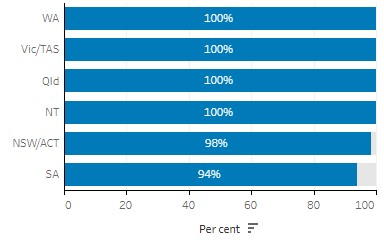
Proportion of Indigenous-specific primary health care organisations and maternal/child health services that had cultural orientation for non-Indigenous staff, by state and territory, 2017-18. Source: Australian Institute of Health and Welfare2 under a CC-BY 3.0 licence.
Note: Source: Australian Institute of Health and Welfare is the acknowledgement required by the licence
Example of a table adapted from a webpage
Table 2. Australian Workforce Statistics by Health Profession
| Profession | 2013 | 2018 | % change |
|---|---|---|---|
| Allied healtha | 108,680 | 133,388 | 22.7 |
| Dental practitionersb | 17,847 | 20,589 | 15.4 |
| Medical practitioners | 82,408 | 98,395 | 19.4 |
| Nurses and midwives | 295,060 | 333,970 | 13.2 |
Data based on Australian Institute of Health and Welfare3 material under a CC-BY 3.0 licence.
aAllied health professionals include Aboriginal and Torres Strait Islander health practitioners, chiropractors, Chinese medicine practitioners, medical radiation practitioners, occupational therapists, optometrists, osteopaths, pharmacists, physiotherapists, podiatrists and psychologists.
bDental practitioners include oral health therapists, dental hygienists, dental therapists, dental prosthestists and dentists.
Note: To save space, tables with more than a few footnotes can also use two columns for the footnotes
Example of a figure reproduced from a chapter in an edited book
Figure 2. Pocket Bottles Filled with Alcohol-Based Hand Rub for Hand Hygiene in ICUs
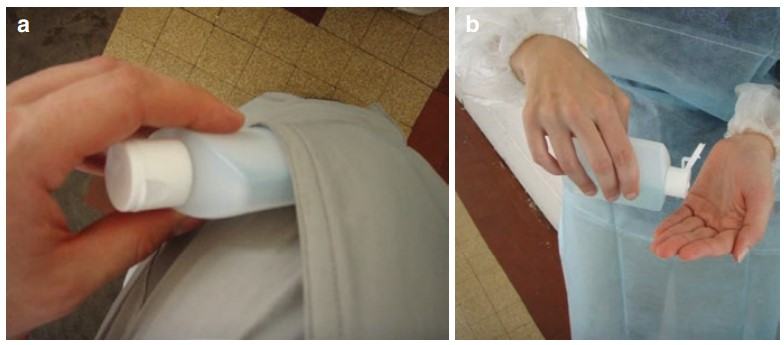
Reproduced from Shultz et al4 under a CC-BY 4.0 licence.
Using published data when creating a table or figure
When creating your own tables and figures from published data (e.g. using data from a report, journal article, book, etc.), a citation and reference list entry is usually sufficient acknowledgement of the source. Depending on how the information is presented, the superscript citation(s) can be included as part of the table or figure, or appear below it. To avoid confusion, superscript citations should not be placed directly after a number in the table or figure, e.g. 216,170 people6 not 216,17066
Above the table or figure:
- Write Table or Figure followed by the number and a full stop, in bold (e.g. Table 1. or Figure 1.). Number sequentially according to their order of appearance in the text of your work. If there is only a single table or figure in your paper, label as Table or Figure without the number. Tables and figures are numbered separately.
- Include a brief descriptive title phrase following the table or figure number. The title should be in headline style capitalisation (where each significant word is capitalised) and not in bold.
- Place a line across the width of the table or figure, between the assignment text and the title of the table or figure.
Below the table or figure:
- A legend (if needed) written in sentence format containing information that describes the table or figure beyond the title
- Footnotes may be provided in the legend to give further information about the specific data in a table or figure. The order of the footnotes follows their appearance in the table or figure and uses superscript lowercase letters in alphabetical order (a-z)
- If a citation and footnote follow the same piece of information, give the citation first, followed by a comma and the footnote letter, e.g. Patient characteristics3,a
- Citations should be numbered according to their appearance in the text, tables or figures. If you have previously cited a source in the text and cite again in the table or figure, repeat with the same number.
Reference list:
- Include a reference list entry for each source cited in the table or figure.
In text:
- Tables and figures should be placed as close as possible to the text discussing it. Refer to the table or figure by its number, e.g. Figure 1 shows the use of alcohol-based hand rub. OR Use of alcohol-based hand rub is important in surgical settings (Figure 1).
Example of a table with information from multiple sources
Table 3. Indigenous Specific Primary Health Care (PHC) Organisations, by Selected States 2016
| State | No. of Indigenous specific organisations5 | Total Indigenous population |
|---|---|---|
| NSW / ACT | 43 (22% of PHC organisations) | 216,170 people6 |
| WA | 26 (13% of PHC organisations) | 75,976 people7 |
Using your own table or figure
When you have created your own table or figure to present your own research or data.
Above the table or figure:
- Write Table or Figure followed by the number and a full stop, in bold (e.g. Table 1. or Figure 1.). Number sequentially according to their order of appearance in the text of your work. If there is only a single table or figure in your paper then label as Table or Figure without the number. Tables and figures are numbered separately.
- Include a brief descriptive title phrase following the table or figure number. The title should be in headline style capitalisation (where each significant word is capitalised) and not in bold.
- Place a line across the width of the table or figure, between the assignment text and the title of the table or figure.
Below the table or figure:
- A legend (if needed) written in sentence format containing information that describes the table or figure beyond the title
- Footnotes may be provided in the legend to give further information about the specific data in a table or figure. The order of the footnotes follows their appearance in the table or figure and uses superscript lowercase letters in alphabetical order (a-z).
Reference list:
- No reference list entry required as you are reporting your own research.
In text:
- Tables and figures should be placed as close as possible to the text discussing it. Refer to the table or figure by its number, e.g. Figure 1 shows the use of alcohol-based hand rub. OR Use of alcohol-based hand rub is important in surgical settings (Figure 1).
Example of your own figure
Figure 3. Therapy Dogs Provide Support to Students

Reference list
Include a reference list entry for each source.
REFERENCES
- Cobiac LJ, Tam K, Veerman L, Blakely T. Taxes and subsidies for improving diet and population health in Australia: a cost-effectiveness modelling study. PLoS Med. 2017;14(2):e1002232. doi:10.1371/journal.pmed.1002232
- Australian Institute of Health and Welfare. Cultural Safety in Health Care for Indigenous Australians: Monitoring Framework. Australian Institute of Health and Welfare; 2021. IHW 222. Accessed August 25, 2021. https://www.aihw.gov.au/reports/indigenous-australians/cultural-safety-health-care-framework
- Australian Institute of Health and Welfare. Health workforce. AIHW. July 23, 2020. Updated January 7, 2021. Accessed September 15, 2021. https://www.aihw.gov.au/reports/australias-health/health-workforce
- Shultz MJ, Dunser MW, Dondorp AM. Development of the guidelines: focus on availability, feasibility, affordability, and safety of interventions in resource-limited settings. In: Dondorp AM, Dunser MW, Shultz MJ, eds. Sepsis Management in Resource-Limited Settings. Springer; 2019:25-30. Accessed September 15, 2021. doi:10.1007/978-3-030-03143-5
- Australian Institute of Health and Welfare. Aboriginal and Torres Strait Islander Specific Primary Health Care: Results from the nKPI and OSR Collections. Australian Institute of Health and Welfare; 2021. IHW 227. Accessed September 20, 2021. https://www.aihw.gov.au/reports/indigenous-australians/indigenous-primary-health-care-results-osr-nkpi/what-are-indigenous-specific-primary-health-care-services/organisations
- Australian Bureau of Statistics. 2016 Census: Aboriginal and/or Torres Strait Islander QuickStats: New South Wales. Australian Bureau of Statistics. October 23, 2017. Accessed September 20, 2021. https://quickstats.censusdata.abs.gov.au/census_services/getproduct/census/2016/quickstat/IQS1
- Australian Bureau of Statistics. 2016 Census: Aboriginal and/or Torres Strait Islander QuickStats: Western Australia. Australian Bureau of Statistics. October 23, 2017. Accessed September 20, 2021. https://quickstats.censusdata.abs.gov.au/census_services/getproduct/census/2016/quickstat/IQS5
</div></div> About UniSkills
UniSkills was created and is maintained by Curtin University Library. To report issues with UniSkills contact Library Help.
Twemoji icons by Twitter, Inc and other contributors, licensed under a CC-BY 4.0 licence.
Except where otherwise noted, UniSkills content in all it’s forms (website, PDFs etc) are licensed under a Creative Commons Attribution ShareAlike 4.0 International Licence. We ask that you attribute any use of the content as created by Curtin University Library with a link to the Library website.
This license does not extend to other Curtin University and Curtin University Library webpages, or to Curtin branding and trademarks. Curtin University’s copyright information is available on the Curtin website.