
IEEE-referencing-printable-guide-UniSkills.pdf
IEEE referencing
Table of Contents
Introduction
IEEE is a numeric style of referencing, predominantly used in electrical engineering, computer science, and other technical fields. It is based on the IEEE Referencing Guide created and managed by the Institute of Electrical and Electronics Engineers (IEEE).
This guide is primarily for students completing assignments at Curtin University. If you are publishing (e.g., journal article, PhD), please consult the above publication as the reference examples provided here may differ from the requirements outlined in the official style guide.
What is referencing?
Referencing is a standardised method of acknowledging sources of information that you have used in your assignments or research, in a way that uniquely identifies the source. It is not only necessary for avoiding plagiarism, but also for supporting your ideas and arguments.
Printable referencing guide
A printable IEEE referencing guide is available on the UniSkills downloads page.
Note on assignment formatting
Please check your unit outline/Blackboard for assignment formatting requirements (such as fonts, headers, spacing, word count etc.) and assignment cover sheets. PhD and Master by research students should consult the relevant publication manual for formatting information. </div>
In-text citations explained
In-text citations are included throughout your writing, to acknowledge the sources of information you have used to build and support your ideas. In the IEEE style, numbers are used to denote in-text citations in your work. Numbers are allocated consecutively to each reference when cited for the first time in the text of the assignment (i.e., the first citation that appears in-text is number one, the next unique citation that appears in-text is number 2 and so on). This number becomes the unique identifier of that source and if the source is cited again in-text, the same number is used.
IEEE uses numbers in square brackets in-text, e.g., [1], [2], [3]. Grammatically, these numbers can be used as footnotes or as nouns.
Examples:
Footnote numbers
The theory was first put forward in 1987 [1].
Smith [2] has argued …
Several recent studies [1], [3], [4], [10], [12] have suggested…
Nouns
As seen in [2] …
According to [4] and [6]-[8] …
In contrast to [5, p. 7], it is evident that …
Quoting
Quoting is when you copy the exact words from another source into your work.
- Include the relevant page inside the square brackets after the citation number, a comma, and a space.
- If quoting a range of pages, include the range in the square brackets separated by a hyphen, after the citation number, a comma, and a space.
- If a source you’re quoting does not contain page numbers, like a website, you are not expected to include page numbers.
Examples:
“Primary energy demand is mainly satisfied by fossil fuels, which has pushed them to the brink of depletion” [1, p. 64].
OR
Deshmukh [1, p. 64] states “primary energy demand is mainly satisfied by fossil fuels…”
OR
As seen in [1, p. 64], “primary energy demand is mainly satisfied by fossil fuels…”
OR, for a range
“Primary energy demand is mainly satisfied by fossil fuels, which has pushed them to the brink of depletion. To decelerate the fast depletion of mineral sources of fuels, it is crucial to seek alternative resources that are renewable and sustainable in nature.” [1, pp. 64-65].
Multiple authors
If a source has two authors and you want to use an author prominent citation, include both authors. If a source has three or more authors, the first author should be named, followed by et al. This would then be followed by the citation number.
Examples:
As outlined by Amador-Perez and Rodriguez-Solis [2] …
Jahn et al. [3] states …
Multiple sources
When citing multiple sources, include separate citation numbers for each source. These can also be grouped as a range if the citation numbers are consecutive.
Examples:
Both [3] and [5] discuss the need for emergency backup power sources.
Power system blackouts can be caused in many varied ways. [3-5]
Generative Artificial Intelligence (GenAI)
Before using GenAI tools in your assessment, check the unit outline or assessment guidelines, or speak with your unit coordinator to confirm whether GenAI use is permitted. </div>
If you use a GenAI tool, such as ChatGPT, Claude, or Copilot, when completing an assessment, it is recommended to declare your use. Additionally, if you have used GenAI to create content that you include in your work, you must reference this use as a source of information.
Referencing is a standardised way of acknowledging sources such as books, articles, and websites to show that your work is based on credible evidence. GenAI must be cited if used as an information source. This is required in the same way as any other information you include in your work that comes from an external source.
It is important to understand that AI-generated content is considered a non-recoverable source. This means that the content produced is usually not accessible to anyone other than the person who generated it. Unless the GenAI tool provides a shareable link to the chat, other people cannot be directed to the exact location where the content was created. This makes it difficult to verify claims in the same way as traditional sources.
GenAI tools are also not considered scholarly sources at this time. Their responses are created from large training datasets, and the original source of the information is often unknown. For this reason, GenAI outputs should be used with care in academic work.
If the GenAI text discusses theories or specific ideas, you should include additional sources to support them with scholarly research.
If you are allowed to use GenAI in your work, it is good practice to include:
- A written declaration
You should follow your Unit Coordinator’s instructions or use the Library’s declaration template to clearly explain how GenAI supported your work. You may also wish to include the prompts you used as a list or by sharing a link to the chat.
- An in-text citation and reference list entry
This is required if the generated text has been quoted, paraphrased or summarised in your written work.
Referencing
AI-generated content is treated as an unpublished private communication in the IEEE style. It should be cited in-text and correspond to an entry in the reference list.
In-text citation
Assign a number in square brackets, as you would with any other in-text citation. For example, an information prominent citation would be:
[2].
And an author prominent citation would be:
According to ChatGPT [2]…
If quoting
Use quotation marks to distinguish between your own words and the words generated by the tool:
Both Macs and PCs are widely used in households throughout Australia; and while the debate over which one is better continues “both platforms have evolved, and the gap between them has narrowed in terms of hardware and software capabilities” [2].
Reference list
Reference components
[Source citation number] Name of tool used, “Prompt”, date, abbreviated Month. year.
**Example** [2] ChatGPT, "Are Macs better than PCs?", 30 Nov. 2023.</div> Reference list format
Author variations
The author variations below apply to all reference types (books, journal articles, websites, etc.).
For reference list entries:
- The given name of the author or editor is abbreviated to the initial only, followed by a full stop, a space, and the surname (last name), e.g. Jane Smith appears as J. Smith
- If a middle name or initial is included, it appears after the first initial with a space in between, e.g., J. A. Smith
- Include a comma after each author and use the word ‘and’ before the last author’s name (e.g., J. Smith, A. Taylor, and K. Mason). There is a variation to this for more than six authors.
- Do not use commas around Jr., Sr., and III in names, e.g., J. Smith Jr.; R. J. Taylor Sr.; D. Clements II.
- List authors in the order they appear on the source you are referencing.
No author
If no personal author is given, check to see if an organisation has acted as the author. Where there are no authors and you are sure that your source is credible, use the title of the work in place of the author in the reference list.
Reference examples
Organisation as author
| [1] | United Nations Development Programme. “UN-Energy.” UNDP.org. Accessed: Jan. 8, 2024. [Online.] Available: https://www.undp.org/energy/change-network/un-energy |
Title of work in place of the author
| [1] | “Tonnes of cargo wash up on NSW beaches after stricken ship sheds load.” heraldsun.com.au. Accessed Jan. 9, 2024. [Online.] Available: https://www.heraldsun.com.au/news/national/tonnes-of-cargo-wash-up-on-nsw-beaches-after-stricken-ship-sheds-load/news-story/4a0e4744d4e1c0c8614c2347591b81bb |
One to six authors
List all names in the order they are given. Separate each name by a comma, and type and before the last name.
Reference example
| [1] | R. Fowler, O. Elmhirst and J. Richards, “Electrification in the United Kingdom: A Case Study Based on Future Energy Scenarios,” IEEE Power and Energy Mag., vol. 16, no. 4, pp. 48-57, July-Aug. 2018. doi: 10.1109/MPE.2018.2822864. |
More than six authors
If there are more than six authors, use the first author’s name followed by et al.
Reference example
| [1] | C. Breyer et al., “On the History and Future of 100% Renewable Energy Systems Research,” IEEE Access, vol. 10, pp. 78176-78218, Jul. 2022. doi: 10.1109/ACCESS.2022.3193402 |
Datasets and data sheets
Dataset
Reference components
| [Source citation number] | Author’s initial(s), Surname, abbreviated Month Day, Year of publication, “Title of Dataset,” distributed by Publisher/Distributor, URL or DOI. |
Data sheet
Reference components
| [Source citation number] | Company Name, “Title of Data sheet,” Data Sheet number, Date of Publication [Revised date] |
</div>
Material Safety Data Sheet (MSDS)
Reference components
| [Source citation number] | Title of MSDS/SDS in Italics; Number of MSDS/SDS [Print or Online]; Name of Manufacturing Company: Location of Company, Date of Publication, URL (accessed abbreviated month. day, year). |
</div> </div>
Conference papers
Papers in print
Reference components
| [Source citation number] | Author initial(s). Surname, “Title of paper,” in Abbreviated Name of Conference., location of conference (optional), Month and day(s) if provided, year, page range. |
Online papers
Reference components
| [Source citation number] | Author initial(s). Surname, “Title of paper,” in Abbreviated Name of Conference., location of conference (optional), year, page range (if provided), doi: |
</div>
Presented at a conference (unpublished)
Reference components
| [Source citation number] | Author initial(s). Surname, “Title of paper,” presented at the Abbreviated name of Conference in italics, City of Conference, Abbrev. State, Country, Month and day(s), year, Paper number (if provided), page range. |
</div>
</div>
Reports and standards
Government or organisation report
Reference components
| [Source citation number] | Author’s initial(s). Surname, “Title of report,” Abbreviated Name of Company or Institution., City, State, Country, Report Number, date. [Online]. Available: URL |
Standards online
Reference components
| [Source citation number] | Title of Standard in Italics, Standard number, Corporate author, location, date. [Online]. Available: URL |
</div>
</div>
Manuals and software
Online manual
Reference components
| [Source citation number] | Abbreviated Name of Company., City of Company, State, Country. Name of Manual/Handbook in Italics, edition number ed. (year). Accessed: Month. Day, Year. [Online]. Available: URL |
Print manual
Reference components
| [Source citation number] | Name of Manual/Handbook in Italics, edition number in italics ed., Abbreviated name of Company., City of Company., State, Country, year, pp. page range. |
</div>
Software
Reference components
| [Source citation number] | Author’s initial(s). Surname. Title of Software in Italics. Date Repository or Archive. (version or year). Publisher Name. Accessed: Date (if applicable). [Type of Medium]. Global Persistent Identifier. Available: site/path/file |
</div> </div>
Books
Entire book
Reference components
| [Source citation number] | Author initial(s). Surname, Title of the Book in Italics, # ed. City of Publisher, State (USA only), Country: Abbreviation of Publisher, year, chapter number ch. #, section number sec. # (if provided), page range pp. ###-###. |
Chapter in an edited book
Reference components
| [Source citation number] | Author initial(s). Surname, “Title of chapter in the book”, in Title of the Book in Italics, editor initial(s). editor surname, Ed., City of Publisher, State (USA only), Country: Abbreviation of Publisher, year, pp. ###-###. |
</div>
eBook
Reference components
| [Source citation number] | Author initial(s). Surname, “Title of chapter in the book.” in Title of the Book in Italics, # ed. City of Publisher, State (USA only), Country: Abbreviation of Publisher, year, ch. #, sec. #, pp. ###-###. [Online]. Available: URL doi: (if available). |
</div>
Thesis
Reference components
| [Source citation number] | Author initial(s). Surname, “Title of thesis,” [Doctoral dissertation or Master’s thesis], Abbreviated Dept., Abbreviated Univ., City of Univ., Abbreviated State, year. [Online]. Available: URL |
</div>
</div>
Journals
Journal article
Reference components
| [Source citation number] | Author’s initial(s). Surname, “Name of paper,” Abbreviated Title of Journal in italics., vol. volume number, no. issue number, pp. page range, abbreviated month. year, doi: |
IEEE Transactions journals
Reference components
| [Source citation number] | Author’s initial(s). Surname, “Name of paper,” IEEE Trans. Abbreviated Title of Journal in Italics., vol. volume number, no. issue number, page range, abbreviated month. year, doi: |
</div>
</div>
Websites and social media
Websites
Reference components
| [Source citation number] | Author’s initial(s). Surname, “Title of page.” Site Name. Accessed: abbreviated Month. Day, Year. [Online.] Available: URL |
Social media
Reference components
| [Source citation number] | Author’s initial(s). Surname, “Title of post.” Site Name. Accessed: abbreviated Month. Day, Year. [Online.] Available: URL |
</div>
YouTube or streaming video
Reference components
| [Source citation number] | Video owner/Creator, Location (if available). Title of Video in Italics. (Release Date). Accessed: Month Day, Year. [Online Video]. Available: URL |
</div> </div>
Patents
Reference components
| [Source citation number] | Author’s initial(s). Surname, “Title of patent,” name of country Patent and patent number, abbreviated Month. Day, Year. |
Online
Reference components
| [Source citation number] | Name of the invention, by inventor’s initial(s). Surname. (year, month day). Patent number [Online]. Available: site/path/file. |
</div> </div>
Indigenous Knowledges
Indigenous knowledges are those which are held and continuously developed by Aboriginal and Torres Strait Islander people in Australia or other First Nations people globally. IP Australia (2021) defines two distinct areas:
- Cultural Expressions - including language, stories, songlines, music, performance, visual arts, crafts, architecture, designs and symbols
- Knowledge - including know-how, practices, skills and innovations, often related but not limited to agricultural, scientific, technical, ecological, medicinal and biodiversity-related knowledge.
How this information is referenced depends on how you have accessed it.
Published sources
Indigenous authored
If you have read a book or journal article, watched a YouTube video or listened to a podcast created by an Indigenous person, follow the guidelines provided in this guide to create your in-text citation and reference list entry according to the source type.
Non-Indigenous authored
Indigenous knowledge may be communicated by non-Indigenous authors. Wherever possible, the author, the Indigenous person, and the appropriate community or language group should be referenced within your narrative and then assigned a citation number which links to an entry in your reference list entry according to the source type.
Non-published sources
Aboriginal and Torres Strait Islander peoples have an oral tradition, meaning their knowledges, beliefs and customs are passed down verbally or through other cultural expressions. If the information has been communicated with you directly (e.g. you have spoken to an Indigenous person directly) and you have permission to use it in your work, follow the guidelines for referencing a Private communication source, but also include the Indigenous community or language group, if known.
Unpublished
Unpublished sources includes private communications and papers still in preparation. Private communications includes emails, text messages, online chats, letters, memos, personal (unpublished) interviews, telephone conversations, live speeches etc. Private communications may not be acceptable to include in your assignment – please check with your lecturer/tutor before doing so.
Private communication
Reference components
| [Source citation number] | Author initial(s). Surname, private communication, abbreviated Month Day, Year. |
Papers in preparation
Reference components
| [Source citation number] | Author initial(s). Surname, “Title of paper,” unpublished. |
</div> </div>
Reference list example
References
| [1] | United Nations Development Programme. “UN-Energy.” UNDP.org. Accessed: Jan. 8, 2024. [Online.] Available: https://www.undp.org/energy/change-network/un-energy |
| [2] | “Tonnes of cargo wash up on NSW beaches after stricken ship sheds load.” heraldsun.com.au. Accessed Jan. 9, 2024. [Online.] Available: https://www.heraldsun.com.au/news/national/tonnes-of-cargo-wash-up-on-nsw-beaches-after-stricken-ship-sheds-load/news-story/4a0e4744d4e1c0c8614c2347591b81bb |
| [3] | R. Fowler, O. Elmhirst and J. Richards, “Electrification in the United Kingdom: A case study based on future energy scenarios,” IEEE Power and Energy Mag., vol. 16, no. 4, pp. 48-57, July-Aug. 2018. doi: 10.1109/MPE.2018.2822864. |
| [4] | C. Breyer, et al., “On the History and Future of 100% Renewable Energy Systems Research,” IEEE Access, vol. 10, pp. 78176-78218, Jul. 2022. doi: 10.1109/ACCESS.2022.3193402. |
| [5] | S. Savazzi, Aug. 2021, “mmWave RIMO Radar Dataset for Testing,” IEEE Dataport, Federated Learning, doi: 10.21227/0wmc-hq36. |
| [6] | Texas Instruments, “High speed CMOS logic analog multiplexers/demultiplexers,” 74HC4051, Nov. 1997 [Revised Sept. 2002]. |
| [7] | Hydrofluoric Acid 48-51% p.a, ACS; SDS No. 000000020540 [Online]; ChemSupply: Gillman, South Australia, Nov. 6, 2017, https://shop.chemsupply.com.au/documents/66156_SDS.pdf (accessed Dec. 18, 2023). |
| [8] | L. M. Quinn, H. H. Zeng and Y. P. Liang, “Research development on constructed wetlands,” in 2014 2nd Int. Conf. Energy Eng. and Environ. Eng., Hong Kong, China, Jan. 10-11, pp. 388-393. |
| [9] | A. Amador-Perez and R. A. Rodriguez-Solis, “Analysis of a CPW-fed annular slot ring antenna using DOE,” in Proc. IEEE Antennas Propag. Soc. Int. Symp., Jul. 2006, pp.4301–4304. |
| [10] | A. Padon, B. Punson, P. Iamtrakul and J. Klaylee, “The study on association between urban green space and temperature changes in mega city,” in 2020 Int. Conf. Utility Exhib. Energy, Environ. Climate Change, Thailand, doi: 10.1109/ICUE49301.2020.9307077. |
| [11] | M. Ge and J. Li, “STEM intervention strategies: Sowing the seeds for more women in STEM” presented at the 28th Annu. Conf. AAEE, Sydney, NSW, Australia, Dec. 10-13 2017, pp. 254-262. |
| [12] | R. J. Hijmans, R. Bivand, E. Pebesma and M.D. Sumner, “Terra: Spatial data analysis,” R Package Version 2.0-12, Dec. 15, 2023. [Online]. Available: https://cran.r-project.org/web/packages/terra/index.html |
| [13] | Department of Industry, Science and Resources, “National quantum strategy,” Australia, 2023. [Online]. Available: https://www.industry.gov.au/sites/default/files/2023-05/national-quantum-strategy.pdf |
| [14] | Amusement rides and devices, AS 3533.1, Standards Australia, Dec. 5, 1997. [Online]. Available: https://www.saiglobal.com/PDFTemp/Previews/OSH/as/as3000/3500/35331.pdf |
| [15] | S. Bandyopadhyay, “Conceptual design of the Lunar Crater Radio Telescope (LCRT) on the far side of the moon,” in 2021 IEEE Aerosp. Conf. (50100), USA, doi: 10.1109/AERO50100.2021.9438165. |
Tables & figures
These instructions for referencing tables and figures are primarily for students completing assignments at Curtin University. They are not intended for those who are publishing their work and making it publicly available (e.g. PhD thesis, journal article, blog, webpage, YouTube video etc.). When publishing and making your work publicly available, written permission to reproduce tables and figures must be obtained from the copyright holder. More information is available from Copyright at Curtin. </div>
What are tables and figures?
- Tables are numerical values or text displayed in rows and columns.
- Figures include all types of illustrations or images (chart, map, graph, photograph, drawing etc.) other than a table.
See below for referencing examples for tables and figures.
Adapting or reproducing a published table
When you are adapting (altering from the original) or reproducing (directly copying) a table from another source in your work.
Above the table:
- Write TABLE followed by the number, in bold. For example TABLE 1. If you have more than one table in your assignment, number them sequentially in the order that they appear.
- Give each table an explanatory title. This title should be written with headline style capitalisation (where each significant word is capitalised), and have no full stop.
- Include the source citation number in square brackets after the title of the table.
Reference list:
- Include an entry for the source of the table (journal article, book, website, etc.) in the reference list. Follow the instructions in the IEEE referencing guide.LINK
- You may need to include a list of the table and figures used in your assignment along with your referencing list. Ask your lecturer or tutor if this is required.
In text:
- In the text of your assignment, you can either refer to the table by its number, e.g. as seen in Table 1, or by its citation number, in square brackets, as you would any other source.
Example:
TABLE 1 Radio frequency gain (measured in dbi) with reduced mesh spacing for 1km diameter reflector [15]
| 3 MHz | 6 MHz | 10 MHz | 20 MHz | 30 MHz | |
|---|---|---|---|---|---|
| Ideal reflector | 28.7 | 34.7 | 39.2 | 45.2 | 48.7 |
| Gap of 1m | 28.7 | 34.6 | 38.7 | 43.6 | 45.7 |
| Gap of 2m | 28.5 | 34.0 | 37.3 | 40.1 | 40.9 |
Adapting or reproducing a published figure
When you are adapting (altering from the original) or reproducing (directly copying) a figure from another source in your work.
Below the figure:
- Write Fig. followed by the number in bold. For example, Fig. 1. If you have more than one figure in your assignment, number them sequentially in the order that they appear.
- Give each figure a caption briefly explaining what it is depicting.
- Include the source citation number in square brackets after the caption.
Reference list:
- Include an entry for the source of the figure (journal article, book, website, etc.) in the reference list. Follow the instructions in the IEEE referencing guide.
- You may need to include a list of the table and figures used in your assignment along with your referencing list. Ask your lecturer or tutor if this is required.
In text:
- In the text of your assignment, you can either refer to the figure by its number, e.g. as seen in Fig. 1, or by its citation number, in square brackets, as you would any other source.
Example:
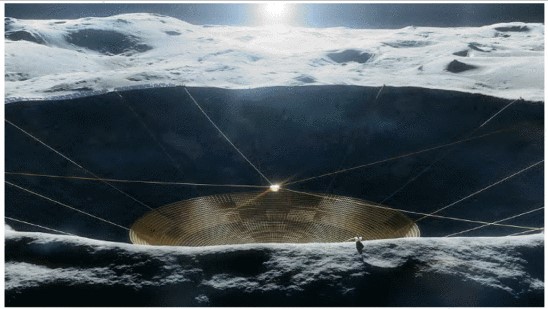
Fig. 1 Concept art of a Lunar Crater Radio Telescope (LCRT) on the far side of the moon [15]
Using your own table
Above the table:
- Write TABLE followed by the number, in bold. For example TABLE 2. If you have more than one table in your assignment, number them sequentially in the order that they appear.
- Give each table an explanatory title. This title should be written with headline style capitalisation (where each significant word is capitalised), and have no full stop.
- No citation number is required.
Reference list:
- No reference list entry is required as you are reporting your own research.
In text
- In the text of your assignment, refer to the table by its number, such as as seen in table 2.
Using your own figure
Below the figure:
- Write Fig. followed by the number in bold. For example, Fig. 2. If you have more than one figure in your assignment, number them sequentially in the order that they appear.
- Give each figure a caption briefly explaining what it is depicting.
Reference list:
- No reference list entry is required as you are reporting your own research.
In text
- In the text of your assignment, refer to the figure by its number, such as as seen in Fig. 2.
Abbreviations
In the reference list, you are required to abbreviate certain information. The IEEE provides a list of standard abbreviations, some of which are list below. The IEEE Reference Guide provides further information.
Common words
There are many common words that should be abbreviated within your reference list. For a full list, refer to useful abbreviations in references list in the IEEE referencing guide. IEEE also has a table of abbreviations for magazine titles. Below is a table of some of the abbreviated common words:
| Aeronautics | Aeronaut. | Imaging | Imag. |
| American | Amer. | Information | Inf. |
| Applications/Applied | Appl. | Innovation | Innov. |
| Australasian | Australas. | Institute | Inst. |
| Automation | Automat. | Integrated | Integr. |
| Bureau | Bur. | International | Int. |
| Conversion | Convers. | Journal | J. |
| Cybernetics | Cybern. | Language | Lang. |
| Department | Dept. | Magazine | Mag. |
| Distribute/Distributed | Distrib. | Manufacturing | Manuf. |
| Dynamics | Dyn. | Military | Mil. |
| Electrical | Elect. | National | Nat. |
| Engineering | Eng. | Particle | Part. |
| Experimental | Exp. | Patent | Pat. |
| Faculty | Fac. | Proceedings | Proc. |
| Hydraulics | Hydraul. | Quarterly | Quart. |
Months
Whenever you are required to include the name a month in your reference it should be abbreviated.
The IEEE abbreviations for each month are: Jan., Feb., Mar., Apr., May., Jun., Jul., Aug., Sept., Oct., Nov., and Dec.
If a journal is issued every two months, the two months are separated by a slash: Jan./Feb. 2020
If a journal is issued every four months, use a dash in between the first and last month: Sept.-Dec. 2020
Conference proceedings
When referencing conference papers, common words (including conference terms) should be abbreviated, and written numbers should be changed to a numerical representation. If provided, acronyms should be used and articles and prepositions (such as ‘of the’ and ‘on’) should be removed.
Examples:
Proceedings of the 16th International Conference on Numerical Simulation of Optoelectronic Devices (NUSOD) becomes Proc. 16th Int. Conf. NUSOD
IEEE International Conference on Communications becomes IEEE Int. Conf. Commun.
Fifth Annual International Conference on Engineering and Technology becomes 5th Annu. Int. Conf. Eng. Tech.
Below is a table of common conference abbreviations:
| Annals | Ann. |
| Annual | Annu. |
| Colloquium | Colloq. |
| Conference | Conf. |
| Convention | Conv. |
| International | Int. |
| Proceedings | Proc. |
| Record | Rec. |
| Symposium | Symp. |
Theses/dissertation
When referencing a thesis or dissertation, you should abbreviate the name of the University using the correct abbreviation, as well as the name of the school or department. See the common words abbreviations for department or school names.
If the thesis or dissertation is from the United States, the state should be included and abbreviated.
Examples:
Curtin University becomes Curtin Univ.
Edith Cowan University becomes ECU
Murdoch University becomes Murdoch Univ.
University of Western Australia becomes UWA
About UniSkills
UniSkills was created and is maintained by Curtin University Library. To report issues with UniSkills contact Library Help.
Twemoji icons by Twitter, Inc and other contributors, licensed under a CC-BY 4.0 licence.
Except where otherwise noted, UniSkills content in all it’s forms (website, PDFs etc) are licensed under a Creative Commons Attribution ShareAlike 4.0 International Licence. We ask that you attribute any use of the content as created by Curtin University Library with a link to the Library website.
This license does not extend to other Curtin University and Curtin University Library webpages, or to Curtin branding and trademarks. Curtin University’s copyright information is available on the Curtin website.