
Chicago-18th-Author-Date-printable-guide-UniSkills.pdf
Chicago 18th Author-Date
Table of Contents
Introduction
Chicago 18th Author-Date is an author-date referencing style used across a broad range of subject areas. It is based on the Chicago Manual of Style, 18th edition.
This guide is primarily for students completing assignments at Curtin University. If you are publishing (e.g. journal article, PhD), please consult the above manual, as the examples provided here may differ slightly from the requirements outlined in the official style guide.
What is referencing?
Referencing is a standardised method of acknowledging sources of information that you have used in your assignments or research, in a way that uniquely identifies the source. It is not only necessary for avoiding plagiarism, but also for supporting your ideas and arguments.
Printable referencing guide
A printable Chicago 18th Author-Date referencing guide is available on the UniSkills downloads page.
Note on assignment formatting
Please check your unit outline/Blackboard for assignment formatting requirements (such as fonts, headers, spacing, word counts etc.) and assignment cover sheets. PhD and Masters by research students should consult the relevant publication manual for formatting information.
Need to use Chicago 18th Footnotes referencing?
If you are required to use the footnotes version of the Chicago referencing style, consult the Chicago Manual of Style, Notes and Bibliography: Sample Citations Citation Quick Guide, which provides examples and instruction for commonly used sources. You should also check your Unit Outline for any specific guidance from your Unit Coordinator. </div> In-text citations
In-text citations are included throughout your writing to acknowledge the sources of information you have used to build and support your ideas. They briefly identify a work by its author and year of publication and direct readers to a reference list entry with the full details of the source. In-text citations are required for paraphrasing, quoting and summarising. Additional locator information, such as a page number or other identifier may also be included after the year, if required.
In brief, this page shows how to:
- present in-text citations: information prominent or author prominent
- format in-text citations based on the number of authors for the source
- include multiple sources within the same in-text citation
- create citations when multiple works have an identical author (or authors) and publication year
- cite multiple references where the different first authors have the same surname
- cite when authors have cited or quoted other authors
- format quotations
</div>
Types of in-text citations
In-text citations can be presented in two ways:
Information prominent - Author(s) and year appear within brackets.
It could be argued that mental flexibility is a key factor in well-being (Palladino and Wade 2010, 4).
Author prominent - Author(s) appear as part of the sentence, followed by the year in brackets.
Palladino and Wade (2010, 4) argue that mental well-being is linked with flexible thinking.
Format of in-text citations The following examples demonstrate how to create in-text citations based on the number of authors and other relevant factors.
Number of authors to include for in-text citations
The format of the authors in the in-text citation changes according to the number of authors for the work.
- For a work with one or two authors, include the author(s) name in every in-text citation
- For a work with three or more authors, include the name of the first author, followed by et al. (meaning and others) in all citations
- For works with no author see No author on the Reference list page.
| Author | Information prominent | Author prominent |
|---|---|---|
| One or two authors | (Smith 2020). (Smith and Jones 2020, 6). |
According to Smith (2020, 6)… Smith and Jones (2020, 6) highlighted this… |
| Three or more authors | (Thomas et al. 2018, 23). | Thomas et al. (2018, 23) recommends… |
| Organisation as author | (World Health Organization 2018, para. 5). | World Health Organization (2018, para. 5) state… |
|
Organisation with optional abbreviation |
First citation: (World Health Organization [WHO] 2018). Subsequent citations: (WHO 2018). |
First citation: World Health Organization (WHO 2018) have… Subsequent citations: WHO (2018) mentions… |
Other in-text citation scenarios
Multiple sources within the same citation
When including multiple sources to support a particular point in your writing or demonstrate a consensus:
- Include all sources in the same set of brackets. You can choose to order these names alphabetically by author, chronologically by date of publication, or by importance, whichever best supports your work
- Separate the citations with semicolons
- Include a reference list entry for each source.
In-text citation example: Multiple sources
There is an established consensus that the current trend towards a warming climate is directly linked to human activity (Hegerl 1996, 12; Levitus et al. 2017, 4; NASA, n.d., 54; Santer et al. 2003, 42).
When including multiple sources by the same author(s) in the same citation:
- Include the author, followed by the years in chronological order (from the oldest to the newest), separated by a comma
- If including page numbers, separate with a semi-colon
- Include a reference list entry for each source.
In-text citation example: Multiple sources by the same author(s)
(Smith et al. 2019, 2023, 2025)
With page numbers:
(Wong 1999, 328; 2000, 475)
Multiple works by the same author(s) published in the same year
- Add a, b, c and so on after the year to differentiate works by the same author(s) published in the same year
- Order alphabetically by the title of the work in the reference list
In-text citation examples: With a date
(Clarke and Fawcett 2014b).
OR
Clarke and Fawcett (2014a) suggest that…
In-text citation examples: No date
(DevelopmentWA, n.d.-a).
OR
DevelopmentWA (n.d.-b) highlight…
Different first authors with the same surname
If referring to two or more publications where the primary (first) authors have the same surname, include the first author’s initials in all in-text citations, even if the year of publication differs.
In-text citation examples:
(B. Johnson 2015, 6). OR According to B. Johnson (2015, 6)…
(M. Johnson et al. 2016, 22). OR M. Johnson et al. (2016, 22) states…
Authors citing other authors
Academic content such as books and journal articles will often contain a lot of citations. When do you need to give credit to the original author (primary source)? Cite the original author when:
- They are quoted by your source (the secondary source)
- When a specific study is discussed in the secondary source and you reproduce findings or arguments from that study without accessing the primary source
When citing a secondary source:
- The in-text citation should include author details and the year from the primary source, as well as the author, year of publication and page/paragraph number from the secondary source
- Only the secondary source is included in the reference list
In-text citation examples:
…“event in nature or in society” (Blaikie et al. 1994, as quoted by Maldonado et al. 2013, 602).
OR
Lazrus (2012, as quoted by Maldonado et al. 2013, 610) outlines the exemptions for certain populations.
Quoting
Quoting is when you copy the exact words (including spelling and punctuation) from another source into your work. Check out Integrating sources: Quoting for information and examples.
Short quotations (40 words or less)
- Short quotations should be run in (incorporated) within the text
- Place quotation marks around the quote
- In-text citation includes author, year of publication and page number or other identifier
Quoting examples:
According to Palladino and Wade (2010, 147), “a flexible mind is a healthy mind.”
OR
In fact, “a flexible mind is a healthy mind” (Palladino and Wade 2010, 147).
Long quotations (40 words or more)
Use a freestanding block of text which:
- Starts on a new line
- Is indented from the left margin
- Does not include quotation marks
Your in-text citation will appear in brackets after the final punctuation mark and will include the author, year of publication, and page number or other identifier (note: there is no punctuation mark after the in-text citation).
Block quotation example:
In-text citations are important in academic writing, drawing the parallel between the author’s work and the sources which support it:
The function of any citation-signaller is to alert the reader to some kind of association between the citing text and the cited text. Citation-signallers may additionally, by using page references or chapter numbers, single out a particular part of the text as especially relevant. (Langham 2005, 361)
</div>
Page numbers and other identifiers Page numbers are used in in-text citations to pinpoint the specific location within a source that you are referring to, especially when you are quoting. It helps the reader locate the exact information you are citing, making it easier for them to verify your claims or consult the source directly. The Chicago style recommends the use of page numbers when:
- Quoting directly from a source
- Referring to a specific idea, section or point in a source.
Note: As there is flexibility with the inclusion of page numbers or other identifiers when referring to specific ideas, sections or other point in a source, it is advisable to check with your tutor.
If page numbers are not available, include another identifier such as a paragraph number, chapter number, section number or heading.
| Identifier | Example |
|---|---|
| Page number | (Thomas et al. 2018, 23). |
| Paragraph number | (World Health Organization 2025, para. 3). |
| Chapter or section number | (Gay and Simnett 2018, chap. 8.2). |
| Section heading | (Australian Bureau of Statistics 2024, under “Education and Employment”). |
|
Timestamp (Audiovisual material) Use the format: HH:MM:SS |
(Ellis 2017, at 0:25-9). (Miller 2015, at 1:12:19-41). |
| Slide number | (Richardson 2015, slide 9). |
Reference lists
The reference list provides the full details of the sources you have cited in your work. Reference list entries usually consist of four elements: author, date, title and source.
Authors The author variations below apply to all reference types (books, journal articles, websites, etc.).
- All author names (first, middle and last names) are listed in full except when only the author initials are provided.
- When there are two or more authors, the first author’s name is inverted with the Surname appearing first, followed by the first and middle names, if given. All subsequent author names are listed in the format of First Name Surname. For example: Smith, Benjamin, Brooke J. Burke, and Shae Anne Barnes.
- If only initials are given, put a full stop after each initial and a space between the initials, e.g. Lee, S. A.
- Include a comma to separate each author’s name and use ‘and’ before the last author’s name (e.g. Smith, Benjamin A., and Brooke J. Burke).
- List authors in the order they appear on the source you are referencing.
- Names that follow Eastern order (Surname first) rather than Western order (Surname last) should not be inverted in a reference list even if they are listed as a second or subsequent author, e.g. Beller, Ben, Lee Kim Hock, and Wang Gui. 2010.
No author
If no personal author is given, check to see if an organisation has acted as the author. Where there are no authors and you are sure that your source is credible, follow the guidelines below:
- Use the title of the work in place of the author in the in-text citation and in the reference list
- If the title is too long, shorten it in the in-text citation but always include the first word of the title
- If the item is a smaller part of a publication (e.g. journal article, book chapter), enclose the title in quotation marks in both the in-text and reference list
- If the item is a book, brochure, website or report, italicise the title both in the in-text and reference list.
Note: Newspaper or magazine articles are exceptions to the above guidelines. Refer to the Newspaper and magazine article example in this guide.
In-text citation
(“A Profession in Charge” 2015).
OR
In the article “A Profession in Charge” (2015) …
Reference list
“A Profession in Charge of its Future - A Vision for 2030.” 2015. Veterinary Record 177 (20): 503-504. https://doi.org/10.1136/vr.h6215.
One or two authors
- Include all authors in the reference list entry.
Reference list examples:
Burns, Timothy. 2015. “Philosophy and Poetry: A New Look at an Old Quarrel.” The American Political Science Review 109 (2): 326-338. https://doi.org/10.1017/S0003055415000076.
Lane, Rod, and Simon Catling. 2016. “Preservice Primary Teachers’ Depth and Accuracy of Knowledge of Tropical Cyclones.” Journal of Geography 115 (5): 198-211. https://doi.org/10.1080/00221341.2016.1153133.
Three to six authors
- Include up to six authors in the reference list entry.
Reference list example:
Thomas, M’Balia, Alisa L. Russell, and Hannah V. Warren. 2018. “The Good, The Bad, and The Ugly of the Pedagogy in Harry Potter: An Inquiry into the Personal Practical Knowledge of Remus Lupin, Rubeus Hagrid, and Serverus Snape.” The Clearing House: A Journal of Educational Strategies, Issues and Ideas 91 (4-5): 186-192. https://doi.org/10.1080/00098655.2018.1433152.
More than six authors
- List only the first three authors followed by et al. (meaning and others) in the reference list.
Reference list example:
Yonkers, Kimberly, A., Susan M. Ramin, A. John Rush, et al. 2001. “Onset and Persistence of Postpartum Depression in an Inner-City Maternal Health Clinic System.” The American Journal of Psychiatry 158 (11): 1856-1863. https://doi.org/10.1176/appi.ajp.158.11.185.
Organisation as author
- Include the organisation name in full in the reference list.
- If you have used the abbreviated name in the in-text citation, display the abbreviation first followed by the organisation’s full name in brackets. Where an organisation is commonly known by its acronym (e.g. CSIRO, Qantas, NASA), list the acronym in the reference list without the full name in brackets
- Where multiple departments are listed, use the organisation most responsible for the information as the author. In government documents particularly, the hierarchy is often displayed, for example: Royal Perth Hospital, Department of Health, Government of Western Australia. The smallest department is usually primarily responsible for the content (in this case, Royal Perth Hospital)
Reference list example:
Department of Education and Training. 2024. “During your studies in Australia.” Australian Government. https://www.education.gov.au/international-education/during-your-studies-australia-0.
Reference list example: organisation name abbreviated in-text
WHO (World Health Organization). 2018. Global Status Report on Road Safety 2018. World Health Organization. https://www.who.int/violence_injury_prevention/road_safety_status/2018/en/.
Title capitalisation
- All titles should appear in title case (where each significant word is capitalised). Example: Youth Subcultures: Theory, History and the Australian Experience.
DOIs and URLs
- A DOI (Digital Object Identifier) is a string of numbers, letters and symbols which uniquely identifies, and creates a permanent link to a journal article, book or other online document, e.g. 10.1108/HER-10-2015-0023
- In the Chicago style, DOIs are preceded by https://doi.org/. For example: https://doi.org/10.1108/HER-10-2015-0023.
- The DOI is given preference over a URL due to its stable nature. If one has been assigned, include it in your reference list entry
- If you cannot locate a DOI, include the online article, book or document’s URL. If the URL is very long or unsuitable, list the name of the library database in place of the URL
- DOIs and URLs are presented as plain text links, preceded by https://… and followed by a full stop. For example: https://doi.org/10.1108/HER-10-2015-0023.
Where can I find the DOI?
DOIs will usually be presented on the first page of an article or with the publication details. If you cannot locate a DOI, do a quick search in the document by clicking CTRL + F (Windows) or Command + F (Mac) and entering doi in the search box
</div>
Reference list page layout
- Begin the reference list on a new page at the end of your work
- Place the label References, centred on the top of the page
- Apply a hanging indent of 1.27cm to each reference list entry
Sample reference list
References
Arkoudis, Sophie, Mollie Dollinger, Chi Baik, and Allan Patience. 2019. “International Students’ Experience in Australian Higher Education: Can We Do Better?” Higher Education 77 (5): 799-813. https://doi.org/10.1007/s10734-018-0302-x.
The Australian. 2016. “A Higher Education Return.” August 18. ProQuest.
ABS (Australian Bureau of Statistics). 2021. Education and Work, Australia. ABS. https://www.abs.gov.au/statistics/people/education/education-and-work-australia.
Boulton, Chris A., Emily Hughes, Carmel Kent, Joanne R. Smith, and Hywel T. P. Williams. 2019. “Student Engagement and Wellbeing Over Time at a Higher Education Institution.” PLoS ONE 14 (11): e0225770. https://doi.org/10.1371/journal.pone.0225770.
Forsyth, Hannah. 2014a. “Dreaming of Higher Education.” Southerly 74 (2): 119-142. https://doi.org/10.3316/informit.792227855125093.
Forsyth, Hannah. 2014b. A History of the Modern Australian University. NewSouth Publishing. https://ebookcentral.proquest.com/lib/curtin/detail.action?docID=2008112.
Forsyth, Hannah. 2017. “Post-War Political Economics and the Growth of Australian University Research, c.1945-1965.” History of Education Review 46 (1): 15-32. https://doi.org/10.1108/HER-10-2015-0023.
MIT (Massachusetts Institute of Technology). 2019. The Future of Higher Education in the Age of Disruption. YouTube. Video, 47 min., 32 sec. https://youtu.be/NFP2S2f3io4.
Rudick, C. Kyle, and Deanna P. Dannels. 2018. “ ‘Yes, and …’: Continuing the Scholarly Conversation About Immigration and Higher Education.” Communication Education 67 (1): 120-123. https://doi.org/10.1080/03634523.2017.1392584.
Tierney, William G., and Michael Lanford. 2016. “Conceptualizing Innovation in Higher Education.” In Higher Education: Handbook of Theory and Research, edited by Michael B. Paulsen. Springer. https://doi.org/10.1007/978-3-319-26829-3.
UNESCO (United Nations Educational, Scientific and Cultural Organization). 2016. Global Education Monitoring Report, 2016: Place: Inclusive and Sustainable Cities. UNESCO. https://unesdoc.unesco.org/ark:/48223/pf0000247862.
UNESCO (United Nations Educational, Scientific and Cultural Organization). n.d. “Education Transforms Lives.” UNESCO. Accessed January 31, 2023. https://en.unesco.org/themes/education.
The World Bank. 2025. “Tertiary Education.” The World Bank. https://www.worldbank.org/en/topic/tertiaryeducation#1.
Order of references in reference list
Arrange the list alphabetically by the first author’s surname (family name) or the organisation name. Where there is no author, use the first word of the title (other than A, An, or The) </div>
Arkoudis, Sophie, Mollie Dollinger, Chi Baik, and Allan Patience. 2019. “International Students’ Experience in Australian Higher Education: Can We Do Better?” Higher Education 77 (5): 799-813. https://doi.org/10.1007/s10734-018-0302-x.
The Australian. 2016. “A Higher Education Return.” August 18. ProQuest.
ABS (Australian Bureau of Statistics). 2021. Education and Work, Australia. ABS. https://www.abs.gov.au/statistics/people/education/education-and-work-australia.
Boulton, Chris A., Emily Hughes, Carmel Kent, Joanne R. Smith, and Hywel T. P. Williams. 2019. “Student Engagement and Wellbeing Over Time at a Higher Education Institution.” PLoS ONE 14 (11): e0225770. https://doi.org/10.1371/journal.pone.0225770.
If there are multiple works by the same author(s) published in different years, order by publication date from oldest to newest. References with no date (n.d.) appear after references with dates </div>
UNESCO (United Nations Educational, Scientific and Cultural Organization). 2016. Global Education Monitoring Report, 2016: Place: Inclusive and Sustainable Cities. UNESCO. https://unesdoc.unesco.org/ark:/48223/pf0000247862.
UNESCO (United Nations Educational, Scientific and Cultural Organization). n.d. “Education Transforms Lives.” UNESCO. Accessed January 31, 2023. https://en.unesco.org/themes/education.
If there are multiple works by the same author(s) published in the same year, order alphabetically by the title of the work. Add a, b, c after the year to differentiate the works </div>
Forsyth, Hannah. 2014a. “Dreaming of Higher Education.” Southerly 74 (2): 119-142. https://doi.org/10.3316/informit.792227855125093.
Forsyth, Hannah. 2014b. A History of the Modern Australian University. NewSouth Publishing. https://ebookcentral.proquest.com/lib/curtin/detail.action?docID=2008112.
A single-author entry in a reference list precedes a multi-author entry beginning with the same name. </div>
Gao, Mobo. 2011. The Battle for China’s Past: Mao and the Cultural Revolution. Pluto Press.
Gao, Mobo, and Greg McCarthy. 2015. “China’s Soft Power and Cultural Diplomacy.” Asian Studies Review 39 (4): 629–645.
Journal & news articles
Journal article
Reference components
Author Surname, First Name(s). Year. “Article Title.” Journal Title in Italics Volume Number (Issue Number): Page Range. https://doi.org/DOI… or URL.
</div>
Reference list examples
Burns, Timothy. 2015. “Philosophy and Poetry: A New Look at an Old Quarrel.” The American Political Science Review 109 (2): 326-338. https://doi.org/10.1017/S0003055415000076.
Foley, Gary, and Tim Anderson. 2006. “Land Rights and Aboriginal Voices.” Australian Journal of Human Rights 12 (1): 83-108. https://doi.org/10.1080/1323238X.2006.11910814.
Naghavi, Mohsen, Amanuel Alemu Abajobir, Cristiana Abbafati, et al. 2017. “Global, Regional, and National Age-Sex Specific Mortality for 264 Causes of Death, 1980-2016: A Systematic Analysis for the Global Burden of Disease Study 2016.” The Lancet 390 (10100): 1151-1210. https://doi.org/10.1016/S0140-6736(17)32152-9.
Thomas, M’Balia, Alisa L. Russell, and Hannah V. Warren. 2018. “The Good, The Bad, and The Ugly of the Pedagogy in Harry Potter: An Inquiry into the Personal Practical Knowledge of Remus Lupin, Rubeus Hagrid, and Serverus Snape.” The Clearing House: A Journal of Educational Strategies, Issues and Ideas 91 (4-5): 186-192. https://doi.org/10.1080/00098655.2018.1433152.
Extra tips
- If there is no volume number, a comma precedes the issue number, and a month or season, if available, is included in brackets
- If only the volume and a month or season is available, replace the issue number with the month or season e.g. 25 (May): 56-59.
- If there is no issue number, list the page number(s) after the volume number separated by a colon with no space in between e.g. 25:56-59.
- Provide a DOI (Digital Object Identifier) or URL for online sources.
Advanced publication, supplements and article numbers
Journal article - Advanced online publication
Mullan, Ryan, Alex D. Davis, Tracey T. Sutton, and Sonke Johnsen. 2023. “An Investigation into the Mechanism Mediating Counterillumination in Myctophid Fishes (Myctopidae).” The Biological Bulletin, ahead of print, April 5. https://doi.org/10.1086/724803.
Journal article published in a supplement
Stoody, Eve E., Joanne M. Spahn, and Kellie O. Casavale. 2019. “The Pregnancy and Birth to 24 Months Project: A Series of Systematic Reviews on Diet and Health.” The American Journal of Clinical Nutrition 109 (Suppl.1): 685S-697S. https://doi.org/10.1093/ajcn/nqy372.
Journal article with an article number/eLocator
Pedersen, Pil Birkefeldt Moller, Joanna B. Olsen, Brody Sandel, and Jens-Christian Svenning. 2019. “Wild Steps in a Semi-Wild Setting? Habitat Selection and Behavior of European Bison Reintroduced to an Enclosure in an Anthropogenic Landscape.” PLOS ONE 14 (11): e0198308. https://doi.org/10.1371/journal.pone.0198308.
Extra tips
- Advanced online publications are articles that are published online ahead of a print issue. List the posted publication date and use ahead of print as shown in the example above. Note: they may not have a volume, issue number or page numbers
- If an article has been accepted for publication but not yet made available (online or in print), use the term Forthcoming in place of the year for the reference list, e.g. Smith, Margaret. Forthcoming. The in-text citation is displayed as (Smith, forthcoming).
- For articles published in a supplement, display the supplement letter or number e.g. Suppl.1 or Suppl. A.
- For a supplement to a particular issue of a journal, include the issue number in brackets followed by the supplement number e.g. (2, Suppl. 5).
- For articles with an article number, include the article number in place of the page range e.g. PLOS ONE 11 (7): e0158474.
News or magazine article
Reference components
Author Surname, First Name(s). Year. “Title of Article.” Newspaper/Magazine Title in Italics, Month Day. URL.
</div>
Reference list examples
Haberman, Maggie, and Peter Baker. 2017. “In Call with Times Reporter, Trump Projects Air of Calm Over Charges.” The New York Times, November 1. https://www.nytimes.com/2017/11/01/us/politics/trump-russia-charges.html.
Kirby, James. 2023. “Big Super’s Plan for Financial Advice Hits Trouble.” The Australian, July 31. Newsbank.
Morris, Linda, Nick Galvin, and Megan Gorrey. 2019. “ ‘Scandalous’: Walsh Bay Arts Precinct Revamp Stalls.” Sydney Morning Herald, August 15. ProQuest.
Weekend Edition Saturday. 2015. “Fairytales Exist: Migrants Get a Football Team of Their Own.” May 9. ProQuest.
Extra tips
- If found online, include a URL or if no suitable URL is available, include the name of the library database
- If the article has no author, cite the title of the newspaper or magazine in place of the author. The newspaper or magazine title is italicised in the reference list and in-text citation e.g. (Weekend Edition Saturday 2015).
- When quoting, include a page number or other identifier in the in-text citation.
Books
Books
Reference components
Author Surname, First Name(s). Year. Book Title in Italics. # ed. Publisher. https://doi.org/DOI… or URL.
</div>
Reference list examples
Berman, Audrey T., Geralyn Frandsen, Shirlee Snyder, et al. 2021. Kozier & Erb’s Fundamentals of Nursing: Concepts, Process and Practice. 5th Aust. ed. Pearson Australia. https://ebookcentral.proquest.com/lib/curtin/detail.action?docID=6352557.
Doyle, Timothy, Doug McEachern, and Sherilyn MacGregor. 2015. Environment and Politics. 4th ed. Routledge. https://ebookcentral.proquest.com/lib/curtin/detail.action?docID=2194948.
Gay, Grant, and Roger Simnett. 2018. Auditing & Assurance Services in Australia. 7th ed. McGraw-Hill. EPUB. https://ebookcentral.proquest.com/lib/curtin/detail.action?docID=5729228.
Millon, Theodore, Roger Davis, Carrie Millon, Luis Escovar, and Sarah Meagher. 2000. Personality Disorders in Modern Life. Wiley.
Extra tips
- For editions other than the first, include the edition number after the book title
- For online books, provide a DOI (Digital Object Identifier) if given. If not, cite the name of the database used to source the book
- For books accessed in EPUB format, add the term EPUB to the reference as shown in the Gay and Simnet example
- When quoting, if an ebook has no fixed page numbers, cite another identifier in-text.
Chapter in an edited book
Reference components
Chapter Author Surname, First Name(s). Year. “Title of Chapter.” In Title of Book in Italics, # ed., edited by Editor(s) First Name(s) Last Name. Publisher. https://doi.org/DOI… or URL.
</div>
Reference list examples
Esteves, Fernando, Joao Rodrigo Mesquita, Carmen Nobrega, et al. 2016. “Epidemiology and Emergence of Schmallenberg Virus Part 1: Origin, Transmission and Differential Diagnosis.” In Epidemiology of Communicable and Non-Communicable Diseases - Attributes of Lifestyle and Nature on Humankind, edited by Fyson Hanania Kasenga. IntechOpen. https://doi.org/10.5772/64741.
Reisinger, Yvette. 2013. “Reflections on Globalisation and Cultural Tourism.” In The Routledge Handbook of Cultural Tourism, edited by Melanie Smith and Greg Richards. Routledge. EPUB. https://ebookcentral.proquest.com/lib/curtin/detail.action?pq-origsite=primo&docID=1114637.
Renner, Adam, Bridget Brew, and Crystal Proctor. 2013. “Plotting Inequality, Building Resistance.” In Rethinking Mathematics: Teaching Social Justice by the Numbers, 2nd ed., edited by Eric Gutstein and Bob Peterson. Rethinking Schools.
Extra tips
- If the author of the chapter being referenced is also the editor of the book, the full names should be repeated for each role
- For editions other than the first, include the edition number after the book title
- For online books, provide a DOI (Digital Object Identifier) if given. If not, cite the name of the database used to source the book
- For books accessed in EPUB format, add EPUB to the reference as shown in the Reisinger above
- When quoting, if an ebook has no fixed page numbers, cite another identifier in-text.
Dictionary or encyclopedia
Reference components
Author Surname, First Name(s). Year. “Title of Entry.” In Title of Dictionary or Encyclopedia in Italics, # ed., edited by Editor(s) First Name(s) Last Name. Publisher. URL.
</div>
Reference list example
Martin, David. 2001. “Religion: Peace, War, and Violence.” In International Encyclopedia of the Social & Behavioral Sciences, edited by Neil J. Smelser and Paul B. Baltes. Pergamon Press. https://www.sciencedirect.com/science/article/pii/B0080430767040389.
Extra tips
- If the definition has no author information, incorporate it into the in-text, citing the title of the resource in italics, year, access date and URL
- Where the article has no publication date, add an accessed date in the format of month day, year followed by the URL
- When quoting, if no fixed page numbers, cite another identifier in-text.
Conference paper or poster
Reference components
Author Surname, First Name(s). Year. “Title of Paper,” paper presented at the Name of Conference, City, State/Country, Month Day(s). https://doi.org/DOI… or URL.
</div>
Reference list examples
Chadwick, M. B., M. Blann, and S. Hilaire. 2008. “Multistep Direct Preequilibrium Reactions and the Monte Carlo Approach,” paper presented at the International Conference on Nuclear Data for Science and Technology, Paris, France, April 23-27, 2007. https://doi.org/10.1051/ndata:07659.
Fredericks, Joel, and Christopher Lawrence. 2018. “#thisismymob: Preserving and Promoting Indigenous Australian Cultural Heritage,” paper presented at the 2nd Workshop on Mobile Access to Cultural Heritage (MobileCH-2018), Barcelona, Spain, September 3-6. http://ceur-ws.org/Vol-2176/paper3.pdf.
Extra tips
- If publication details such as dates or location are not provided, look for this information by searching for the Conference Name on Google
- If the year the paper was published online is different to the year the conference was held, list them accordingly
- A conference paper included in published proceedings is treated like a chapter in an edited book. If published in a journal, it is treated as a journal article.
Thesis or dissertation
Reference components
Author Surname, First Name(s). Year. “Title of Thesis.” PhD diss. or Master’s thesis, University Name. Database Name (Document Identifier). URL.
</div>
Reference list examples
Dowling, Carol Susan. 2017. “ ‘Find One of Your Own Kind’: Auto-ethnography and My Aboriginal Women Ancestors.” PhD diss., Curtin University. espace. https://espace.curtin.edu.au/handle/20.500.11937/73585.
Ling, Justin. 2015. “Lords and Ladies of the Modern Age.” Master’s thesis, Mills College. ProQuest (1586702).
Extra tips
- For theses or dissertations retrieved from a commercial database, list the name of the database and, in brackets, any identification number supplied by the database.
Websites & social media
Webpage on a website
Reference components
Author Surname, First Name(s) or Organisation Name. Year. “Title of Webpage.” Website Name or Owning Organisation. URL.
</div>
Reference list examples
DET (Department of Education and Training). 2016. “Improving Australian and European Mobility.” Australian Government. https://www.education.gov.au/news/improving-australian-and-european-mobility.
DevelopmentWA. n.d. “Yagan Square.” DevelopmentWA. Accessed April 8, 2020. http://www.developmentwa.com.au/projects/redevelopment/yagan-square/overview.
Wikipedia Foundation. 2025. “Carbon Footprint.” Wikipedia. https://en.wikipedia.org/wiki/Carbon_footprint.
Extra tips
- If there is no author, cite the name of the organisation that owns the website
- If you have used an abbreviation for the organisation name in the in-text citation, list the abbreviation first, followed by the organisation’s full name in brackets in the reference list entry
- If the webpage has no date of publication or revision date, use n.d. in place of the year and add the accessed date before the URL
- For multiple pages from the same website published in the same year, include a unique reference for each (ordered alphabetically by title), and differentiate with a, b, c etc. after the date in-text and in the reference list e.g. 2019a. 2019b.
- When quoting, if there are no page numbers, cite another identifier in-text.
Blog post
Reference components
Author Surname, First Name(s). Year. “Title of Blog Post.” Title of Blog in Italics, Month Day. URL.
</div>
Reference list example
Huberman, Ben. 2016. “Live from Paris: David Lebovitz on Food, France, and Writing.” Discover (blog), March 3. https://discover.wordpress.com/2016/03/03/david-lebovitz-food-france-writing/.
Sentance, Nathan M. 2019. “Anniversaries Need to be Uncomfortable.” Archival Decolonist (blog), November 6. https://archivaldecolonist.com/2019/11/06/anniversaries-need-to-be-uncomfortable/.
Extra tips
- The word blog enclosed in brackets may be added after the title of the blog, unless it is part of the title
- If the author’s name is not available, use the username
- When quoting, if there are no page numbers, cite another identifier in-text
- Blog comments are not included in the reference list, but should be cited within the text itself e.g.
A comment posted about the Library’s closing message (2015) from the Curtin Library Blog on May 2, 2015 suggested that …
Social media post
Facebook, Instagram, LinkedIn, TikTok, X (Twitter) etc.
Reference components
Author Surname, First Name(s) (Screen Name). Year. “Title of entry or up to the first 280 characters of the post.” Name of Platform, Month Day. URL.
</div>
Reference list examples
ABC News Australia (@abcnewsau). 2023. “What we’ve discovered is that we can take waste textiles and grind them up into really fine particles.” TikTok, November 11. https://www.tiktok.com/@abcnewsaus/video/7298573844044844290.
Curtin University. 2023. “Check out these highlights from the Bachelor of Creative Arts Exhibition at this year’s Faculty of Humanities Graduate Showcase!” LinkedIn, November 9. https://www.linkedin.com/posts/curtinuniversity_curtinuniversity-curtinlife-curtingradshow23-activity-7127960735678173184-NOIb/.
Obama, Barack (@barakobama). 2018. “During my presidency, I started a tradition of sharing my reading lists and play lists.” Facebook, January 1. https://www.facebook.com/barackobama/posts/10155532677446749.
Souza, Pete (@petesouza). 2018. “A loving touch.” Instagram, February 8. https://www.instagram.com/p/Be8MsHcl8DP/.
University of Melbourne Library (@unilibrary). 2018. “Good morning one and all. #Onthisday in 1975 90% of Icelandic women went on strike, refusing to work in protest of gender inequality.” X, October 24. https://x.com/unilibrary/status/1054855102111064065.
Extra tips
- If the author’s real name is unknown, provide their username or screen name, without the brackets
- For the title, list up to the first 280 characters of the post, including spaces, and retaining any emojis
- Follow the style of capitalisation used in the post, rather than the title case capitalisation required for titles in other reference types
- When quoting, if there are no page numbers, cite another identifier in-text
- Comments on social media posts are not included in the reference list, but should be cited within the text itself e.g.
Stephanie Lopez replied to President Obama’s Facebook post thanking him for his leadership as the President (January 1, 2018, comment on Obama 2018).
Reports & grey literature
Government or organisation report
Reference components
Author Surname, First Name(s) or Government Department Name or Organisation Name. Year. Title of Report in Italics. Report or Catalogue Number. Publisher. URL.
</div>
Reference list examples
AIHW (Australian Institute of Health and Welfare). 2015. Emergency Department Care 2014-15: Australian Hospital Statistics. Cat. no. HSE 168. AIHW. https://www.aihw.gov.au/getmedia/0fd096e0-b481-4f92-98d72f9c8719/19527_1.pdf.aspx?inline=true.
Lowitja Institute. 2021. Culture is Key: Towards Cultural Determinants-Driven Health Policy: Final Report. Lowitja Institute. https://www.lowitja.org.au/resource/culture-is-key-towards-cultural-determinants-driven-health-policy/.
Saunes, Ingrid Sperre, Marina Karanikolos, and Anna Sagan. 2020. Norway: Health System Review 2020. Health Systems in Transition, vol. 22, no. 14. Norwegian Institute of Public Health and European Observatory of Health Systems and Policies. https://eurohealthobservatory.who.int/publications/i/norway-health-system-review-20.
Extra tips
- If you cannot locate certain elements (e.g. publisher, report or catalogue number), omit them from your reference
- If you have used an abbreviated organisation name in the in-text citation, display the abbreviation first followed by the organisation’s full name in brackets. Where an organisation is commonly known by its acronym (e.g. CSIRO, Qantas, NASA), list the acronym in the reference list without the full name in brackets
- If the author and publisher are the same, an abbreviation may be used for the publisher
- When quoting, if there are no page numbers, cite another identifier in-text.
Press release
Reference components
Author Surname, First Name(s). Year. “Title of Release.” Release type, Month Day of release. URL.
</div>
Reference list examples
APA (American Psychological Association). 2018. “Dishonest Individuals Perceived as Less Capable.” Press release, January 31. https://www.apa.org/news/press/releases/2018/01/dishonest-individuals.aspx.
Birmingham, Simon. 2017. “Tens of Thousands of Preschoolers to Learn a Language in 2017.” Media release, January 9. https://ministers.education.gov.au/birmingham/tens-thousands-preschoolers-learn-language-2017.
Extra tips
- Most common releases include ‘Media Release’ or ‘Press Release’
- If you have used an abbreviated organisation name in the in-text citation, display the abbreviation first followed by the organisation’s full name in brackets. Where an organisation is commonly known by its acronym (e.g. CSIRO, Qantas, NASA), list the acronym in the reference list without the full name in brackets
- When quoting, if there are no page numbers, cite another identifier in-text.
Brochure, factsheet or pamphlet
Reference components
Author Surname, First Name(s) or Organisation Name. Year. Title in Italics. Publisher. URL.
</div>
Reference list examples
Department of Health and Aged Care. 2024. Support at Home - Fact Sheet. Australian Government. https://www.health.gov.au/resources/publications/support-at-home-fact-sheet.
Extra tips
- For print material, omit the URL
- If certain elements cannot be identified (e.g. Publisher), omit them from your reference
- When quoting, if there are no page numbers, cite another identifier in-text.
Dataset
Reference components
Author Surname, First Name(s). Year. “Title of Dataset.” Publisher or Source. https://doi.org/DOI… or URL.
</div>
Reference list example
Irino, Tomohisa, and Ryuji Tada. 2009. “Chemical and Mineral Compositions of Sediments from ODP Site 127-797.” Pangaea dataset. https://doi.org/10.1594/PANGAEA.726855.
Zou, Heng-Xing, and Volker, H. W. Rudolf. 2023. Data from “Priority Effects Determine How Dispersal Affects Biodiversity in Seasonal Metacommunities.” Dryad dataset. https://doi.org/10.5061/dryad.sbcc2frb4.
Extra tips
- The year refers to the year of publication of the dataset; not the year of publication of the paper which contains the dataset
- If there’s no date of publication, use n.d. (no date) and provide an access date. But if the cited data applies to a specific year(s), use this date instead of n.d.
- Data found in an independent database, dataset or other collection of files, can be cited directly, even when tied to another publication (as in the Zou example above)
- Provide a DOI (Digital Object Identifier) if available. If you cannot locate a DOI, include the item’s URL
Legislation & standards
Act of Parliament
The Chicago Manual of Style does not cover Australian legal materials. The guidelines presented are adapted from the Australian Guide to Legal Citation.
Reference components
Short Title of Act Year in Italics (Jurisdiction) Section # and subdivision (if relevant). URL.
</div>
Reference list example
Copyright Act 1968 (Cth) S. 40. https://www.austlii.edu.au/au/legis/cth/consol_act/ca1968133/.
Extra tips
- For in-text citations and reference list, put the title of the Act (which includes the Year) in italics
- Abbreviate the jurisdiction (e.g. Commonwealth is abbreviated to Cth)
- Always include the section/paragraph/part number (if available) in the in-text to aid discoverability. For example: Section 40 of the Copyright Act 1968 states that “a fair dealing with a literary work does not constitute an infringement.”
- In the reference list, separate this from the main body of the list under the subheading: Legislation.
Case
The Chicago Manual of Style does not cover Australian legal materials. The guidelines presented are adapted from the Australian Guide to Legal Citation.
Reference components
Case Name in Italics. Year. Volume Number Law Report Series Starting Page or Pinpoint. URL.
</div>
Reference list example
Shea v News Ltd. 2015. WASC 1. http://www.austlii.edu.au/cgi-bin/sign.cgi/au/cases/wa/WASC/2015/1.
Extra tips
- Cases are only included in the reference list if considered essential to your argument
- If the volume number is not available, leave this out of the reference list
- The Law Report Series is always abbreviated in the reference list e.g. WASC
- If the case is obtained from an electronic database, add a URL as for electronic journal articles
- The Pinpoint refers to a specific page or paragraph number within the report
- If you decide to include a case in your reference list, set it apart from the main body of the reference list under the subheading: Legal Authorities.
Standard
Reference components
Standard Issuer Name. Year. Title of Standard in Italics. Standard Number. Publisher. URL.
</div>
Reference list example
American Society Testing & Materials. 2024. Standard Practice for Random Sampling of Construction Materials. ASTM D 3665:2024. ASTM. Intertek Inform.
Standards Australia. 2009. Wire-Rope Slings: Product Specification. AS 1666.1-2009. Standards Australia. https://au.i2.saiglobal.com/management/display/index/0/298565/-/9be24c09161d0e738ff81c70e056a06b.
Extra tips
- If there is no standard number, omit this from the reference
- In the Intertek Inform database, the publisher for individual standards may differ. Always check the standard document itself for publisher information
- If the author and publisher are the same, an abbreviation may be used for the publisher
- If accessed online, include a URL or if no suitable URL is available, include the name of the library database
Audiovisual media
YouTube or other streaming video
Reference components
Author Surname, First Name(s). Year. Title of Video in Italics. Streaming Platform. Format, Running length time. URL.
</div>
Reference list examples
California Newsreel. 2008. In Sickness and in Wealth. Kanopy. Video, 58 min. https://curtin.kanopy.com/video/sickness-and-wealth.
Ellis, Lindsay. 2017. Auteur Theory vs. Michael Bay: The Whole Plate: Episode 2. YouTube. Video, 12 min., 31 sec. https://www.youtube.com/watch?v=srk-tPbQVcs.
Lyiscott, Jamila. 2014. 3 Ways to Speak English. TED Talk. Video, 4 min., 17 sec. https://www.ted.com/talks/jamila_lyiscott_3_ways_to_speak_english.
Extra tips
- The person who posted the video is often credited as the author.
- If the real name of the person who posted the video is unknown, include only the username.
- When quoting, include a timestamp in the in-text citation.
Film or video
Reference components
Creator Surname, First Name(s). Year released. Title of Work in Italics. Publisher, Year of Publication. Format/URL/Platform.
</div>
Reference list example
Cuarón, Alfonso, dir. 2013. Gravity. Warner Bros. Pictures, 2014. Blu-ray Disc, 1080p HD.
Miller, George, dir. 2015. Mad Max: Fury Road. Warner Bros. Pictures. https://search.informit.org/doi/10.3316/edutv.1193010.
Extra tips
- Omit the year of publication if it is the same as the year of release.
- Include the format for physical media such as DVDs, in place of the URL or platform.
- When quoting, include a timestamp in the in-text citation.
TV series episode
Reference components
Creator’s Surname, First Name(s), role. Year. Title of Series in Italics. Season #, episode #, “Title of Episode.” Aired/Accessed Month Day, Year, on Network/Service. URL (if available).
</div>
Reference list examples
Fryman, Pamela, dir. 2019. Merry Happy Whatever. Episode 2, “Harmony.” Aired November 28, 2019, on Netflix.
Mayberry, Russ, dir. 1971. The Brady Bunch. Season 3, episode 10, “Her Sister’s Shadow.” Aired November 19, 1971, on ABC.
Murphy, Ryan, dir. 2022. American Crime Story: The People v. O. J. Simpson. Season 1, episode 6, “Marcia, Marcia, Marcia.” Accessed June 10, 2022, on Prime. https://www.amazon.com/dp/B01ARVPCOA/.
Extra tips
- The creator can be the producer or director
- If accessed online, if there is no date of production/publication provided, include an access date instead.
- Omit season and episode number if unavailable.
- When quoting, include a timestamp in the in-text citation.
News broadcasts
Reference components
News Network or News Service. Year. “Title of News Item.” Title of Program in Italics. Broadcast Month Day. Type of broadcast. URL (if available).
</div>
Reference list examples
ABC (Australian Broadcasting Corporation). 2014. “Growing Calls for a Royal Commission into the Commonwealth Bank Fraud Scandal.” 7.30 Report. July 1. Television broadcast.
CNN. 2025. “South African Journalist: Ramaphosa Was Prepared for Trump.” The Lead. May 22. Television broadcast. https://edition.cnn.com/2025/05/21/world/video/the-lead-south-africa-white-farmer-genocide-president-donald-trump-elon-musk-jake-tapper.
SBS (Special Broadcasting Service). 2020. “Government Has Announced a New Rescue Package for Victoria’s Childcare Sector.” World News Australia. August 5. https://search.informit.org/doi/10.3316/tvnews.tsm202008050216.
Extra tips
- If you have used an acronym for the news network in the in-text citation, start the reference list with the acronym, followed by the full name in brackets.
- If the broadcast is viewed via live stream, on demand or through a database, include the URL.
- When quoting, include a timestamp in the in-text citation.
Radio and podcast episode
Reference components
Presenter Surname, First Name(s), role. Year. Title of Podcast or Radio Series in Italics. Season #, episode #, “Title of Episode.” Production Company/Network, Broadcast Month Day. Format, Duration. URL.
</div>
Reference list examples
Ober, Lauren, host. 2022. The Loudest Girl in the World. Season 1, episode 2, “Goodbye, Routine; Hello, Meltdown!” Pushkin Industries, September 13. Podcast, 32 min., 49 sec. https://www.pushkin.fm/podcasts/loudest-girl-in-the-world.
Qadar, Sana, presenter. 2025. All in the Mind. “Is Clutter Making You Feel Bad?” ABC Radio National, August 17. Radio, 29 min. https://www.abc.net.au/listen/programs/allinthemind/is-clutter-making-you-feel-bad/105606210.
Silva, Kristian, and Stephen Stockwell, presenters. 2025. Mushroom Case Daily. “What Happened to the Leftovers? Our Friday Wrap.” ABC Listen, May 9. Podcast, 33 min. https://www.abc.net.au/listen/programs/mushroom-case-daily.
Extra tips
- If the podcast season or episode number is not provided, omit it from the reference
- When quoting, include a timestamp in the in-text citation.
Music
Reference components
Creator Surname, First Name(s), role. Year. “Title of Track.” Track # on Title of Record in Italics. Format. Publisher.
</div>
Reference list examples
Rihanna, vocalist. 2007. “Umbrella.” Track 1 on Good Girl Gone Bad. MP3 audio. Island Def Jam.
The Wombats, band. 2017. Beautiful People Will Ruin Your Life. MP3 audio. Warner Music Australia.
Extra tips
- Only the title of the album is italicised. Quotation marks are used for the individual track titles.
- The role of the creator can be a vocalist, composer, conductor, director, performer or other person primarily responsible for the content.
- Reference components should be adapted to suit the requirements of your referencing e.g. track versus album
- When quoting, include a timestamp in the in-text citation.
Company information
Annual report
Reference components
Organisation Name. Year. Title of Report in Italics. Publisher. URL.
</div>
Reference list example
Starbucks. 2024. Starbucks Fiscal 2024 Annual Report. Starbucks. https://investor.starbucks.com/financials/annual-reports/default.aspx.
Qantas. 2015. A Strong, Sustainable Future: Qantas Annual Report 2015. Qantas. https://www.qantas.com.au/infodetail/about/investors/2015AnnualReport.pdf.
Extra tips
- If author name is provided, use this in place of the organisation name
- Where an organisation is commonly known by its acronym (e.g. CSIRO, Qantas, NASA), list the acronym in the reference list
- Abbreviations such as Inc., Ltd. can be omitted
- If the publisher name is unavailable, this can be omitted.
Dataset created using a company database
Reference components
Database Name. Year. “Title of Dataset.” Dataset. Accessed Month Day, Year. URL of database.
</div>
Reference list example
Morningstar Datanalysis Premium. 2014. “GICS Industry Metals & Mining: Financial Data.” Dataset. Accessed October 9, 2014. https://datanalysis.morningstar.com.au.
Extra tips
- Use the name of the database used to create the dataset as the author.
Company and industry reports created using a database
Reference components
Author Surname, First Name(s) or Organisation Name. Year. “Title of Report.” Report Series Title in Italics. URL.
</div>
Reference list examples
Baikie, Victoria. 2021. “Art Galleries and Museums in Australia.” IBISWorld Industry Report. https://my.ibisworld.com/au/en/industry/r8910/about.
IBISWorld. 2021. “Sigma Healthcare Limited.” IBISWorld Company Report. https://my.ibisworld.com/au/en/company-reports/9965/company-details.
Company and industry profile from a database
Reference components
Author Surname, First Name(s). Year. “Title of Profile.” Profile Series Title in Italics. URL.
</div>
Reference list examples
Euromonitor International. 2021. “Ferrero & Related Parties in Packaged Food (World).” Passport. https://www.warc.com/content/article/ferrero-and-related-parties-food/90830.
Marketline. 2021. “Oil and Gas in Australia June 2021.” Marketline Industry Profile. https://link.library.curtin.edu.au/gw?url=CUR_ALMA61114962510001951.
Extra tips
- If author information is not provided, use the name of the company used to create the profile as the author.
Other sources
Generative Artificial Intelligence (GenAI)
Before using GenAI tools in your assessment, check the unit outline or assessment guidelines, or speak with your unit coordinator to confirm whether GenAI use is permitted. </div>
If you use a GenAI tool, such as ChatGPT, Claude, or Copilot, when completing an assessment, it is recommended to declare your use. Additionally, if you have used GenAI to create content that you include in your work, you must reference this use as a source of information.
Referencing is a standardised way of acknowledging sources such as books, articles, and websites to show that your work is based on credible evidence. GenAI must be cited if used as an information source. This is required in the same way as any other information you include in your work that comes from an external source.
It is important to understand that AI-generated content is considered a non-recoverable source. This means that the content produced is usually not accessible to anyone other than the person who generated it. Unless the GenAI tool provides a shareable link to the chat, other people cannot be directed to the exact location where the content was created. This makes it difficult to verify claims in the same way as traditional sources.
GenAI tools are also not considered scholarly sources at this time. Their responses are created from large training datasets, and the original source of the information is often unknown. For this reason, GenAI outputs should be used with care in academic work.
If the GenAI text discusses theories or specific ideas, you should include additional sources to support them with scholarly research.
If you are allowed to use GenAI in your work, it is good practice to include:
-
A written declaration - You should follow your Unit Coordinator’s instructions or use the Library’s declaration template to clearly explain how GenAI supported your work. You may also wish to include the prompts you used as a list or by sharing a link to the chat.
-
An in-text citation - This is required if the generated text has been quoted, paraphrased or summarised in your written work.
In-text citations
AI-generated content is treated as a form of personal communication in the Chicago style and should be cited in-text rather than included in the reference list. When citing, include the name of the tool, the version (if available), and the date the content was generated.
In-text examples
(ChatGPT-3.5, May 12, 2023).
OR
The following recipe for pizza dough was generated by ChatGPT-3.5 on May 12, 2023.
If quoting
Use quotation marks to distinguish between your own words and the words generated by the tool:
Dogs and cats represent the most common pets in Australia; however, there is some debate as to which is better. “Some people may prefer dogs because they are considered to be more loyal and protective, while others may prefer cats because they are independent and low maintenance” (ChatGPT-3.5, May 12, 2023).
GenAI outputs do not require a reference list entry. However, if you have been specifically instructed to include a reference, cite the publisher or developer of the tool rather than the tool name itself, and include a publicly accessible URL.
OpenAI. 2023. Response to “What is the best pizza dough recipe?” ChatGPT-3.5, May 12, 2023. https://chatgpt.com/c/68107ccf-4958-800b-b382-bc80fb9e2bca.
Indigenous Knowledges
Indigenous Knowledges are those which are held and continuously developed by Aboriginal and Torres Strait Islander people in Australia. IP Australia (2021) defines two distinct areas:
- Traditional Cultural Expressions - including languages, stories, songlines, music, performances, visual arts, crafts, architecture, designs and symbols
- Traditional Knowledge - including know-how, practices, skills and innovations, often related but not limited to agricultural, scientific, technical, ecological, medicinal and biodiversity-related knowledge.
The way in which Indigenous Knowledges is referenced depends on whether, and how the information has been recorded.
Published sources
Indigenous authored sources
If you have read a book or journal article, watched a YouTube video or listened to a podcast created by an Indigenous person (the information was recorded in a format that can be retrieved) follow the standard guidelines provided in this guide to create your in-text citation and reference list entry, according to the source type (e.g. journal article, book, video etc.).
Non-Indigenous authored sources
Indigenous Knowledge may be communicated by non-Indigenous authors. Wherever possible, the author, the Indigenous person, and the appropriate community or language group should be referenced within your narrative or in your in-text citations (if an individual is not mentioned, include the community or language group alone). If the source does not provide this information, use the broader term ‘Indigenous Knowledge’ within the citation before the source details.
In-text example - Non-Indigenous authored - Known individual or language group
The Government policy of removing Aboriginal and Torres Strait Islander children from their parents continues to have a considerable impact, despite formally ending in 1969. “Stories such as this need to be told as we, as Aboriginal people, suffer a lot.” (Ryder, Ballardong Noongar, as quoted by Clark 2021, para. 12).
In-text example - Non-Indigenous authored - Unknown individual or language group
The Yugul Mangi Rangers suggest that burning is guided by “the old people” (Indigenous ancestors) and typically occurs directly after the rain. Knowledge is communicated orally and learned through experience (Indigenous Knowledge, as quoted by McKemey et al. 2020, 1000).
Extra tips
- It may be appropriate to refer to an Indigenous Elder as Aunty or Uncle in your narrative if they are referred to in the source or if you have permission to do so. For example: Uncle Charles, Bundjalung, highlights the importance of stillness and listening to the lessons from Country (Moran and Moran 2004, 56).
- Names of ethnic, national and other regional groups are capitalised, including adjectives associated with these names (e.g. Indigenous).
- In-text references for non-Indigenous authors should follow the format of Authors citing other authors.
Non-published sources
Aboriginal and Torres Strait Islander peoples have an oral tradition, meaning their knowledges, beliefs and customs are passed down verbally or through other cultural expressions. If the information has been communicated with you directly (e.g. you have spoken to an Indigenous person directly) and you have permission to use it in your work, follow the guidelines for referencing a Personal Communication, but also include the Indigenous community or language group, if known. If the source of information is an Indigenous Elder or other Indigenous Knowledge Keeper, also include the name of the Elder or Knowledge Keeper.
For example, the in-text citation will be displayed as:
(I. Cumming, Whadjuk Noongar, personal communication, July 1, 2021).
Extra tip
- Some Elders and Knowledge Keepers will prefer to be listed under their Traditional Name rather than their legal name, sometimes even without listing a legal name. Whenever possible, confirm with the Elder or Knowledge Keeper.
</div>
Personal communication
Personal communications are not included in the reference list.
</div>
- Cite in text only. Give the initials as well as the surname of the communicator and provide as exact a date as possible, e.g. (J. Smith, personal communication, February 9, 2016)
- Personal communications are works which cannot be recovered by the reader. They include emails, text messages, online chats, letters, memos, personal (unpublished) interviews, telephone conversations, live speeches etc.
- Personal communications may not be acceptable to include in your assignment – please check with your lecturer/tutor before doing so
- Mention the type of communication within your in-text citation (examples: email, text message etc.).
In-text examples
(B. Burns, text message to author, May 12, 2019).
OR
In J. Smith’s personal communication with her lecturer on February 9, 2016, she reasoned that “there was no basis for the copyright claim.”
Unpublished interview
Unpublished interviews are not included in the reference list
</div>
- Include the term ‘interview’ within your in-text citation
- Each person cited must be fully identified in the in-text citation
- An interview with a person who prefers to remain anonymous may be cited in whatever form is appropriate in context. The absence of a name should be explained (e.g. All interviews were conducted in confidence, and the names of interviewees are withheld by mutual agreement)
In-text examples
(Mary Smith, unpublished interview, May 7, 2017).
OR
In K. Watson’s interview with a health-care worker on July 31, 2017 it was revealed that the issue was still in progress.
Lecture
Reference components
Author Surname, First Name(s). Year. “Title of Lecture.” Format. URL.
</div>
Reference list examples
Leaver, Tama. 2012. “Social Media Rivers.” iLecture. https://echo.ilecture.curtin.edu.au:8080/ess/echo/presentation/893b5284-ecad-4ad4-8af7-0ad2a1e19e24.
Richardson, Christine. 2015. “RDA Management.” PowerPoint slides. https://lms.curtin.edu.au/bbcswebdav/pid3704556-dt-content-rid-21756633_1/xid-21756633_1.
Extra tips
- Include the format of the lecture after the lecture title
- When quoting, include a timestamp for recorded lectures and slide numbers for PowerPoints.
Tables & figures
These instructions for referencing tables and figures are primarily for students completing assignments/assessments at Curtin University. They are not intended for those who are publishing their work and making it publicly available (e.g. PhD thesis, journal article, blog, webpage, YouTube video etc.). When publishing and making your work publicly available, written permission to reproduce tables and figures must be obtained from the copyright holder. More information is available from Copyright at Curtin and the Chicago Manual of Style, 18th edition. </div>
What are tables and figures?
- Tables are numerical values or text displayed in rows and columns.
- Figures include all types of illustrations or images (chart, map, graph, photograph, drawing etc.) other than a table.
Why is referencing tables and figures different? In the Chicago referencing style, an in-text citation and reference list entry provide an appropriate level of acknowledgement to the work of others for most types of materials. However, when adapting or reproducing tables or figures (photographs, illustrations or artworks) you may need to provide additional information and copyright acknowledgement for the work.
Using tables and figures in your assignment This guide provides different referencing scenarios and additional information to help you acknowledge tables and figures in your assignments appropriately.
Scenario 1: Adapting or reproducing a published table or figure
When you are reproducing (directly copying) or adapting (altered from the original such as changed the layout or presented only some of the data) a table or figure from another source in your work.
Adapting or reproducing a table
Above the table:
- Write the word Table followed by the number and a colon (e.g. Table 1:)
- If you have more than one table, number them sequentially in the order that they appear in your text (Table 1, Table 2). Numbering is separate for tables and figures
- Give each table a brief explanatory title. The title should be in sentence case capitalisation (where only the first word in the title, the first word in a subtitle, and proper names are capitalised) and have no full stop
Below the table: Write a caption that explains where the table came from
- Start with the word Source in italics followed by a colon, then write “Table reproduced from” when you have reproduced it or “Table adapted from” when you have adapted it
- Provide the author, year of publication and page number for the source, followed by a full stop.
Reference list:
- Provide a reference list entry for the source (journal article, book, etc.) where you found the table. Follow the instructions in the Chicago referencing guide.
In-text:
- In the text of your assignment, refer to the table by its number. See Assignment example
Example of a table adapted from a journal article
Table 1: Participant information of dog owner interviews about dog walking
| Gender(s) | Age(s) | Dog(s) |
|---|---|---|
| F | 51 | Poodle/spaniel Border Terrier |
| M F |
62 49 |
Alaskan Malamute |
| M F |
69 Unknown |
Labrador |
Source: Table adapted from Westgarth et al. (2017, 3-4).
Adapting or reproducing a figure (visual representation of data, e.g. chart, graph)
Below the figure: Write a caption that explains where the figure came from
- Start with the word Figure followed by the number and a full stop (e.g. Figure 1.)
- If you have more than one figure, number them sequentially in the order that they appear in your text (Figure 1., Figure 2.)
- Give each figure a brief explanatory title. The title should be in sentence case capitalisation (where only the first word of the title, the first word of a subtitle, and proper names are capitalised), and have no full stop
- On the next line, write the word Source in italics followed by a colon, then write “Figure reproduced from” when you have reproduced it (directly copied) or “Figure adapted from” when you have adapted it (altered from the original such as changed the layout or presented only some of the data)
- Provide the author, year of publication, and page number for the source, followed by a full stop.
Reference list:
- Provide a reference list entry for the source (journal article, book, etc.) where you found the figure. Follow the instructions in the Chicago referencing guide.
In-text:
- In the text of your assignment, refer to the figure by its number. See Assignment example
Example of a figure reproduced from a published journal article
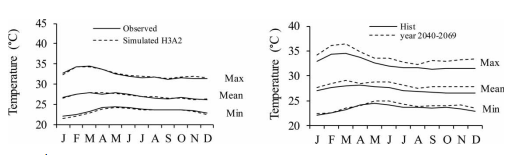
Figure 1. Simulated and projected (years 2040-2069) temperature trend at Alor Setar meteorological station
Source: Figure reproduced from Tukimat and Harun (2015, 653).
Reproducing a photograph
Provide the full reference details in a caption presented directly below the photograph, starting with a figure number (e.g. Figure 1.)
Captions may include the name of the creator/photographer, title or description of the photo, year of creation, information about the medium and dimensions (if available), source details, object number (if available) and copyright information (if available).
When formatting photograph captions:
- If the creator is unknown, leave this part blank, or write ‘Unknown Creator’
- Titles of photographs are usually presented in italics and in sentence case capitalisation (see Figure 1 below). If there is no title, provide a description of the photograph, presented in sentence case capitalisation and without italics (see Figure 2 below)
- If the year is unknown, write n.d. (for no date)
- If viewed online, provide a URL; if it’s long, use a shortened version that still allows readers to find the source
- If available, state the copyright year and the name of the copyright holder or provide a Creative Commons licence. See Copyright and Creative Commons for more detail.
- Adjust the information as needed, e.g. if there is no copyright information, leave this out etc.
Note: For photographs of works of art, see section on Reproducing a work of art.
Reference list:
- Provide a reference list entry for the source (journal article, book, etc.) where you found the photograph. Follow the instructions in the Chicago referencing guide.
In-text:
- In the text of your assignment, refer to the photo by its number. See Assignment example
Examples of reproduced photographs
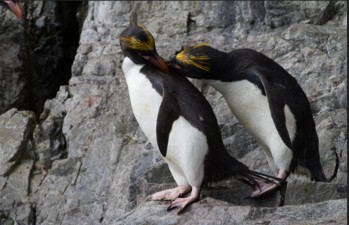
Figure 1. Pablo Fernicola, Rockhopper penguins preening. 2012, digital photo. Reproduced from: Flickr. https://www.flickr.com/photos/fernicola/8331007094/. CC BY-NC 2.0.
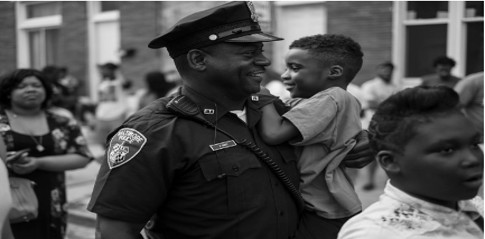
Figure 2. Devin Allen, Untitled photograph of a Baltimore police officer holding a child. 2015, digital photo, 3264 pixels x 4896 pixels. Reproduced from: Smithsonian Institution, object no. 2016.98.52. https://www.si.edu/object/untitled:nmaahc_2016.98.11. Copyright by Devin Allen.
Reproducing a work of art (e.g. painting, drawing, sculpture, photograph)
Provide the full reference details in a caption presented directly below the artwork, starting with a figure number (e.g. Figure 1.).
There is no single format for artwork captions; the information included depends on the type of artwork (see examples below) Captions may include the name of the artist/creator, title or description of the artwork, year (creation/completion), medium, dimensions, location (e.g. gallery, museum), accession/object number, source details and copyright information.
When formatting artwork captions:
- If the artist or creator is unknown, leave this part blank, or write ‘Unknown Artist’
- For Indigenous Australian artworks, include the Traditional Country or Language Group (if available) in title case capitalisation (see Figure 6 below)
- Titles of paintings, drawings, sculptures, photographs and other works of art are presented in italics and in title case capitalisation (see Figure 3 below). However, the names of works of antiquity (e.g. physical artifacts, sculptures, sacred sites, monuments etc. that were created in ancient times) are not presented in italics (see Figures 4 and 5 below)
- If there is no title, provide a description of the artwork; descriptions are presented in sentence case capitalisation and without italics (see Figure 4 below)
- If the year of creation or completion is unknown, write n.d. (for no date)
- If viewed online, provide a URL; if it’s long, use a shortened version that still allows readers to find the source
- Where available, state the copyright year and the name of the copyright holder or provide a Creative Commons licence. See Copyright and Creative Commons for more detail.
- Adjust the information as needed: omit unavailable details; if a photographer is mentioned, add the name before the source etc.
Reference list: _
- Provide a reference list entry for the source (journal article, book, website etc.) where you found the artwork. Follow the instructions in the Chicago referencing guide.
In-text:
- In the text of your assignment, refer to the artwork by its number. See Assignment example
Examples of reproduced artworks
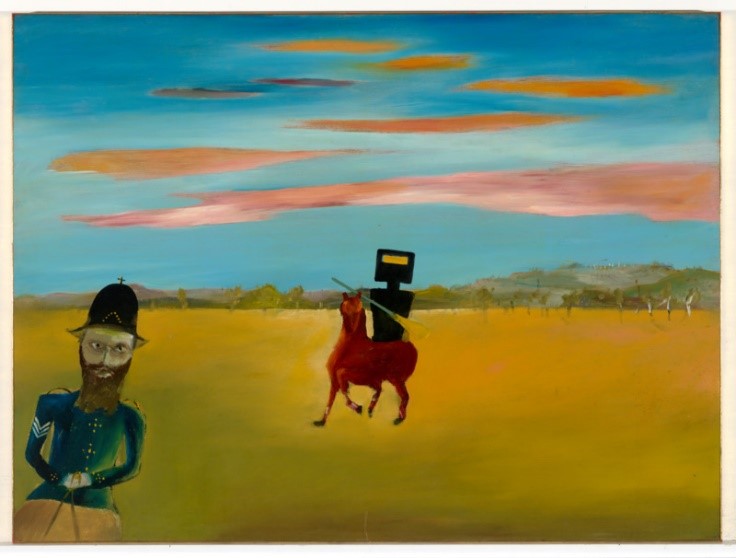
Figure 3. Sidney Nolan, The Encounter. 1946, enamel paint on hardboard, 121.2 x 90.4 cm. Reproduced from: National Gallery of Australia, accession no. 76.289. https://searchthecollection.nga.gov.au/object/28938. Copyright 2026 by The Sidney Nolan Trust.
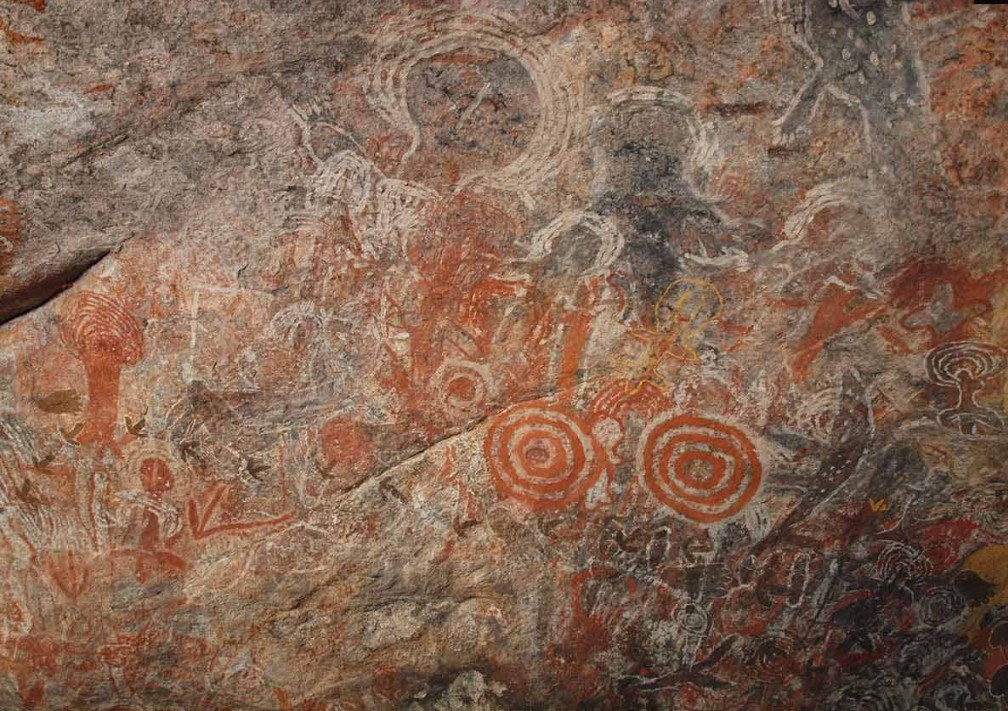
Figure 4. Australian rock art. n.d., Walinynga (Cave Hill) Archaeological Site, South Australia. Reproduced from: National Museum of Australia. https://www.nma.gov.au/defining-moments/resources/first-rock-art.
Figure 5. Head of the God Amun. ca. 1336-1327 B.C., granodiorite, 44 x 38.2 x 41.5 cm. Reproduced from: Metropolitan Museum of Art, New York, object no. 07.228.34. https://www.metmuseum.org/art/collection/search/544691.
Figure 6. Marg Adams ( Kamilaroi, Northern Riverine Region), Reflection. 1996, synthetic polymer paint on canvas, 94.4 x 123.3 x 3.9 cm. Reproduced from: Art Gallery of New South Wales, accession no. 567.1996. https://www.artgallery.nsw.gov.au/collection/works/567.1996/. Copyright by The Estate of Marg Adams.
Scenario 2: Including published tables or figures in a PowerPoint
A PowerPoint presentation has a different purpose from an essay or report but still requires referencing, including acknowledgement of tables and figures adapted or reproduced from another source. Please check with your tutor for specific requirements for referencing in PowerPoints.
Including a table in a PowerPoint slide
On the slide, state the Table number and title (in sentence case capitalisation). Below the table, provide the source information:
Table 1: Physical development of inland NSW magpies (n=36)
| Age | Weight (g) | Body length (mm) |
|---|---|---|
| 1st week | 50-73 | 51 |
| 2nd week | 100-208 | 76 |
| 3rd week | 220-250 | 89 |
| 4th week | 380 | 104 |
| 3 months | 340-400 | 104 |
Source: Table adapted from Kaplan (2019, 124).
Including a figure in a PowerPoint slide
On the slide include the figure number and title below the figure:
Galahs: Background information
- Galahs are members of the Cockatoo family (Birdlife Australia, n.d.)
- Galahs can grow to 35 cm and live to 25 years in the wild (Foundation for National Parks & Wildlife, n.d.)
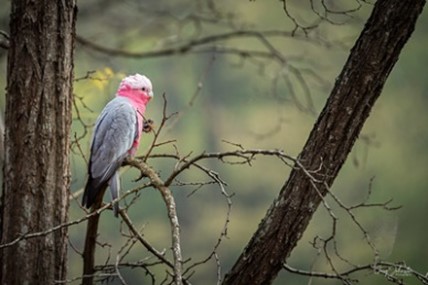
At the end of your presentation, before the reference list, provide a separate list of figures used in your presentation. This contains the caption information that would usually be included under the figure.
Example list of figures in a PowerPoint slide
List of Figures
Figure 1. Greg Johnston, Galah. 2019, digital photo. Reproduced from: Flickr. https://www.flickr.com/photos/gregjohnston/48372512176. CC BY-NC 2.0.
Figure 2. Jim Bendon, Galah walking. 2015, digital photo. Reproduced from: Flickr. https://www.flickr.com/photos/jim_bendon_1957/16207540769/. CC BY-SA 2.0.
Your PowerPoint should always end with your reference list, detailing all the sources used in your presentation (including tables and figures):
Example of a reference list in a PowerPoint slide
References
Bendon, Jim. 2015. “Galah Walking.” Flickr. https://www.flickr.com/photos/jim_bendon_1957/16207540769/.
BirdLife Australia. n.d. “Galah: Basic Information.” Birds in Backyards. Accessed January 13, 2023. https://www.birdsinbackyards.net/species/Eolophus-roseicapillus.
Foundation for National Parks & Wildlife. n.d. “Galah.” Backyard Buddies. Accessed January 13, 2023. https://www.backyardbuddies.org.au/fact-sheets/Galah.
Johnston, Greg. 2019. “Galah.” Flickr. https://www.flickr.com/photos/gregjohnston/48372512176.
Kaplan, Gisela. 2019. Australian Magpie: Biology and Behaviours of an Unusual Songbird. 2nd ed. Victoria, Australia: CSIRO Publishing. https://ebookcentral.proquest.com/lib/curtin/reader.action?docID=5762566.
Scenario 3: Using your own table or figure
You may wish to include your own photos in an assignment, or you may create a table or figure to present data that you have collected yourself. In this scenario, you will need to include a table or figure number, as well as a descriptive title.
Including your own table
Above the table:
- Write the word Table followed by the number and a colon (e.g. Table 2:)
- If you have more than one table in your paper, number them sequentially in the order that they appear in your text (Table 1, Table 2)
- Give each table a brief explanatory title. The title should be in sentence case capitalisation (where only the first word of the title, the first word of a subtitle, and proper names are capitalised), with no full stop.
Below the table:
- No attribution is required as you have collected the data yourself; however you may want to write ‘Table by Author’ or something similar if omitting the attribution will cause confusion.
Reference list:
- No reference list entry required as you are reporting your own research.
Example of your own table
Table 2: Pet ownership by occupation
| Occupation | Dogs | Cats | Birds |
|---|---|---|---|
| Librarian | 22 | 56 | 9 |
| Accountant | 53 | 29 | 6 |
| Ornithologist | 22 | 0 | 61 |
| Artist | 33 | 33 | 22 |
Including your own figure
Below the figure:
- Write the word Figure, followed by the number and a full stop (e.g. Figure 2.)
- If you have more than one figure in your paper, number them sequentially in the order that they appear in your text (Figure 1, Figure 2)
- Give each figure a brief explanatory title. The title should be in sentence case capitalisation (where only the first word of the title, the first word of a subtitle, and proper names are capitalised), with no full stop
- No attribution is required as it is your own figure; however you may want to write ‘Photograph by Author’ or something similar if omitting the attribution will cause confusion.
Reference list:
- No reference list entry required as you are reporting your own research.
Example of your own figure
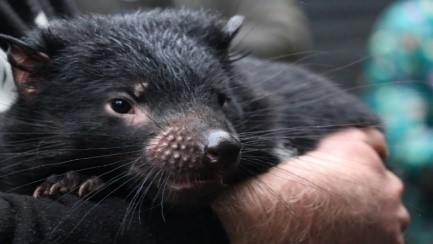
Figure 2. Sleepy Tasmanian Devil in the rain (Photo by Author)
Scenario 4: Using published data to create your own table
When creating your own tables from published data (e.g. with data taken from a report, journal article, book etc.), an in-text citation and reference list entry is usually sufficient acknowledgement of the source material.
Above the table:
- Write the word Table followed by the number and a colon (e.g. Table 3:)
- If you have more than one table in your paper, number them sequentially in the order that they appear in your text (Table 1, Table 2)
- Give each table a brief explanatory title. The title should be in sentence case capitalisation (where only the first word of the title, the first word of a subtitle, and proper names are capitalised), and have no full stop.
Below the table:
- Write the word Source(s) in italics followed by a colon, then write “Data from”
- Provide the name of the author, year of publication and page number for each source used
- If your data comes from more than one source, identify your sources with a superscript letter and separate them with a semi colon.
Reference list
- Provide a reference list entry for the source(s) (journal article, book, etc.) where you found the data. Follow the instructions in the Chicago referencing guide.
In-text:
- In the text of your assignment, refer to the table by its number. See Assignment example
Example of a table created using published data
Table 3: Australian government Indigenous programs and policy locations with Indigenous population by selected states
| State | Number of centresa |
Total Indigenous population |
|---|---|---|
| NSW | 56 | 216,170b |
| WA | 342 | 75,976c |
Sources: Data from a Services Australia (2020); b Australian Bureau of Statistics (2017a, Section: People); c Australian Bureau of Statistics (2017b, Section: People)
If there are no page numbers, add a paragraph number or other identifier to help the reader locate the information, e.g. Section name.
Example incorporating tables and figures into an assignment
Australia’s Indigenous people have a longstanding connection with country, valuing it for a range of cultural, social and economic reasons, in a history that goes back an estimated 60,000 years (Jacobsen, Howell, and Read 2020; Olsen and Russell 2019). Prior to colonisation Australia was comprised of over 250 societies that covered the entire landmass, groups that had their own language, customs and responsibility for managing the land (Karidakis and Kelly 2017). This responsibility has only recently begun to be handed back to Indigenous people with Jacobsen, Howell, and Read (2020) reporting 134 million hectares of land in Australia, 17% of the total landmass, as Indigenous owned. Figure 1 presenting data from the Australian Bureau of Agriculture and Resource Economics and Sciences (ABARES 2020) shows that the bulk of this land is located in central Australia.
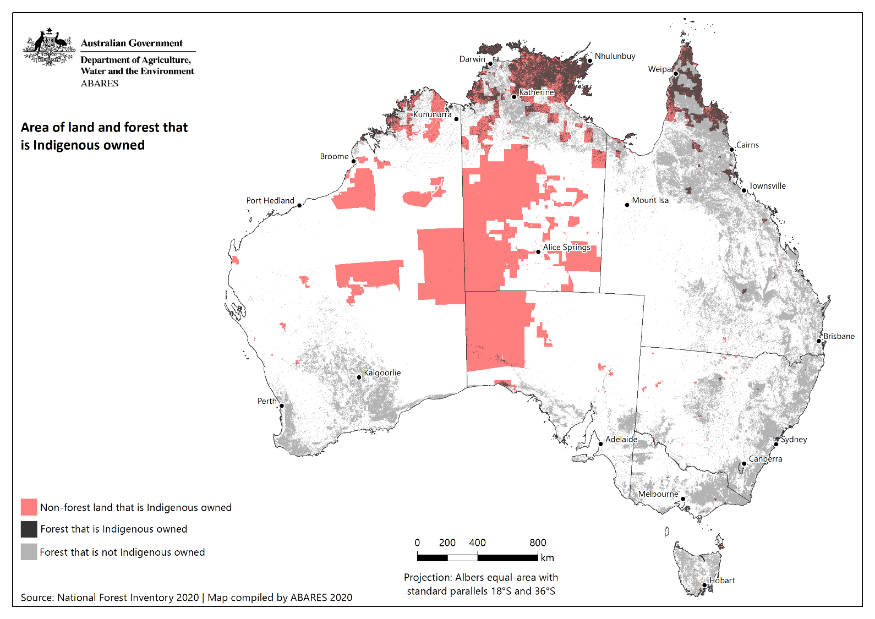
Figure 1. Areas of land and forest that is Indigenous owned
Source: Figure reproduced from Australian Bureau of Agriculture and Resource Economics and Sciences (2020, Map 1). CC-BY 4.0.
Dillon et al. (2015, 6) defines Indigenous land as “all land over which Indigenous people have use and rights as recognised through ownership, management, access or other special rights.” Incorporating these broader definitions, Table 1 breaks down the total area of recognised Indigenous land in Australia.
Table 1: Indigenous land management categories and size (hectares)
| Category | Definitiona | Total areab |
|---|---|---|
| Owned and managed | Lands that are both owned and managed by Indigenous communities | 142,306,000 |
| Managed | Lands that are managed but not owned by Indigenous communities | 32,357,000 |
| Co-managed | Owned and managed by non-Indigenous parties, but agreements guarantee Indigenous people rights in managing land | 28,028,000 |
| Special rights | Lands subject to Native Title determinations and active Indigenous Land Use Agreements | 304,531,000 |
Sources: Data from a Dillon et al. (2015, 9); b Jacobsen, Howell, and Read (2020, 5).
References
Australian Bureau of Agriculture and Resource Economics and Sciences. 2020. “Australia’s Indigenous Forest Estate.” Australian Government. https://data.gov.au/data/dataset/australia-s-indigenous-forest-estate-2020/resource/02e9f3f5-181c-4a71-b4af-70e43d71f28d.
Dillon, Robert, Jeya Jeyasingham, Sid Eades, and Steve Read. 2015. Development of Australia’s Indigenous Forest Estate (2013) Dataset. Research Report 15.6. Canberra: Canberra: Australian Bureau of Agricultural and Resource Economics and Sciences. https://www.agriculture.gov.au/sites/default/files/documents/IndigenousForestEstate_20150828_v1.0.0.pdf.
Jacobsen, Rohan, Claire Howell, and Steve Read. 2020. Australia’s Indigenous Land and Forest Estate: Separate Reporting for Indigenous Ownership, Management and Other Special Rights. Technical Report 20.15. Canberra: Australian Bureau of Agricultural and Resource Economics and Sciences. https://daff.ent.sirsidynix.net.au/client/en_AU/search/asset/1031081/0.
Karidakis, Maria, and Barbara Kelly. 2017. “Trends in Indigenous Language Usage.” Australian Journal of Linguistics 38 (1): 105-126. https://doi.org/10.1080/07268602.2018.1393861.
Olsen, Penny, and Lynette Russell. 2019. “ ‘Civilisation’ Displaces Indigenous Wildlife Balance.” Wildlife Australia 56 (4): 36-41. https://doi.org/10.3316/ielapa.887587290235282.
Copyright and Creative Commons images
Reproducing images
It is important to consider copyright obligations when reusing an image. Don’t assume that a freely accessible image is available to use without permission. This article about copyright infringement illustrates the importance of permission checking before reusing images found on the web.
Many images can be freely downloaded under certain terms and conditions, while websites such as Associated Press, iStock by Getty Images, and Shutterstock require payment for a license to reuse content.
Open license, Creative Commons and public domain images
One of the easiest ways to successfully ensure that you are abiding by copyright requirements is to select Open License, Creative Commons (CC) or public domain images.
An Open License is one that grants permission to access, reuse and redistribute work with few or no restrictions. Creative Commons is the most well-known open license system.
A CC license doesn’t replace copyright. CC material is still protected by copyright, but the copyright owners have provided upfront permission for others to reuse their content in particular ways. You don’t have to seek permission from the copyright holder as long as you abide by the conditions set out in the CC license. You can find out more about the various CC licenses through the Creative Commons website.
Public domain images can refer to material in which copyright has expired and can be used without restriction; or where the copyright owner gives very broad permissions to people to use the content freely.
Where can I find Open License, Creative Commons and public domain images?
The following websites provide easily accessible advance search filters to quickly identify Creative Commons or public domain images:
- flickr
- Openverse (formerly Creative Commons image search)
- Wikimedia Commons
- The New York Public Library Digital Collections
- State Library of Victoria copyright-free image search (mainly historical images)
- Unsplash
- CSIRO ScienceImage
Locating copyright or Creative Commons information
Sometimes it can be difficult to locate copyright or license information associated with a table or figure. If it’s not presented alongside the content you want to use, do a search of the document for either ‘copyright’ or ‘CC’ using Ctrl + F (command + F on a Mac).
On some websites, you might want to check the footer for a link to ‘Terms of use’ which will provide you with the information you need for copyright acknowledgement.
Reference list
Include a reference list entry for each source used in your assignment, including sources of figures and tables. Below is a list of references used in this tables and figures guide.
References
Australian Bureau of Statistics. 2017a. 2016 Census Aboriginal and/or Torres Strait Islander QuickStats: New South Wales. Canberra, ACT: ABS. https://quickstats.censusdata.abs.gov.au/census_services/getproduct/census/2016/quickstat/IQS5.
Australian Bureau of Statistics. 2017b. 2016 Census Aboriginal and/or Torres Strait Islander QuickStats: Western Australia. Canberra, ACT: ABS. https://quickstats.censusdata.abs.gov.au/census_services/getproduct/census/2016/quickstat/IQS1.
Bendon, Jim. 2015. “Galah Walking.” Flickr. https://www.flickr.com/photos/jim_bendon_1957/16207540769/.
BirdLife Australia. n.d. “Galah: Basic Information.” Birds in Backyards. Accessed January 13, 2023. http://www.birdsinbackyards.net/species/Eolophus-roseicapillus.
Fernicola, Pablo. 2012. “Rockhopper Penguins Preenong.” Flickr: https://www.flickr.com/photos/fernicola/8331007094/.
Foundation for National Parks & Wildlife. n.d. “Galah.” Backyard Buddies. Accessed January 13, 2023. https://www.backyardbuddies.org.au/fact-sheets/Galah.
Johnston, Greg. 2019. “Galah.” Flickr: https://www.flickr.com/photos/gregjohnston/48372512176.
National Gallery of Australia. n.d. “The Encounter.” National Gallery of Australia. Accessed May 12, 2023. https://searchthecollection.nga.gov.au/results?keyword=the%20encounter&includeParts&hasImages&searchIn=title&searchIn=artistOrCulture.
Services Australia. 2020. “Australian Government Indigenous Programs & Policy Locations (AGIL) Dataset.” Australian Government. https://data.gov.au/data/dataset/34b1c164-fbe8-44a0-84fd-467dba645aa7.
Smithsonian Institution. 2018. “Great White Shark: Carcharodon Carcharias.” Smithsonian Institution. https://ocean.si.edu/ocean-life/sharks-rays/great-white-shark.
Tukimat, Nurul, and Sobri Harun. 2015. “Climate Change Impact on Rainfall and Temperature in Muda Irrigation Area Using Multicorrelation Matrix and Downscaling Method.” Journal of Water and Climate Change 6 (3): 647-660. https://doi.org/10.2166/wcc.2015.015.
Westgarth, Carri, Robert M. Christley, Garry Marvin, and Elizabeth Perkins. 2017. “I Walk My Dog Because It Makes Me Happy: A Qualitative Study to Understand Why Dogs Motivate Walking and Improved Health.” International Journal of Environmental Research and Public Health 14 (8): 936. https://doi.org/10.3390/ijerph14080936.
</div>
Referencing checklist
This brief checklist highlights some general points to pay attention to when editing your in-text citations and reference list. For the components and formatting required for specific reference types, please consult the relevant sections of this guide.
In-text citations
Example: (Smith, Jones, and Lopez 2018).
Reference list
Example: Smith, Ben, Brooke A. Burke, and Jay M. Lopez.
Example: Networked Privacy: How Teenagers Negotiate Context in Social Media
About UniSkills
UniSkills was created and is maintained by Curtin University Library. To report issues with UniSkills contact Library Help.
Twemoji icons by Twitter, Inc and other contributors, licensed under a CC-BY 4.0 licence.
Except where otherwise noted, UniSkills content in all it’s forms (website, PDFs etc) are licensed under a Creative Commons Attribution ShareAlike 4.0 International Licence. We ask that you attribute any use of the content as created by Curtin University Library with a link to the Library website.
This license does not extend to other Curtin University and Curtin University Library webpages, or to Curtin branding and trademarks. Curtin University’s copyright information is available on the Curtin website.