
APA-7th-referencing-printable-guide-UniSkills.pdf
APA 7th referencing
Table of Contents
Introduction
APA 7th is an author-date referencing style used in many subject areas. It is based on the Publication Manual of the American Psychological Association, 7th edition.
This guide is designed for students completing assessments at Curtin University. If you are publishing (e.g., a journal article or PhD thesis), you should consult the official APA manual as requirements may differ.
What is referencing?
Referencing is a standard way to acknowledge sources of information you use in your assessments or research. It identifies the source clearly so others can find it, avoids plagiarism by giving credit to the original author and supports your ideas and arguments with evidence.
Printable referencing guide
A printable APA 7th referencing guide is available on the UniSkills downloads page.
Note on assignment formatting
Please check your unit outline/Blackboard for assessment formatting requirements (such as fonts, headers, spacing, word counts etc.) and assessment cover sheets. PhD and Masters by research students should consult the relevant publication manual for formatting information. </div>
APA referencing quiz
This short interactive tutorial and quiz should take 10-15 minutes to complete.
H5P interactive activity In-text citations
In-text citations are included in your writing to acknowledge the sources of information you have used to support your ideas. They briefly identify a work by its author and year of publication and direct readers to a reference list entry with the full details of the source. In-text citations are required for both paraphrasing and quoting. Additional locator information, such as a page or paragraph number, is also included in some instances.
In brief, this page explains how to:
- present in-text citations: information prominent or author prominent
- include multiple sources in the same in-text citation
- cite multiple works with the same author(s) and publication year
- cite different first authors who have the same surname
- cite authors who have quoted or referred to other authors
- format quotations
</div>
Types of in-text citations
In-text citations can be presented in two ways:
Information prominent - The author(s) and year are in brackets.
It could be argued that mental flexibility is a key factor in well-being (Palladino & Wade, 2010).
Author prominent - The author(s) is part of the sentence, and the year is in brackets.
Palladino and Wade (2010) argue that mental well-being is linked with flexible thinking.
Format of in-text citations The following examples demonstrate how to create in-text citations based on the number of authors and other relevant factors.
Number of authors to include for in-text citations
The format of the authors in the in-text citation changes according to the number of authors for the work.
- One or two authors: Include the author’s surname(s) in every citation
- Three or more authors: Use the first author’s surname followed by et al. (which means “and others”) in all citations
- No author: See the No author section on the Reference list page.
| Author type | Information prominent | Author prominent |
|---|---|---|
| One author | (Smith, 2020). | According to Smith (2020)… |
| Two authors | (Smith & Jones, 2020). | Smith and Jones (2020) highlighted this… |
| Three or more authors | (Thomas et al., 2018). | Thomas et al. (2018) recommends… |
| Organisation as author | (World Health Organization, 2018). | World Health Organization (2018) state… |
| Organisation with optional abbreviation |
First citation: (World Health Organization [WHO], 2018). Later citations: (WHO, 2018). |
First citation: World Health Organization (WHO, 2018) have… Later citations: WHO (2018) mentions… |
In-text citation variations
Multiple sources in the same citation
Sometimes you might want to include more than one source in a single in-text citation. This is useful when you are showing that many authors agree on the same idea (called synthesising).
- Put all the sources in the same set of brackets
- List them in alphabetical order by the first author’s surname
- Separate each source with a semicolon (;)
- Make sure each source is listed in your reference list.
Multiple sources example
There is an established consensus that the current trend towards a warming climate is directly linked to human activity (Hegerl, 1996; Levitus et al., 2017; NASA, n.d.; Robinson et al., 2014).
Multiple works by the same author(s) published in the same year
If you cite multiple works by same author (or authors) published in the same year, add a letter after the year (a, b, c) to tell the works apart.
- In the reference list, order the works alphabetically by their title
- In the in-text citation, include the letter after the year
- If the work has no date (shown as n.d.), use: (n.d.-a), (n.d.-b), etc.
In-text citation
(Clarke & Fawcett, 2014b).
Clarke and Fawcett (2014a) suggest that…
Reference list
Clarke, P. N., & Fawcett, J. (2014a). Life as a mentor. Nursing Science Quarterly, 27(3), 213-215. https://doi.org/10.1177/0894318414534492
Clarke, P. N., & Fawcett, J. (2014b). Life as a nurse researcher. Nursing Science Quarterly, 27(1), 37-41. https://doi.org/10.1177/0894318413509708
Multiple works shorten to the same in-text citation
If multiple works with three or more authors shorten to the same citation, write out as many author names as needed to tell the sources apart and use et al. for the remaining authors. If the only difference is the last author, write all author names in every citation.
In-text citation example
(Smith, Jones, McDonald et al., 2019)
(Smith, Jones, Black et al., 2019)
OR
Smith, Jones, McDonald et al. (2019)
Smith, Jones, Black et al. (2019)
Different first authors with the same surname
If you use sources where the first authors have the same surname, but different initials, you need to include the initials in your in-text citations. This helps readers tell the authors apart and find the correct entry in your reference list. This rule applies even if the works were published in different years.
Examples
(B. Johnson, 2017). OR According to B. Johnson (2017)…
(M. Johnson et al., 2016). OR M. Johnson et al. (2016) state…
Authors citing other authors
Academic content such as books and journal articles will often contain a lot of citations. You need to credit the original author (primary source) when:
- They are quoted by your source (the secondary source) and you use that quote in your work
- When a specific study is discussed in the secondary source, and you use the findings or ideas from that study without accessing the primary source.
When you cite a secondary source:
- In your in-text citation, include the author and year from the primary (original) source, followed by “as cited in” and the author, year, and page number of the source you actually read (the secondary source)
- In your reference list, only include the secondary source.
In-text citation
“We are part of the land, it is part of us” (Philippe, 2008, as cited in Maldonado et al., 2013, p. 610).
OR
Philippe (2008, as cited in Maldonado et al., 2013) states “we are part of the land, it is part of us” (p. 610).
Reference list
Maldonado, J. K., Shearer, C., Bronen, R., Peterson, K., & Lazrus, H. (2013). The impact of climate change on tribal communities in the US: Displacement, relocation, and human rights. Climatic Change, 120(3), 601-614. https://doi.org/10.1007/s10584-013-0746-z
Still confused about who to reference? Watch this short video for further explanation and examples: https://youtu.be/tkwboeng0WY
Quoting
Quoting means copying the exact words from another source into your writing. For more information, check out Integrating sources: Quoting for examples and tips.
Short quotations (40 words or less)
- Use quotation marks around the quote “ “
- Include the author, year and page number (or another identifier if there are no page numbers) in the in-text citation.
Quoting example - with page numbers
“Automatic thinking is thought that is nonconscious, unintentional, involuntary, and effortless” (Aronson et al., 2021, p. 75).
OR
Aronson et al. (2021) define automatic thinking as “thought that is nonconscious, unintentional, involuntary, and effortless” (p. 75).
Quoting example - without page numbers
Lee (2015) states that, “in APA style, double quotation marks are used to enclose quoted material” (para. 1).
OR
“In APA style, double quotation marks are used to enclose quoted material” (Lee, 2015, para. 1).
Long quotations (more than 40 words)
If the quote you want to use is more than 40 words, format it as a block quotation:
- Start the quote on a new line
- Indent the whole quote from the left margin
- Do not use quotation marks
- Put the in-text citation in brackets after the final punctuation mark. Include the author, year of publication, and page number or another identifier.
Block quotation example
In-text citations are important in academic writing, drawing the parallel between the author’s work and the sources which support it:
The function of any citation-signaller is to alert the reader to some kind of association between the citing text and the cited text. Citation-signallers may additionally, by using page references or chapter numbers, single out a particular part of the text as especially relevant. (Langham, 2005, p. 361)
</div>
Page numbers and other identifiers When you quote from a source, you should include a page number in your in-text citation. This helps readers find the exact part of the source you are referring to. If the source does not have page numbers, use another type of identifier, such as: a paragraph number, heading or section name, or timestamp.
| Identifier | Example |
|---|---|
| Page number | (Thomas et al., 2018, p. 23). |
| Paragraph number | (World Health Organization, 2025, para. 3). |
| Heading or section name | (Australian Bureau of Statistics, 2024, Education and Employment section). |
|
Heading or section name with paragraph number |
(American Psychiatric Association, 2022, Pica section, para. 1). (Brosnan, 2020, Linking Cooperation section, para. 3). |
|
Timestamp (Audiovisual material) Use the format: HH:MM:SS |
(Sandberg, 2019, 1:55:51). (Leaver, 2012, 1:30). |
| Slide number | (Richardson, 2015, slide 9). |
Reference lists
The reference list gives the full details of the sources you used in your work. Reference list entries usually include four parts: author, date, title and source.
Authors
These rules apply to all types of sources, including books, journal articles, and websites. When writing your reference list:
- Start with the author’s last name (surname), followed by a comma and their initials. For example, Jane Smith becomes Smith, J.
- Put a full stop after each initial and a space between them. For example: Lee, S. A.
- List the authors in the same order they appear in the source you are referencing.
No author
If a source does not list a personal author, first check if an organisation is named as the author. If there is no author at all, and you are sure the source is credible, follow these steps:
- Use the title of the work instead of the author’s name in both your in-text citation and the reference list
- If the title is long, shorten it in the in-text citation to make it easier to read
- If the title is italicised in the reference list, italicise it in the in-text citation too
- If the title is not italicised in the reference list, use double quotation marks around it in the in-text citation
- Use headline style capitalisation (capitalise all major words) in both the in-text citation and in your writing
- In your reference list, arrange the entry alphabetically by the first word of the title (ignore words like A, An, In, or The at the beginning).
In-text citation
(In the Former Capital, 2020). OR The article In the Former Capital (2020) suggests…
(“A Higher Education Return,” 2016). OR In the article “A Higher Education Return” (2016)…
Reference list
In the former capital of pro-slavery America, Confederate statues are coming down. (2020, July 2). SBS News. https://sbs.com.au/news/in-the-former-capital-of-pro-slavery-america-confederate-statues-are-coming-down
A higher education return. (2016, August 18). The Australian. https://www.proquest.com/newspapers/higher-education-return/docview/1811922139/se-2?accountid=10382
One to 20 authors
- If there is more than one author, add a comma after each name and use an ampersand (&) before the last author
- Include all authors in the reference list entry.
Examples
Burns, T. (2015). Philosophy and poetry: A new look at an old quarrel. The American Political Science Review, 109(2), 326-338. https://doi.org/10.1017/S0003055415000076
Habary, A., Johansen, J. L., Nay, T. J., Steffensen, J. F., & Rummer, J. L. (2017). Adapt, move or die - How will tropical coral reef fishes cope with ocean warming? Global Change Biology, 23(2), 566-577. https://doi.org/10.1111/gcb.13488
Lane, R., & Catling, S. (2016). Preservice primary teachers’ depth and accuracy of knowledge of tropical cyclones. Journal of Geography, 115(5), 198-211. https://doi.org/10.1080/00221341.2016.1153133
21 or more authors
- In the reference list entry, list the first 19 authors followed by an ellipsis (…) then the final author’s name
- Do not use an ampersand (&) before the final author’s name in this case.
Example
Naghavi, M., Abajobir, A. A., Abbafati, C., Abbas, K. M., Abd-Allah, F., Abera, S. F., Aboyans, V., Adetokunboh, O., Afshin, A., Agrawal, A., Ahmadi, A., Ahmed, M. B., Aichour, A. N., Aichour, M. T. E., Aichour, I., Aiyar, S., Alahdab, F., Al-Aly, Z., Alam, K., . . . Murray, C. J. L. (2017). Global, regional, and national age-sex specific mortality for 264 causes of death, 1980-2016: A systematic analysis for the Global Burden of Disease Study 2016. The Lancet, 390(10100), 1151-1210. https://doi.org/10.1016/S0140-6736(17)32152-9
Organisation as author
- Write the organisation name in full in the reference list
- If there are multiple departments listed, use the one most responsible for the content as the author. This is common in government documents, where the full hierarchy might be shown. For example: Government of Western Australia, East Metropolitan Health Service, Royal Perth Hospital. In this case, Royal Perth Hospital is the department that created the content, so it should be listed as the author. The larger organisation (e.g. Government of Western Australia) can be listed as the publisher in the source element.
Examples
Royal Perth Hospital. (2023, April 14). Electronic prescriptions. Government of Western Australia. https://rph.health.wa.gov.au/Patients-and-Visitors/Outpatients/Electronic-Prescriptions
World Health Organization. (2023). Global status report on road safety 2023. https://www.who.int/teams/social-determinants-of-health/safety-and-mobility/global-status-report-on-road-safety-2023
Title capitalisation
All titles, with the exception of journal titles, should be presented in sentence-case capitalisation (where only the first letter of the first word, the first letter of a subtitle and any proper nouns or abbreviations are capitalised). </div>
Example: Youth subcultures: Theory, history and the Australian experience
Journal titles should be presented in headline-style capitalisation (where each significant word is capitalised). </div>
Example: New England Journal of Medicine
DOIs and URLs
A DOI (Digital Object Identifier) is a unique link to a journal article, book, or online document.
- In APA style, DOIs are written as hyperlinks starting with https://doi.org/. Example: https://doi.org/10.1108/HER-10-2015-0023
- If a DOI is available, use it instead of a URL because it is more stable
- If there is no DOI, include the URL of the source
- All DOIs and URLs should start with https:// and can be presented as either live links or as plain text, but should be consistent throughout the reference list.
Where can I find the DOI?
Look on the first page of the article or in the publication details. If you cannot find the DOI, press CTRL + F (Windows) or Command + F (Mac) and search for “doi”.
</div>
Reference list page layout
- Start the reference list on a new page after your main text
- Write References in bold and centre it at the top of the page
- Double space the entire list (both within and between entries)
- Use a hanging indent of 1.27cm for each entry.
Sample reference list
References
Arkoudis, S., Dollinger, M., Baik, C., & Patience, A. (2019). International students’ experience in Australian higher education: Can we do better? Higher Education, 77(5), 799-813. https://doi.org/10.1007/s10734-018-0302-x
Boulton, C. A., Hughes, E., Kent, C., Smith, J. R., & Williams, H. T. P. (2019). Student engagement and wellbeing over time at a higher education institution. PLoS ONE, 14(11), Article e0225770. https://doi.org/10.1371/journal.pone.0225770
Forsyth, H. (2014a). Dreaming of higher education. Southerly, 74(2), 119-142. https://search.informit.org/doi/10.3316/informit.792227855125093
Forsyth, H. (2014b). A history of the modern Australian university. NewSouth Publishing.
Forsyth, H. (2017). Post-war political economics and the growth of Australian university research, c.1945-1965. History of Education Review, 46(1), 15-32. https://doi.org/10.1108/HER-10-2015-0023
A higher education return. (2016, August 18). The Australian. https://www.proquest.com/newspapers/higher-education-return/docview/1811922139/se-2?accountid=10382
Massachusetts Institute of Technology (MIT). (2019, February 27). The future of higher education in the age of disruption [Video]. YouTube. https://youtu.be/NFP2S2f3io4
Rudick, C. K., & Dannels, D. P. (2018). “Yes, and … “: Continuing the scholarly conversation about immigration and higher education. Communication Education, 67(1), 120-123. https://doi.org/10.1080/03634523.2017.1392584
10 ways wearables will revolutionise education. (2015, April 28). Progressive Digital Media Technology News. https://www.proquest.com/wire-feeds/10-ways-wearables-will-revolutionise-education/docview/1677305214/se-2?accountid=10382
Tierney, W. G., & Lanford, M. (2016). Conceptualizing innovation in higher education. In M. B. Paulsen (Ed.), Higher education: Handbook of theory and research (pp. 1-40). Springer. https://doi.org/10.1007/978-3-319-26829-3
United Nations Educational, Scientific and Cultural Organization. (n.d.). Education transforms lives. https://www.unesco.org/en/education
United Nations Educational, Scientific and Cultural Organization. (2016). Global education monitoring report, 2016: Place: Inclusive and sustainable cities. https://unesdoc.unesco.org/ark:/48223/pf0000246230
The World Bank. (2025). Tertiary education. https://www.worldbank.org/en/topic/tertiaryeducation
Order of references in the reference list
Sort entries alphabetically by the first author’s surname or organisation name. If there is no author, use the first word of the title, ignoring words like A, An, or The at the beginning. </div>
Arkoudis, S., Dollinger, M., Baik, C., & Patience, A. (2019). International students’ experience in Australian higher education: Can we do better? Higher Education, 77(5), 799-813. https://doi.org/10.1007/s10734-018-0302-x
Boulton, C. A., Hughes, E., Kent, C., Smith, J. R., & Williams, H. T. P. (2019). Student engagement and wellbeing over time at a higher education institution. PLoS ONE, 14(11), Article e0225770. https://doi.org/10.1371/journal.pone.0225770
A higher education return. (2016, August 18). The Australian. https://www.proquest.com/newspapers/higher-education-return/docview/1811922139/se-2?accountid=10382
List works by the same author(s) by publication date, starting with the oldest first. References with no date (n.d.) come before references with dates. </div>
Bull, M. (2008). Governing the heroin trade: From treaties to treatment. Ashgate Publishing. https://ebookcentral.proquest.com/lib/curtin/detail.action?docID=438571
Bull, M. (2015). Punishment and sentencing: Risk rehabilitation and restitution. Oxford University Press. https://ebookcentral.proquest.com/lib/curtin/detail.action?docID=1985996
If there are multiple works by the same author(s) published in the same year, order them alphabetically by title. Add a, b, c after the year to tell them apart. </div>
Forsyth, H. (2014a). Dreaming of higher education. Southerly, 74(2), 119-142. https://search.informit.org/doi/10.3316/informit.792227855125093
Forsyth, H. (2014b). A history of the modern Australian university. NewSouth Publishing.
If a reference list entry starts with a number, alphabetise it as if the number were spelled out (e.g. treat 10 as if written as ten) </div>
Rudick, C. K., & Dannels, D. P. (2018). “Yes, and … “: Continuing the scholarly conversation about immigration and higher education. Communication Education, 67(1), 120-123. https://doi.org/10.1080/03634523.2017.1392584
10 ways wearables will revolutionise education. (2015, April 28). Progressive Digital Media Technology News. https://www.proquest.com/wire-feeds/10-ways-wearables-will-revolutionise-education/docview/1677305214/se-2?accountid=10382
Journal & news articles
Journal article
Reference components
Author’s Surname, Initial(s). (year of publication). Title of journal article: Subtitle. Journal Title in Italics, volume number in italics(issue number), page range. https://doi.org… or URL
</div>
Reference list examples
Habray, A., Johansen, J. L., Nay, T. J., Steffensen, J. F., & Rummer, J. L. (2017). Adapt, move or die - How will tropical coral reef fishes cope with ocean warming? Global Change Biology, 23(2), 566-577. https://doi.org/10.1111/gcb.13488
Lane, R., & Catling, S. (2016). Preservice primary teachers’ depth and accuracy of knowledge of tropical cyclones. Journal of Geography, 115(5), 198-211. https://doi.org/10.1080/00221341.2016.1153133
Lock, M. (2015). Eclipse of the gene and return of divination. Current Anthropology, 46(Suppl. 5), S47-S70. https://doi.org/10.1086/432452
Steinmetz, J. D., Seeher, K. M., Schiess, N., Nichols, E., Cao, B., Servili, C., Cavallera, V., Cousin, E., Hagins, H., Moberg, M. E., Mehlam, M. L., Abate, Y. H., Abbas, J., Abbasi, M. A., Abbasian, M., Abbastabar, H., Abdelmasseh, M., Abdollahi, M., Abdollahi, M., . . . Dua, T. (2024). Global, regional, and national burden of disorders affecting the nervous system, 1990-2021: A systematic analysis for the Global Burden of Disease Study 2021. The Lancet Neurology, 23(4), 344-381. https://doi.org/10.1016/S1474-4422(24)00038-3
Extra tips
- Provide a DOI (Digital Object Identifier) or URL for online sources
- If there is no issue number, omit this from your reference
- If an article has 21 or more authors, list the first 19 authors, then an ellipsis (. . .) followed by the final author’s name
- If the article is from a supplement, replace the issue number with the word Suppl. followed by the letter or number, e.g. (Suppl. A) or (Suppl. 3). For a supplement to a specific issue, include both the issue number and the supplement, e.g. (5, Suppl. 2)
Journal article with an article number
Reference components
Author’s Surname, Initial(s). (year of publication). Title of journal article: Subtitle. Journal Title in Italics, volume number in italics(issue number), Article #. https://doi.org… or URL
</div>
D’Aquino, S., Kumar, A., Riordan, B., & Callinan, S. (2024). Long-term effects of alcohol consumption on anxiety in adults: A systematic review. Addictive Behaviors, 155, Article 108047. https://doi.org/10.1016/j.addbeh.2024.108047
Eades, S. J., & Banks, E. (2017). 50 years since citizenship: Successes and challenges in Indigenous health. Public Health Research & Practice, 27(4), Article e2741730. https://doi.org/10.17061/phrp2741730
Extra tips
- Some online journals use article numbers instead of a page range. Write the word Article followed by the article number in place of the page range in the reference
- If quoting, include the page number that appears on the article itself in the in-text citation, e.g. (D’Aquino et al., 2024, p. 2).
Advance online publication
Reference components
Author’s Surname, Initial(s). (year of publication). Title of journal article: Subtitle. Journal Title in Italics. Advance online publication. https://doi.org… or URL
</div>
Castro-Lopez, A., Cervero, A., Galve-Gonzalez, C., & Bernardo, A. (2025). The role of emotions in the university classroom: Implications for engagement and dropout prevention. Active Learning in Higher Education. Advance online publication. https://doi.org/10.1177/14697874251387029
Extra tips
- Advance online publications are articles that have been accepted for publication and made available online, but haven’t yet been included in an issue of the journal (so do not have a volume or issue number)
- Before submitting your work, check whether the article has been included in the journal issue yet and, if it has, update the reference details.
Newspaper article
Reference components
Author’s Surname, Initial(s). (year, Month day of publication). Title of article: Subtitle. Newspaper or Magazine Title in Italics. URL
</div>
Reference list examples
Garside, J., Harding, L., Watt, H., Pegg, D., Bengtsson, H., Bowers, S., Gibson, O., & Hopkins, N. (2016, April 5). What are the Panama papers? A guide to history’s biggest data leak. The Guardian. https://theguardian.com/news/2016/apr/03/what-you-need-to-know-about-the-panama-papers
A higher education return. (2016, August 18). The Australian. https://www.proquest.com/newspapers/higher-education-return/docview/1811922139/se-2?accountid=10382
Winning, D., & Glynn, J. (2020, January 6). World news: Australia’s fires create own storms. Wall Street Journal. https://www.proquest.com/newspapers/world-news-australia-s-fires-create-own-storms/docview/2333541834/se-2?accountid=10382
Extra tips
- If you are referencing a print newspaper article replace the URL with the page number e.g. The West Australian, 22.
- For articles from news websites that do not have an associated daily or weekly newspaper (such as ABC News), use Webpage from a news website (under Websites in the guide menu)
- The title moves to the author position when there is no author
Books
Book
Reference components
Author Surname, Initial(s). (year). Title of book in italics: Subtitle (# ed.). Publisher Name. https://doi.org/DOI or URL
</div>
Reference list examples
Aronson, E., Wilson, T. D., & Sommers, S. R. (2021). Social psychology (10th Global ed.). Pearson. https://ebookcentral.proquest.com/lib/curtin/detail.action?docID=6145712
Grant, S. (2021). Australia Day. Harper Collins Publishers.
Haider, J., & Sundin, O. (2022). Paradoxes of media and information literacy: The crisis of information. Routledge. https://doi.org/10.4324/9781003163237
Extra tips
- For editions other than the first, include the edition number in brackets after the book title
- Provide a DOI (Digital Object Identifier) or URL for online sources
- When quoting, if an ebook has no page numbers, cite another identifier in-text.
Chapter in an edited book
Reference components
Chapter Author Surname, Initial(s). (Year). Title of chapter: Subtitle. In Editor Initial(s). Editor Surname (Ed.), Title of book in italics: Subtitle (# ed., pp. chapter page range). Publisher Name. https://doi.org/DOI or URL
</div>
Reference list examples
Bessarab, D., & Forrest, S. (2017). Anggaba jina nimoonggoon: Whose knowledge is that? Aboriginal perspectives of community development. In C. Kickett-Tucker, D. Bessarab, J. Coffin, & M. Wright (Eds.), Mia mia Aboriginal community development: Fostering cultural security (pp. 1-18). Cambridge University Press. https://doi.org/10.1017/CBO9781107741768.002
Kaye, J. (2014). The regulation of human genomics research. In D. Kumar & C. Eng (Eds.), Genomic medicine: Principles and practice (2nd ed., pp. 259-269). Oxford University Press. https://ebookcentral.proquest.com/lib/curtin/detail.action?docID=1780390
Zeleke, W. A., Hughes, T. L., & Drozda, N. (2020). Home–school collaboration to promote mind–body health. In C. Maykel & M. A. Bray (Eds.), Promoting mind–body health in schools: Interventions for mental health professionals (pp. 11–26). American Psychological Association.
Extra tips
- For editions other than the first, include the edition number in brackets after the book title
- Provide a DOI (Digital Object Identifier) or URL for online sources
- If an ebook chapter has no page numbers, omit the page range from the reference
- When quoting, if an ebook has no page numbers cite another identifier in-text.
Conference paper
Reference components
Author Surname, Initial(s). (year, Month Day). Title of paper in italics [Type of presentation]. Title of Conference: Subtitle, Location. https://doi.org/DOI or URL
</div>
Reference list examples
Della Vedova, M. L., Tacchini, E., Moret, S., Ballarin, G., DiPierro, M., & de Alfaro, L. (2018, May 16). Automatic online fake news detection combining content and social signals [Paper presentation]. 22nd Conference of Open Innovations Association: FRUCT, Jyvaskyla, Finland. https://ieeeexplore.ieee.org/stamp/stamp.jsb?tp=&arnumber=8468301
Fredericks, J., & Lawrence, C. (2018, September 3). #thisismymob: Preserving and promoting Indigenous Australian cultural heritage [Paper presentation]. MobileCH 2018, Barcelona, Spain. http://ceur-ws.org/Vol-2176/paper3.pdf
White, H., Chan, J., & Cairns, A. (2020, February 13). Practitioner and researcher collaboration through a student master’s paper [Paper presentation]. VALA 2020: Focus on the Future, Melbourne, Australia. https://vala.org.au/vala2020-proceedings/vala2020-session-12-white
Extra tips
- Provide a DOI (Digital Object Identifier) or URL for online sources
- For a poster, use [Poster presentation]
- For conference proceedings published in a journal or book, follow the format for journal article or chapter in an edited book
Thesis
Reference components
Author Surname, Initial(s). (year). Title of dissertation or thesis in italics [Doctoral dissertation or Master’s thesis, Name of Institution Awarding the Degree]. Source Name. URL
</div>
Reference list examples
Gao, W. (2018). Fuel properties and thermal processing of bio-oil and its derived fuel mixtures [Doctoral dissertation, Curtin University]. espace. https://espace.curtin.edu.au/handle/20.500.11937/75545
Ling, J. (2015). Lords and ladies of the modern age [Master’s thesis, Mills College]. ProQuest Dissertations and Theses. https://proquest.com/dissertations-theses/lords-ladies-modern-age/docview/1676462563/se-2?accountid=10382
Religious work
Reference components
Title of work in italics. (year). Publisher Name. URL (Original work published Year)
</div>
Reference list examples
King James Bible. (2017). King James Bible Online. https://kingjamesbibleonline.org/ (Original work published 1769)
The Qur’an (M. A. S. Abdel Haleem, Trans.). (2004). Oxford University Press.
Extra tips
- Religious works are usually treated as having no author
- If the original publication date is unknown, omit this from the reference. For versions of religious works that are republished, include the republished date
- If referencing a translated version, include the translator after the title in the reference (e.g. The Qur’an example)
- Include the original publication date in the in-text citation, e.g. (King James Bible, 1769/2017).
Classic work
Reference components
Author Surname, Initial(s). (year). Title of work in italics (Translator Initial(s). Surname, Trans.; Editor Initial(s). Surname, Ed.; # ed.). Publisher Name. https://doi.org/DOI or URL (Original work published Year)
</div>
Reference list examples
Aristotle. (1997). Poetics (G. Whalley, Trans.; J. Baxter & P. Atherton, Eds.). McGill-Queen’s University Press. https://ebookcentral.proquest.com/lib/curtin/detail.action?docID=3330809 (Original work published ca. 350 B.C.E.)
Shakespeare, W. (1988). Richard III (J. Hankey, Ed.). Bristol Classic Press. (Original work published 1597)
Shakespeare, W. (2012). Romeo and Juliet. First Avenue Editions. https://ebookcentral.proquest.com/lib/curtin/detail.action?docID=5445113 (Original work published 1599)
Extra tips
- If referencing a translated version, include the translator after the title in the reference
- When the date of original publication is ancient, use the abbreviation B.C.E. (stands for ‘before the common era’), and if the date is approximate, use the abbreviation ca. (stands for ‘circa’)
- Include the original publication date in the in-text citation, e.g. (Aristotle, ca. 350 B.C.E/1997). or Shakespeare (1599/2012) wrote…
Websites
Webpage on a website
Reference components
Author Surname, Initial(s) or Organisation. (year). Title of webpage in italics. Site Name. URL
</div>
Reference list examples
Department of Education. (2025). During your studies in Australia. Australian Government. https://www.education.gov.au/international-education/during-your-studies-australia
DevelopmentWA. (n.d.). Yagan Square. https://developmentwa.com.au/projects/redevelopment/yagan-square/overview
Hansen, J. (2019, November 17). Coming together in times of crisis. Sea Shepherd. https://seashepherd.org.au/latest-news/bushfire-commentary
Extra tips
- When the author and the site name are the same, omit the site name
- If there is no date on the webpage, replace the year with (n.d.)
- Do not use a website’s copyright date as the publication date for a specific page. If the page shows a last updated date, this can be used
- If available, additional date information can be included to aid retrieval, e.g. (Year, Month) or (Year, Month Day). For the in-text citation, only the year is included
- If you are referencing multiple pages from the same website, published in the same year, create a separate reference for each. List in alphabetical order by title and add a letter (a, b, c, etc.) after the year in both the in-text citations and reference list entries, e.g. (2021a) (2021b) (n.d.-a) (n.d.-b)
Webpage on a news website
Reference components
Author Surname, Initial(s). (year, Month day). Title of article in italics. Site Name. URL
</div>
Reference list examples
In the former capital of pro-slavery America, Confederate statues are coming down. (2020, July 2). SBS News. https://sbs.com.au/news/in-the-former-capital-of-pro-slavery-america-confederate-statues-are-coming-down
Hill, B., Unik, B., Bonson, D., Dodd, J., & Bennett, S. (2021, June 25). New research shows how Indigenous LGBTIQ+ people don’t feel fully accepted by either community. The Conversation. https://theconversation.com/new-research-shows-how-indigenous-lgbtiq-people-don’t-feel-fully-accepted-by-either-community-161096
Thannoo, J., & Collins, A. (2023, October 2). Echidnas communicating with each other recorded for first time by Curtin University researchers. ABC News. https://www.abc.net.au/news/2023-10-02/echidna-sounds-recorded-for-first-time-by-curtin-university/102917730
Extra tips
- Use for articles from online news sources that do not have an associated daily or weekly newspaper
- If there is no author, the title moves to the author position
Online dictionary or encyclopedia entry (e.g. Wikipedia)
Reference components
Author Surname, Initial(s) or Organisation. (year). Title of entry. In Editor Initial(s). Editor Surname (Ed.), Title of dictionary or encyclopedia in italics (# ed.). Publisher Name. Retrieved Month day, year, from URL
</div>
Reference list examples
Ecology. (n.d.). In Wikipedia. Retrieved March 15, 2020, from https://en.wikipedia.org/wiki/Ecology
Merriam-Webster. (n.d.). Behaviorism. In Merriam-Webster.com dictionary. Retrieved November 20, 2019, from https://www.merriam-webster.com/dictionary/behaviorism
Pavese, C. (2021). Knowledge how. In E. N. Zalta (Ed.), Stanford encyclopedia of philosophy (Summer 2021 ed.). Stanford University. Retrieved June 26, 2021, from https://plato.stanford.edu/entries/knowledge-how/
Extra tips
- Check with your lecturer first that sources such as Wikipedia are appropriate for use in your assessment
- The title moves to the author position when there is no author
- If the author and publisher are the same, omit the publisher
- Include a retrieval date when the source material may change over time
- If there is no date, replace the year with (n.d.)
Lecture
Reference components
Author Surname, Initial(s). (year). Title of lecture in italics [Format]. Site name. URL
</div>
Reference list examples
Leaver, T. (2012). Social media rivers [iLecture]. Blackboard. https://echo.ilecture.curtin.edu.au
Richardson, C. (2015). RDA management [PowerPoint slides]. Blackboard. https://lms.curtin.edu.au
Extra tips
- Include the format of the lecture in square brackets after the title
- When quoting, include a timestamp or slide number for the in-text citation.
Social media
Blog post
Reference components
Author Surname, Initial(s). (year, Month day). Title of blog post. Blog Name in italics. URL
</div>
Reference list example
saywhatnathan. (2019, November 6). Anniversaries need to be uncomfortable. Archival Decolonist. https://archivaldecolonist.com/2019/11/06/anniversaries-need-to-be-uncomfortable/
Tay, A. (2019, January 15). Why our citation practices make no sense. Musings About Librarianship. http://musingsaboutlibrarianship.blogspot.com/2019/01/why-our-citation-practices-make-no-sense.html
Extra tip
- If the author’s name is not available, provide the username
Social media post
Facebook, Instagram, LinkedIn, Reddit, TikTok, Threads, X (Twitter) etc.
Reference components
Author Surname, Initial(s). or Organisation [Username]. (year, Month day posted). Content of the post up to the first 20 words in italics [Description]. Source. URL
</div>
Reference list examples
ABC News Australia [@abcnewsau]. (2023, November 11). What we’ve discovered is that we can take waste textiles and grind them up into really fine particles, which we [Video]. TikTok. https://www.tiktok.com/@abcnewsaus/video/7298573844044844290
Curtin University. (2023, November 9). Check out these highlights from the Bachelor of Creative Arts Exhibition at this year’s Faculty of Humanities Graduate Showcase! The [Images attached] [Post]. LinkedIn. https://www.linkedin.com/posts/curtinuniversity_curtinuniversity-curtinlife-curtingradshow23-activity-7127960735678173184-NOIb/
Obama, B. (2018, January 1). During my presidency, I started a tradition of sharing my reading and play lists. It was a nice way to [Status update]. Facebook. https://www.facebook.com/barackobama/posts/10155532677446749
Souza, P. [@petesouza]. (2018, February 8). A loving touch [Photograph]. Instagram. https://instagram.com/p/Be8MsHcI8DP
Extra tips
- If the real name of the author is unknown, include only the username without brackets
- If no exact date is provided for a post, use the date information to infer as specific a date as possible for the reference
- Provide a description of the content in square brackets after the title of the post e.g., Post, Video, Photograph, Poll, Status update, Infographic.
- Do not alter the spelling or capitalisation used in the post
Social media profile or page
Facebook, Instagram, LinkedIn, Threads, TikTok, X (Twitter) etc.
Reference components
Author Surname, Initial(s). or Organisation [username]. (Year). Title of page in italics [Description]. Source. Retrieved Month Day, Year, from URL
</div>
Reference list examples
ABC News Australia [@abcnewsaus]. (n.d.). “this is the kind of news I’m on this app for” [TikTok profile]. Retrieved November 15, 2023 from https://www.tiktok.com/@abcnewsaus/
Curtin University. (n.d.). Home [LinkedIn profile]. Retrieved November 15, 2023 from https://www.linkedin.com/school/curtinuniversity/
Swift, T. [@taylorswift] (n.d.). Reels [Instagram profile]. Instagram. Retrieved November 15, 2023 from https://www.instagram.com/taylorswift/reels/
World Health Organization. (n.d.). Posts [Facebook page]. Retrieved November 15, 2023 from https://www.facebook.com/WHO/
Extra tips
- Use the page title in the reference, e.g. Home, About, Posts etc.
- As TikTok does not have page titles, use the first 20 words of the description as the title. If there is no description, omit the title from the reference
- Provide a description of the content inside square brackets after the title e.g. Facebook page, Instagram profile, LinkedIn profile etc.
- Include a retrieval date as the page changes over time and is not archived
- Do not alter the spelling or capitalisation used
Reports and grey literature
Government or organisation report
Reference components
Author surname, Initial(s) or Organisation Name. (year). Title of report in italics: Subtitle in italics (Report No.). Publisher Name. URL
</div>
Reference list examples
Australian Institute of Health and Welfare. (2022). People with disability in Australia 2022 (Cat. No. DIS 72). Australian Government. https://www.aihw.gov.au/reports/disability/people-with-disability-in-australia/contents/about
Lowitja Institute. (2021). Culture is key: Towards cultural determinants-driven health policy: Final report. https://www.lowitja.org.au/resource/culture-is-key-towards-cultural-determinants-driven-health-policy/
Winkelmann, J., Rossi, J. G., & van Ginneken, W. (2022). Oral health care in Europe: Financing, access and provision (Health Systems in Transition, Vol. 24, No. 2). European Observatory on Health Systems and Policies. https://eurohealthobservatory.who.int/publications/i/oral-health-care-in-europe-financing-access-and-provision
Extra tips
- When the author is also the publisher, omit the publisher name from the reference
- For the report number use the terminology that appears on the report, e.g. Publication No., Cat. No. etc.
- If there is no report or catalogue number, omit this from the reference
- If the report is part of a series, include the series information in brackets preceding the report number
Press release
Reference components
Author Surname, Initial(s). (year, Month day). Title of press release in italics [Press release]. Publisher Name. URL
</div>
Reference list example
Saffioti, R. (2023, November 4). World’s biggest tourism summit confirmed for WA [Press release]. Government of Western Australia. https://www.wa.gov.au/government/media-statements/Cook-Labor-Government/World’s-biggest-tourism-summit-confirmed-for-WA-20231104
Extra tip
- When the publisher is the same as the author, omit the publisher name from the reference
Brochure, factsheet or pamphlet
Reference components
Author Surname, Initial(s) or Organisation Name. (year). Title in italics [Type of document]. Publisher Name. URL
</div>
Reference list example
Department of Health and Aged Care. (2024). Support at home [Fact sheet]. Australian Government. https://www.health.gov.au/resources/publications/support-at-home-fact-sheet
Extra tips
- When the author is also the publisher, omit the publisher name from the reference
- For print material, omit the URL
Code of ethics or code of conduct
Reference components
Organisation Name. (year). Title of code in italics. Publisher Name. URL
</div>
Reference list examples
Australian Public Service Commission. (2025). APS code of conduct. Australian Government. https://www.apsc.gov.au/aps-code-conduct
International Council of Nurses. (2021). The ICN code of ethics for nurses. https://www.icn.ch/sites/default/files/inline-files/ICN_Code-of-Ethics_EN_Web.pdf
Extra tips
- When the author is also the publisher, omit the publisher name from the reference
- When citing a particular part of a professional code (such as a provision, standard, or section), use the terminology from the code itself in your in-text citation. According to the American Psychological Association (2017, Standard 3.04)… or (International Council of Nurses, 2021, Code 2.1).
Legislation & standards
Act of Parliament
Note. The APA Manual does not cover Australian legal materials. These guidelines are adapted from the Australian Guide to Legal Citation.
Reference components
Title of Act in Italics (Jurisdiction abbreviation) section number and subdivision if relevant. URL
</div>
Reference list examples
Building Industry Act 1985 (Cth) s. 10.4. https://legislation.gov.au/Details/C2016C01029
Work Health and Safety Act 2020 (WA). https://www.legislation.wa.gov.au/legislation/statutes.nsf/law_a147282.html
Extra tips
- Include the name of the Act in the in-text citation, e.g. (Building Industry Act 1985). OR According to the Building Industry Act 1985…
- If referring to multiple sections in the same act, section numbers can be included in-text, e.g. Section 19.1 of the Work Health and Safety Act 2020 states… OR (Work Health and Safety Act 2020, Section 22.2).
Case
Note. The APA Manual does not cover Australian legal materials. These guidelines are adapted from the Australian Guide to Legal Citation.
Reference components
Case Name in Italics (year) volume number Law Report Series Title starting page. URL
</div>
Reference list example
Shea v. News Ltd. (2015) WASC 1. http://austlii.edu.au/au/cases/wa/WASC/2015/1.html
Extra tips
- If the volumes of the law report are organised by year, there will be no volume number
- For cases from overseas jurisdictions, refer to the Australian Guide to Legal Citation
- Include the case name in the in-text citation, e.g. (Shea v. News Ltd., 2015). OR Shea v. News Ltd. (2015) highlights this issue.
Standard
Reference components
Author Surname, Initial(s) or Organisation Name. (year). Title of standard in italics (Standard number). Publisher Name. URL
</div>
Reference list example
Standards Australia. (2015). Placement and presentation of hand hygiene materials in relation to the basin in healthcare settings (AS 1071:2015). SAI Global. https://i2.saiglobal.com/management/display/anchor/1132770/-/afc2ef8b83148a9765e393fde990404a
Nursing and Midwifery Board of Australia. (2018). Midwife standards for practice. https://www.nursingmidwiferyboard.gov.au/Codes-Guidelines-Statements/Professional-standards/Midwife-standards-for-practice.aspx
Extra tips
- If there is no standard number, omit this from the reference
- When the publisher is the same as the author, omit the publisher name from the reference
- In the Intertek Inform database, the publisher for individual standards may differ. Always check the standard document itself for publisher information
United Nations treaties and conventions
Reference components
Name of Treaty or Convention, Month Day, Year of signing or approval, URL
</div>
Reference list example
United Nations Convention on the Rights of the Child, November 20, 1989, https://www.unicef.org.au/united-nations-convention-on-the-rights-of-the-child
United Nations Convention on the Rights of Persons with Disabilities, December 13, 2006, https://www.un.org/development/desa/disabilities/convention-on-the-rights-of-persons-with-disabilities.html
Extra tips
- Include the name of the treaty or convention in the in-text citation, e.g. (United Nations Convention on the Rights of the Child, 1989). OR The United Nations Convention on the Rights of Persons with Disabilities (2006) outlines…
- If referring to a specific article, this can be included in-text, e.g. Article 31 of the United Nations Convention on the Rights of the Child (1989) states… OR (United Nations Convention on the Rights of Persons with Disabilities, 2006, Article 6).
Audiovisual media
YouTube or other streaming video
Reference components
Author Surname, Initial(s). [Screen name]. (year, Month day). Title of video in italics [Video]. Site Name. URL
</div>
Haran, B. [Numberphile2]. (2015, May 14). Why basic research is important - Numberphile [Video]. YouTube. https://youtube.com/watch?v=6gnsQjPCC
Packnett, B. (2019, April). How to build your confidence - and spark it in others [Video]. TED. https://ted.com/talks/brittany_packnett_how_to_build_your_confidence_and_spark_it_in_others
TED. (2014, June 27). How to speak so that people want to listen: Julian Treasure [Video]. YouTube. https://youtu.be/elho2SOZahl
Extra tips
- The person or group who posted the video is credited as the author for retrievability, even if they did not create it
- If the real name of the person who posted it is unknown, then include only the screen name without brackets
- When a TED Talk comes from TED’s website, use the name of the speaker as the author. When the TED Talk is on YouTube, list the owner of the YouTube account as the author for retrievability
Film or video
Reference components
Director Surname, Initial(s). (Director). (year). Title of work in italics [Film]. Production Company. URL
</div>
Reference list examples
Miller, G. (Director). (2015). Mad Max: Fury road [Film]. Warner Bros. Pictures. https://search.informit.org/doi/10.3316/edutv.1193010
Sandberg, D. F. (Director). (2019). Shazam! [Film]. Warner Bros. Pictures; New Line Cinema; DC Films.
Extra tip
- If accessed online, provide a URL (if available) to aid in retrieval
TV series episode
Reference components
Writer Surname, Initial(s). (Writer), & Director Surname, Initial(s). (Director). (year). Title of episode (Season #, Episode #) [TV series episode]. In Executive Producer Initial(s). Surname (Executive Producer), TV series name in italics. Production Company. URL
</div>
Reference list example
Muharrar, A. (Writer), & Adams, A. (Director). (2019). Chillaxing (Season 4, Episode 3) [TV series episode]. In M. Schur, D. Miner, M. Sackett, & D. Goddard (Executive Producers). The good place, Fremulon; 3 Arts Entertainment; Universal Television.
Extra tip
- If accessed online, provide a URL (if available) to aid in retrieval
TV series
Reference components
Executive Producer Surname, Initial(s). (Executive Producer). (Years series aired). Title of series in italics [TV series]. Production Company. URL
</div>
Reference list example
Michaels, L., Fey, T., Miner, D., Klein, M., Carlock, R., Richmond, J., & Riggi, J. (Executive Producers). (2006-2013). 30 Rock [TV series]. Broadway Video; Little Stranger; NBC Studios; NBC Universal Television; Universal Media Studios.
Extra tips
- If the series is still airing, replace the second year with the word present e.g. (2007-present)
- If accessed online, provide a URL (if available) to aid in retrieval
Podcast episode
Reference components
Host Surname, Initial(s). (Host). (year, Month day). Title of episode (Episode Number) [Audio podcast episode]. In Title of podcast in italics. Site Name. URL
</div>
Reference list example
Malcolm, L. (Host). (2018, September 16). Tripping for depression [Audio podcast episode]. In All in the mind. ABC Radio National. https://www.abc.net.au/radionational/programs/allinthemind/tripping-for-depression/10223006
Extra tip
- If the podcast does not have an episode number, omit this from the reference
Music - Single song or track
Reference components
Artist Surname, Initial(s). (year). Title of song [Description]. On Title of album in italics. Label.
</div>
Reference list examples
Beyonce. (2008). Single ladies (put a ring on it) [Song]. On I am… Sasha Fierce. Sony BMG Music Entertainment.
Childish Gambino. (2014). What kind of love [Song]. MCDJ Entertainment; Glassnote Entertainment Group.
Sheeran, E., & Bieber, J. (2019). I don’t care [Song]. On No. 6 collaborations project. Warner Music UK; Def Jam Recordings.
Extra tips
- If the song has no associated album, omit this from the reference (e.g. Childish Gambino example)
- Include a URL if that location is the only means of retrieval (e.g. for artists who only provide music in one location, such as SoundCloud or their website)
Health resources
Cochrane systematic review
Reference components
Author Surname, Initial(s). (year). Title of review. Cochrane Database of Systematic Reviews. https://doi.org/DOI
</div>
Reference list example
Thomas, R. E., Jefferson, T., Lasserson, T. J., & Earnshaw, S. (2025). Influenza vaccination for healthcare workers who care for people aged 60 or older living in long-term care institutions. Cochrane Database of Systematic Reviews. https://doi.org/10.1002/14651858.CD005187.pub6
UpToDate
Reference components
Author Surname, Initial(s). (year). Title of article or entry. UpToDate. Retrieved Month day, year, from URL
</div>
Reference list example
Bordeaux, B. (2024). Benefits and risks of caffeine and caffeinated beverages. UpToDate. Retrieved December 2, 2024, from https://www.uptodate.com/contents/benefits-and-risks-of-caffeine-and-caffeinated-beverages
Extra tips
- Provide a retrieval date as the content will change over time
- Take the year from the last updated date in the database
AMH, MIMs and Martindale
Reference components
Title of article or entry. (year). Title of Source in Italics. Retrieved Month day, year, from URL
</div>
Reference list examples
Atorvastatin. (2019). Australian Medicines Handbook. Retrieved November 7, 2019, from https://amhonline-amh-net-au.eu1.proxy.openathens.net/chapters/cardiovascular-drugs/drugs-dyslipidaemia/statins/atorvastatin
Panamax. (2017). MIMS Online. Retrieved November 7, 2019, from https://www.mimsonline.com.au
Rheumatoid arthritis. (2019). Martindale. Retrieved November 11, 2019, from https://www.medicinescomplete.com/#/content/martindale/17192-a4-3-w
Extra tips
- The title moves to the author position when there is no author (“Atorvastatin,” 2019).
- Provide a retrieval date as the content will change over time
- When referencing MIMs, provide the URL for the homepage of the database
DSM-5 and ICD
Reference components
Author. (year). Title of chapter or entry. In Title of diagnostic manual in italics (# ed.). Publisher Name. https://doi.org/DOI or URL
</div>
Reference list examples
American Psychiatric Association. (2022). Feeding and eating disorders. In Diagnostic and statistical manual of mental disorders (5th ed.). https://doi.org/10.1176/appi.books.9780890425787.x10_Feeding_and_Eating_Disorders
World Health Organization. (2024). Sleep-related movement disorders. In International statistical classification of diseases and related health problems (11th ed.). http://id.who.int/icd/entity/49589409
Extra tips
- When the author and the publisher are the same, omit the Publisher Name
- When referring to the complete manual, use the Book reference type
Clinical practice guidelines
Reference components
Author Surname, Initial(s) or Organisation Name. (year). Title of clinical guideline in italics (Guideline no.). Source Name. URL
</div>
Reference list examples
National Institute for Health and Care Excellence. (2020). Joint replacement (primary): Hip, knee and shoulder (NICE Guideline NG157). https://www.nice.org.uk/guidance/NG157
The Royal Children’s Hospital Melbourne. (2023). Bronchiolitis. https://www.rch.org.au/clinicalguide/guideline_index/Bronchiolitis/
Extra tips
- When the author and the source are the same, omit the Source Name
- If there is no guideline number, omit from the reference
Other sources
Generative Artificial Intelligence (GenAI)
Before using GenAI tools in your assessment, check the unit outline or assessment guidelines, or speak with your unit coordinator to confirm whether GenAI use is permitted. </div>
If you use a GenAI tool, such as ChatGPT, Claude, or Copilot, when completing an assessment, it is recommended to declare your use. Additionally, if you have used GenAI to create content that you include in your work, you must reference this use as a source of information.
Referencing is a standardised way of acknowledging sources such as books, articles, and websites to show that your work is based on credible evidence. GenAI must be cited if used as an information source. This is required in the same way as any other information you include in your work that comes from an external source.
It is important to understand that AI-generated content is considered a non-recoverable source. This means that the content produced is usually not accessible to anyone other than the person who generated it. Unless the GenAI tool provides a shareable link to the chat, other people cannot be directed to the exact location where the content was created. This makes it difficult to verify claims in the same way as traditional sources.
GenAI tools are also not considered scholarly sources at this time. Their responses are created from large training datasets, and the original source of the information is often unknown. For this reason, GenAI outputs should be used with care in academic work.
If the GenAI text discusses theories or specific ideas, you should include additional sources to support them with scholarly research.
If you are allowed to use GenAI in your work, it is good practice to include:
- A written declaration
You should follow your Unit Coordinator’s instructions or use the Library’s declaration template to clearly explain how GenAI supported your work. You may also wish to include the prompts you used as a list or by sharing a link to the chat.
- An in-text citation and reference list entry
This is required if the generated text has been quoted, paraphrased or summarised in your written work.
In-text citation
- Provide the author of the tool (e.g. OpenAI) and the year of the version used.
(OpenAI, 2023).
Or
According to OpenAI (2023)…
Reference list
Specific AI chat
Use this format when you want to reference a particular conversation with an AI tool.
Reference components
AI Company Name. (Year, Month Day). Title of chat in italics [Generative AI chat]. Tool Name/Model. URL
**Example**:OpenAI. (2025, August 21). High school grammar concepts [Generative AI chat]. ChatGPT. https://chatgpt.com/share/68a77b60-0ee4-800c-9acc-cd3fd573c311
--- AI tool Use this when you used the tool but do not need to cite a specific chat. **_Reference components_** AI Company Name. (Year). _Tool Name/Model in Italics_ [Description]. URL **Example**:Microsoft. (2025). Copilot [Large language model]. https://copilot.microsoft.com
</div>
AI-generated images
There are currently no official APA style guidelines for referencing images created by GenAI. Below is a suggested format to follow.
Above the figure
- Write Figure in bold. If you use more than one figure, number them in the order they appear in your work (e.g. Figure 1, Figure 2).
- One double-spaced line below the label, include a short title that explains what the figure shows. The title should be in italics, with each major word starting with a capital letter and no full stop at the end
- If there is no title for the image, add your own title in square brackets.
Below the figure
- Start with Note. in italics
- Write a caption that explains where the figure came from
- Include an in-text citation for the AI tool.
Reference list
- Provide a reference list entry for the AI tool.
In your writing
- Call out (refer) to the figure by its number in your writing, e.g. As shown in Figure 1… OR Primary prevention has many intersecting dimensions (Figure 2).
Example
Figure 1
[Cat Sleeping on a Wooden Desk in a Library]

Note. Image generated using Copilot (Microsoft, 2025).
</div>
Indigenous Knowledges
Indigenous Knowledges are those which are held and developed by Aboriginal and Torres Strait Islander people in Australia or other First Nations people globally. IP Australia (2021) defines two distinct areas:
- Cultural Expressions - including language, stories, songlines, music, performance, visual arts, crafts, architecture, designs and symbols
- Knowledge - including know-how, practices, skills and innovations, often related but not limited to agricultural, scientific, technical, ecological, medicinal and biodiversity-related knowledge.
How you cite Indigenous Knowledge depends on whether the information is from a published or non-published source.
Published sources
Indigenous authored sources
If you have read a book or journal article, watched a YouTube video or listened to a podcast created by an Indigenous person (the information was recorded in a format that can be retrieved) follow the standard guidelines provided in this guide to create your in-text citation and reference list entry, according to the source type (e.g. journal article, book, video etc.).
Non-Indigenous authored sources
Indigenous Knowledge may be communicated by non-Indigenous authors. Wherever possible, the author, the Indigenous person, and the appropriate community or language group should be referenced within your narrative or in your in-text citations (if an individual is not mentioned, include the community or language group alone). If the source does not provide this information, use the broader term ‘Indigenous Knowledge’ within the citation before the source details.
In-text example - Non-Indigenous authored - Known individual or language group
The Government policy of removing Aboriginal and Torres Strait Islander children from their parents continues to have a considerable impact, despite formally ending in 1969. “Stories such as this need to be told as we, as Aboriginal people, suffer a lot.” (Ryder, Ballardong Noongar, as cited by Clark, 2021, para. 12).
In-text example - Non-Indigenous authored - Unknown individual or language group
The Yugul Mangi Rangers suggest that burning is guided by “the old people” (Indigenous ancestors) and typically occurs directly after the rain. Knowledge is communicated orally and learned through experience (Indigenous Knowledge, as cited by McKemey et al., 2020, p. 1000).
Extra tips
- It may be appropriate to refer to an Indigenous Elder as Aunty or Uncle in your narrative if they are referred to in the source or if you have permission to do so. For example: Uncle Charles, Bundjalung, highlights the importance of stillness and listening to the lessons from Country (Moran & Moran, 2004, p. 56).
- Names of ethnic, national and other regional groups are capitalised, including adjectives associated with these names (e.g. Indigenous).
- In-text references for non-Indigenous authors should follow the format of Authors citing other authors.
Non-published sources
Aboriginal and Torres Strait Islander peoples have an oral tradition, meaning their knowledges, beliefs and customs are passed down verbally or through other cultural expressions. If the information has been communicated with you directly (e.g. you have spoken to an Indigenous person directly) and you have permission to use it in your work, follow the guidelines for referencing a Personal Communication, but also include the Indigenous community or language group, if known. If the source of information is an Indigenous Elder or other Indigenous Knowledge Keeper, also include the name of the Elder or Knowledge Keeper.
For example, the in-text citation will be displayed as:
(I. Cumming, Whadjuk Noongar, personal communication, July 1, 2021).
Extra tip
- Some Elders and Knowledge Keepers will prefer to be listed under their Traditional Name rather than their legal name, sometimes even without listing a legal name. Whenever possible, confirm with the Elder or Knowledge Keeper.
</div>
Personal communication
Personal communications are not included in the reference list
</div>
- Personal communications may not be acceptable to include in your assessment – please check with your lecturer/tutor before doing so
- Personal communications are works which cannot be recovered by the reader. They include emails, text messages, online chats, letters, memos, personal (unpublished) interviews, telephone conversations, live speeches etc.
- Cite in text only. Give the initials as well as the surname of the communicator and provide as exact a date as possible
- Quotations from participants whom you interviewed as part of your research are treated differently than quotations from published works. See page 278 of the APA 7th manual for more information
In-text examples
“…” (T. S. Reed, personal communication, September 20, 2019).
According to P. M. Walker (personal communication, April 18, 2015) …
Data set
Reference components
Author Surname, Initial(s). (year). Title of data set in italics [Data set]. Publisher Name. https://doi.org/DOI or URL
</div>
Reference list example
Irino, T., & Tada, R. (2009). Chemical and mineral compositions from ODP site 127-797 [Data set]. PANGAEA. https://doi.org/10.1594/PANGAEA.726855
Australian curriculum
Reference components
Organisation name. (year). Title of curriculum document: Subtitle (Version number). URL
</div>
Reference list examples
Australian Curriculum, Assessment and Reporting Authority. (2015). Science: Sequence of content F-6 strand: Science understanding (Version 8.1). https://docs.acara.edu.au/resources/Science_-_Sequence_of_content.pdf
Australian Curriculum, Assessment and Reporting Authority. (2022). Humanities and social sciences: Civics and citizenship 7-10: Curriculum content 7-10 (Version 9.0). https://v9.australiancurriculum.edu.au/content/dam/en/curriculum/ac-version-9/downloads/humanities-and-social-sciences/civics-and-citizenship/humanities-and-social-sciences-civics-and-citizenship-curriculum-content-v9.docx
School Curriculum and Standards Authority. (2016). Mathematics - Scope and sequence - P-6 (Version 8.1). https://k10outline.scsa.wa.edu.au/home/teaching/curriculum-browser/mathematics-v8/overview/Maths_P-10_Scope-and-Sequence_Phase_1_March_2016.PDF
Extra tip
- Download the curriculum document for date and version information
Tables & figures
These guidelines are for students doing assessments at Curtin University. They are not meant for people who are publishing their work and making it available to the public, such as in a PhD thesis, journal article, blog, website, or YouTube video. If you are publishing your work, you must get written permission from the copyright owner before using or copying tables and figures. More information is available from Copyright at Curtin and the Publication Manual of the American Psychological Association, 7th edition. </div>
What are tables and figures?
- Tables are numerical values or text displayed in rows and columns.
- Figures include all types of illustrations or images (chart, map, graph, photograph, drawing etc.) other than a table.
Why is referencing tables and figures different? Referencing tables and figures is different from referencing other materials in APA style. Normally, you just need an in-text citation and a reference list entry to give credit. However, when you reproduce (copy) or adapt a table or figure from another source, the APA style requires you to provide additional copyright attribution.
Using tables and figures in your assessment
Using a published table or figure
If you are reproducing or adapting a table or figure from another source to use in your assessment, follow these steps:
Above the table or figure
- Write Table or Figure in bold
- If you use more than one table or figure, number them in the order they appear in your work (e.g. Table 1, Table 2). Tables and figures are numbered separately
- One double-spaced line below the label, give the table or figure a short title that explains what it shows. The title should be in italics, with each major word starting with a capital letter and no full stop at the end
Below the table or figure
- Write a caption that explains where the table or figure came from
- Start with Note. in italics. Then write “From” if you copied it exactly, or “Adapted from” if you changed it (for example, by changing the layout or only using part of the data)
- Include the title, author, year it was published, and other source details. See Caption components section
- Say who owns the copyright and what year it was published (e.g. Copyright 2015 by IWA Publishing). If it uses a Creative Commons licence, include that instead (e.g. CC BY-NC). You can find more information in the Copyright and Creative Commons images section
- Double-space the caption.
Reference list
- Add a full reference for the source of the table or figure in your reference list. Follow the APA referencing guide.
In your writing
- Call out (refer) to the table or figure by its number in your writing, e.g. Primary prevention has many intersecting dimensions (Figure 2). OR As shown in Table 1…
Example of a table adapted from a journal article
Table 1
Participant Information of Dog Owner Interviews about Dog Walking
| Gender(s) | Age(s) | Dog(s) |
|---|---|---|
| F | 51 | Poodle/spaniel Border Terrier |
| M F |
62 49 |
Alaskan Malamute |
| M F |
69 Unknown |
Labrador |
Note. Adapted from “I Walk my Dog Because it Makes me Happy: A Qualitative Study to Understand Why Dogs Motivate Walking and Improved Health,” by C. Westgarth, R. M. Christley, G. Marvin and E. Perkins, 2017, International Journal of Environmental Research and Public Health, 14(8), Article 936 (https://doi.org/10.3390/ijerph14080936). CC BY.
Example of a figure reproduced from a webpage
Figure 1
Fossil Tooth Whorl of Ancient Shark
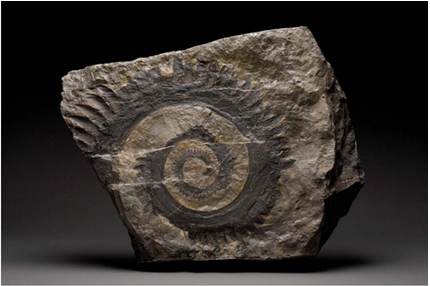
Note. From Great White Shark: Carcharodon Carcharias [Photograph], by Smithsonian Institution, 2018 (https://ocean.si.edu/ocean-life/sharks-rays/great-white-shark). Copyright 2018 by Chip Clark/Smithsonian Institution.
Example of a figure reproduced from a chapter in an edited book
Figure 2
The Ecological Model of Health Promotion/Primary Prevention
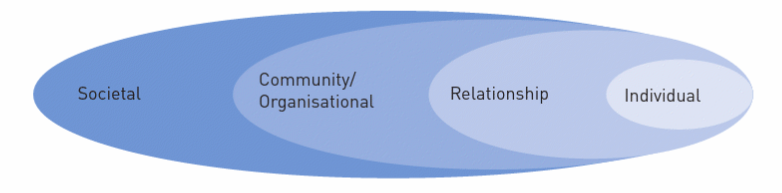
Note. From “Health Promotion,” by H. Keleher, in H. Keleher and C. MacDougall (Eds.), Understanding Health (4th ed., p. 98), 2016, Oxford University Press (https://ebookcentral.proquest.com/lib/curtin/reader.action?docID=4747941). Copyright 2016 by Helen Keleher and Colin MacDougall.
Using tables or figures in PowerPoint
Note: Always check with your tutor if they have specific guidelines for referencing in PowerPoint presentations.
When you include tables or figures in your PowerPoint presentation, you need to show where they came from if they have been adapted or copied from another source. You can choose to put the caption(s):
- On the slide, directly underneath the table or figure OR
- At the end of your presentation, before your reference list (see below instructions).
On the slide where the table or figure appears
- Above the table or figure, write Table or Figure in bold
- If you use more than one table or figure, number them in the order they appear in your work (e.g. Table 1, Table 2). Tables and figures are numbered separately
- One double-spaced line below the label, give the table or figure a short title that explains what it shows. The title should be in italics, with each major word starting with a capital letter and no full stop at the end
Example of a table in a PowerPoint slide
Table 1
Physical Development of Inland NSW Magpies (n=36)
| Age | Weight (g) | Body length (mm) |
|---|---|---|
| 1st week | 50-73 | 51 |
| 2nd week | 100-208 | 76 |
| 3rd week | 220-250 | 89 |
| 4th week | 380 | 104 |
| 3 months | 340-400 | 104 |
Example of a figure in a PowerPoint slide
Galahs: Background information
- Galahs are members of the Cockatoo family (Birdlife Australia, n.d.)
- Galahs can grow to 35 cm and live to 25 years in the wild (Foundation for National Parks & Wildlife, n.d.)
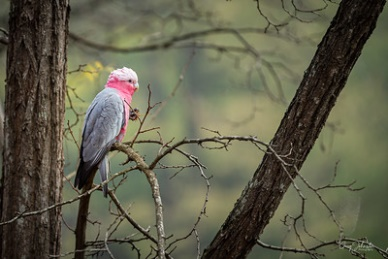
Figure 1
Galah Sitting on a Tree Branch
At the end of your presentation
- Before the reference list, include a slide with the caption information (see Caption components section) that would normally appear under the table or figure.
Example list of tables and figures in a PowerPoint slide
List of tables and figures
Table. Note. Adapted from Australian Magpie: Biology and Behaviours of an Unusual Songbird (p. 124), by G. Kaplan, 2019, CSIRO Publishing (https://ebookcentral.proquest.com/lib/curtin/reader.action?docID=5762566). Copyright 2019 by Gisela Kaplan.
Figure 1. Note. From Galah [Photograph], by G. Johnston, 2019, Flickr (https://www.flickr.com/photos/gregjohnston/48372512176). CC BY-NC-ND 2.0.
Figure 2. Note. From Galah Walking [Photograph], by J. Bendon, 2015, Flickr (https://www.flickr.com/photos/jim_bendon_1957/16207540769/. CC BY-SA 2.0.
Reference list
- Include a reference list with full references for all the sources used in your presentation, following the APA style.
Example reference list in a PowerPoint slide
References
Bendon, J. (2015). Galah walking [Photograph]. Flickr. https://www.flickr.com/photos/jim_bendon_1957/16207540769/
BirdLife Australia. (n.d.). Galah: Basic information. Birds in Backyards. http://www.birdsinbackyards.net/species/Eolophus-roseicapillus
Foundation for National Parks & Wildlife. (n.d.). Galah. Backyard Buddies. https://www.backyardbuddies.org.au/fact-sheets/Galah
Johnston, G. (2019). Galah [Photograph]. Flickr. https://www.flickr.com/photos/gregjohnston/48372512176
Kaplan, G. (2019). Australian magpie: Biology and behaviours of an unusual songbird (2nd ed.). CSIRO Publishing. https://ebookcentral.proquest.com/lib/curtin/reader.action?docID=5762566
Using your own table or figure
You may wish to include your own photograph or image in an assessment, or you may create a table or figure from data that you have collected yourself. As you have created the table or figure, there is no need to cite a source but it should still be formatted properly.
Above the table or figure
- Write Table or Figure in bold
- If you use more than one table or figure, number them in the order they appear in your work (e.g. Table 1, Table 2). Tables and figures are numbered separately
- One double-spaced line below the label, give the table or figure a short title that explains what it shows. The title should be in italics, with each major word starting with a capital letter and no full stop at the end
Below the table or figure
- No citation needed (you may wish to add a note to say Photograph by Author or similar if it is not clear that it is your own work)
In your writing
- Call out (refer) to the table or figure by its number in your writing, e.g. As shown in Table 1… OR Primary prevention has many intersecting dimensions (Figure 2).
Examples of your own tables or figures
Figure 1
Sleepy Tasmanian Devil in the Rain
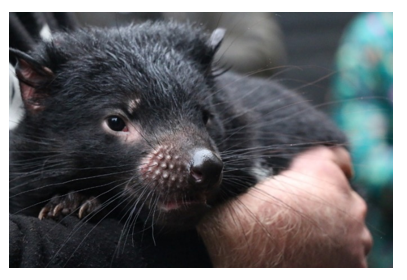
Table 1
Pet Ownership by Occupation
| Dogs | Cats | Birds | |
|---|---|---|---|
| Librarian | 22 | 56 | 9 |
| Accountant | 53 | 29 | 6 |
| Ornithologist | 22 | 0 | 61 |
| Artist | 33 | 33 | 22 |
Using published data to create a table or figure
When you create your own table or figure using data from a published source (e.g. a government report, journal article, or book), an in-text citation and reference list entry is usually sufficient acknowledgement of the source material.
Above the table or figure
- Write Table or Figure in bold
- If you use more than one table or figure, number them in the order they appear in your work (e.g. Table 1, Table 2). Tables and figures are numbered separately
- One double-spaced line below the label, give the table or figure a short title that explains what it shows. The title should be in italics, with each major word starting with a capital letter and no full stop at the end
Within or below the table or figure
- Show where the data came from by adding citations in the table or figure (e.g. next to each row or column) or below it.
In your reference list
- Include a full entry for each source (book, article, website, etc.) in your reference list, following APA style.
In your writing
- Call out (refer) to the table or figure by its number in your writing, e.g. Primary prevention has many intersecting dimensions (Figure 2). OR As shown in Table 1…
Example with citations included in the table
Table 1
Australian Government Indigenous Programs and Policy Locations with Indigenous Population by Selected States
| State | Number of centres (Services Australia, 2020) |
Total Indigenous population |
|---|---|---|
| NSW | 56 | 216,170 (Australian Bureau of Statistics [ABS], 2017a) |
| WA | 342 | 75,976 (ABS, 2017b) |
Example with citations included below the table
Table 2
Indigenous Land Management Categories and Size (Hectares)
| Category | Definition a | Total area b |
|---|---|---|
| Owned and managed | Lands that are both owned and managed by Indigenous communities | 142,306,000 |
| Managed | Lands that are managed but not owned by Indigenous communities | 32,357,000 |
| Co-managed | Owned and managed by non-Indigenous parties, but agreements guarantee Indigenous people rights in managing land | 28,028,000 |
| Special rights | Lands subject to Native Title determinations and active Indigenous Land Use Agreements | 304,531,000 |
Note. aCategories and definitions per Dillon et al. (2015, p. 9). bArea totals provided in Jacobsen et al. (2020, p. 5).
Caption components
Tips for captions
- Table and figure captions are formatted differently to reference list entries
- When the author and the publisher/source are the same, omit the publisher/source from the caption
- Titles appear in headline capitalisation where each major word starts with a capital letter, e.g. Climate Change in Australia
- Author/editor initials appear before their last name, e.g. P. E. Marik
Book or government/organisation report
Caption components
Note in Italics. From [or Adapted from] Title of Book or Report in Italics (p. xxx), by Initial(s). Author Surname and Initial(s). Author Surname, year, Publisher (DOI or URL). Copyright year by Name of Copyright Holder or Creative Commons licence.
Note. From Evidence-Based Critical Care (p. 108), by P. E. Marik, 2015, Springer (https://doi.org/10.1007/978-3-319-11020-2). Copyright 2015 by Springer International Publishing.
Chapter in an edited book
Caption components
Note in Italics. From [or Adapted from] “Title of Chapter,” by Initial(s). Author Surname and Initial(s). Author Surname, in Initial(s). Editor Surname (Ed.), Title of Book in Italics (any edition or volume number, p. xxx), year, Publisher (DOI or URL). Copyright year by Name of Copyright Holder or Creative Commons licence.
Note. From “Aboriginal Protest,” by L. Duncan, in G. Foley, A. Schaap and E. Howell (Eds.), The Aboriginal Tent Embassy: Sovereignty, Black Power, Land Rights and the State (p. 62), 2014, Routledge (http://ebookcentral.proquest.com/lib/curtin/reader.action?docID=1323346). Copyright 2014 by Gary Foley, Andrew Schaap and Edwina Howell.
Journal article, magazine or newspaper
Caption components
Note in Italics. From [or Adapted from] “Title of Article,” by Initial(s). Author Surname and Initial(s). Author Surname, year, Title of Journal in Italics, Volume in Italics(Issue), p. xx (DOI or URL). Copyright year by Name of Copyright Holder or Creative Commons licence.
Note. From “‘Strong Black Women’: African American Women with Disabilities, Intersecting Identities, and Inequality,” by A. L. Miles, 2019, Gender & Society, 33(1), p. 4 (https://doi.org/10.1177/0891243218814820). Copyright 2018 by The Author.
Webpage
Caption components
Note in Italics. From [or Adapted from] Title of Webpage in Italics, by Initial(s). Author Surname and Initial(s). Author Surname, year, Site Name (URL). Copyright year by Name of Copyright Holder or Creative Commons licence.
Note. From Climate Change in Australia, by CSIRO, 2020 (https://doi.org/10.1177/0891243218814820). Copyright 2020 by Commonwealth Scientific and Industrial Research Organisation.
Example assessment
Australia’s Indigenous people have a longstanding connection with country, valuing it for a range of cultural, social and economic reasons, in a history that goes back an estimated 60,000 years (Jacobsen et al., 2020; Olsen & Russell, 2019). Prior to colonisation, Australia comprised over 250 societies that covered the entire landmass, groups that had their own language, customs and responsibility for managing the land (Karidakis & Kelly, 2017). This responsibility has only recently begun to be handed back to Indigenous people, with Jacobsen et al. (2020) reporting 134 million hectares of land in Australia, 17% of the total landmass, as Indigenous owned. A map produced by the Australian Bureau of Agriculture and Resource Economics and Sciences (ABARES, Figure 1) shows that the bulk of this land is located in central Australia.
Figure 1
Area of Land and Forest that is Indigenous Owned
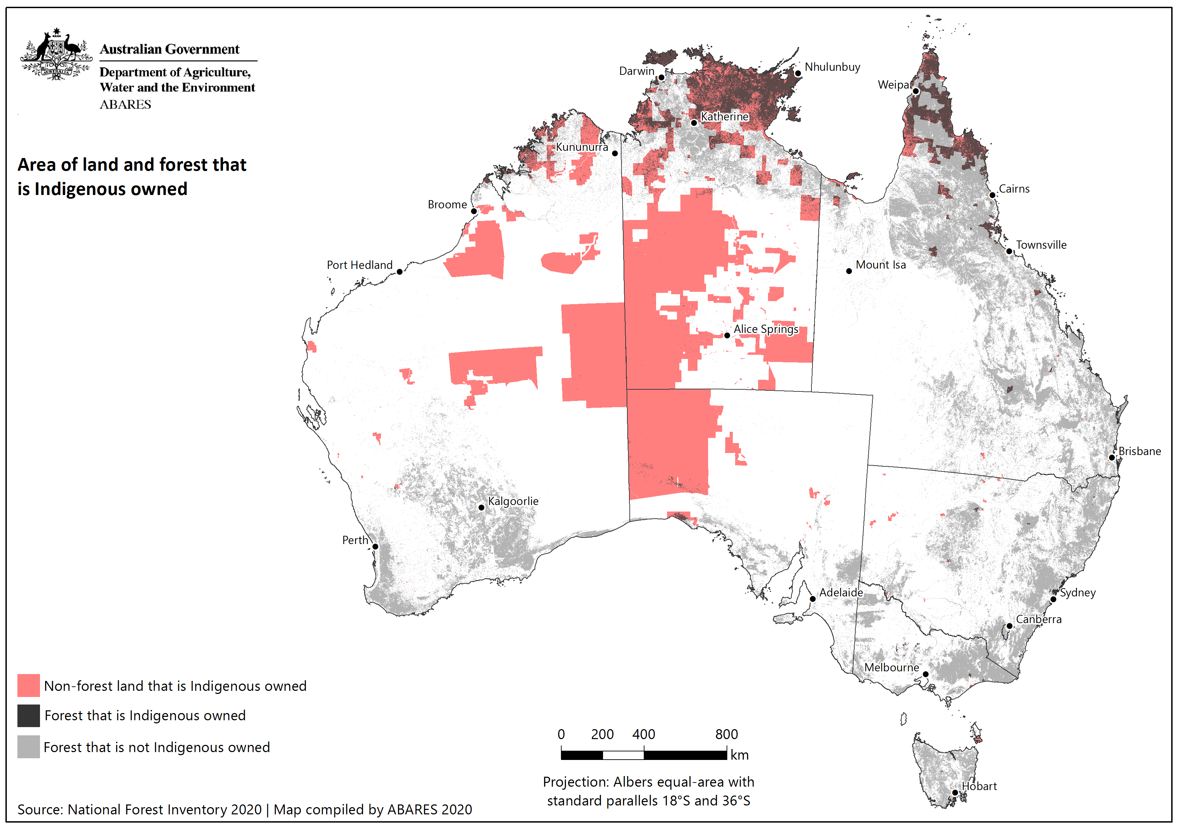
Note. From Australia’s Indigenous Forest Estate, by Australian Bureau of Agriculture and Resource Economics and Sciences, 2020 (https://data.gov.au/data/dataset/australia-s-indigenous-forest-estate-2020). CC BY.
Dillon et al. (2015) defines Indigenous land as “all land over which Indigenous people have use and rights as recognised through ownership, management, access or other special rights” (p. 6). Incorporating these broader definitions, Table 1 breaks down the total area of recognised Indigenous land in Australia.
Table 1
Indigenous Land Management Categories and Size (Hectares)
| Category | Definition a | Total area b |
|---|---|---|
| Owned and managed | Lands that are both owned and managed by Indigenous communities | 142,306,000 |
| Managed | Lands that are managed but not owned by Indigenous communities | 32,357,000 |
| Co-managed | Owned and managed by non-Indigenous parties, but agreements guarantee Indigenous people rights in managing land | 28,028,000 |
| Special rights | Lands subject to Native Title determinations and active Indigenous Land Use Agreements | 304,531,000 |
Note. aCategories and definitions per Dillon et al. (2015, p. 9). bArea totals provided in Jacobsen et al. (2020, p. 5).
References
Australian Bureau of Agriculture and Resource Economics and Sciences. (2020). Australia’s Indigenous forest estate. Australian Government. https://data.gov.au/data/dataset/australia-s-indigenous-forest-estate-2020
Dillon, R., Jeyasingham, J., Eades, S., & Read, S. (2015). Development of Australia’s Indigenous forest estate (2013) dataset (Research Report 15.6). Australian Bureau of Agricultural and Resource Economics and Sciences. https://www.agriculture.gov.au/sites/default/files/documents/IndigenousForestEstate_20150828_v1.0.0.pdf
Jacobsen, R., Howell, C., & Read, S. (2020). Australia’s Indigenous land and forest estate: Separate reporting for Indigenous ownership, management and other special rights. Australian Bureau of Agricultural and Resource Economics and Sciences. https://doi.org/10.25814/bqr0-4m20
Karidakis, M., & Kelly, B. (2017). Trends in Indigenous language usage. Australian Journal of Linguistics, 38(1), 105-126. https://doi.org/10.1080/07268602.2018.1393861
Olsen, P., & Russell, L. (2019). ‘Civilisation’ displaces Indigenous wildlife balance. Wildlife Australia, 56(4), 36-41. https://doi.org/10.3316/ielapa.887587290235282
Copyright and Creative Commons images
Copyright is a law that gives creators (such as writers, artists, musicians) the right to control how their work is used. If you make something original, you automatically own the copyright. Others need your permission to copy, share, or change it. Creative Commons is a system that lets creators share their work more freely. It does not remove copyright, instead it provides licenses that say what others can do with the work—whether they can copy it, change it, or use it for commercial purposes. It is a way to share while still retaining some rights.
To find out more about copyright and Creative Commons, see the Copyright toolkit.
Reproducing images
When you reuse images, it is important to follow copyright rules. Just because an image is easy to find online does not mean you can use it freely. You need to check if you have permission. Some websites let you download images for free, but others—like Shutterstock or Getty Images—require you to pay for a license. A good way to stay within the rules is to use images that have an Open License, are under a Creative Commons (CC) license, or are in the public domain.
Open license, Creative Commons and public domain images
An Open License means the creator has given permission for others to use and share the image, often with few restrictions. Creative Commons is a type of open license that tells you how you can use the image without needing to ask for permission. Public domain images are either no longer protected by copyright or have been released by the creator for anyone to use freely.
The following websites provide easily accessible advance search filters to quickly identify Creative Commons or public domain images:
- flickr
- Openverse
- Wikimedia Commons
- The New York Public Library Digital Collections
- State Library of Victoria copyright-free image search (mainly historical images)
- Unsplash
Locating copyright or Creative Commons information
Sometimes it can be difficult to locate copyright or license information associated with a table or figure. If it is not presented alongside the content you want to use, do a search of the document for either ‘copyright’ or ‘CC’ using Ctrl + F (command + F on a Mac).
On some websites, you might want to check the footer for a link to ‘Terms of use’ which will provide you with the information you need for copyright acknowledgement.
</div></div></div></div>
Referencing checklist
This brief checklist highlights some general points to pay attention to when editing your in-text citations and reference list. For the components and formatting required for specific reference types, please consult the relevant sections of this APA referencing guide.
In-text citations
Reference list
Example: Youth subcultures: Theory, history and the Australian experience
Example: New England Journal of Medicine
About UniSkills
UniSkills was created and is maintained by Curtin University Library. To report issues with UniSkills contact Library Help.
Twemoji icons by Twitter, Inc and other contributors, licensed under a CC-BY 4.0 licence.
Except where otherwise noted, UniSkills content in all it’s forms (website, PDFs etc) are licensed under a Creative Commons Attribution ShareAlike 4.0 International Licence. We ask that you attribute any use of the content as created by Curtin University Library with a link to the Library website.
This license does not extend to other Curtin University and Curtin University Library webpages, or to Curtin branding and trademarks. Curtin University’s copyright information is available on the Curtin website.