
AGLC-referencing-printable-guide-UniSkills.pdf
AGLC referencing
Table of Contents
Introduction
AGLC 4 is a footnotes referencing style used in law. AGLC 4 is based on the Australian Guide to Legal Citation, 4th edition, produced by the Melbourne University Law Review Association in collaboration with the Melbourne Journal of International Law.
This guide is intended for students completing assignments at Curtin University. If you are publishing (for example, journal article, PhD), please consult the above publication as the examples provided here may differ from the requirements in the official style guide.
An online version of the complete AGLC manual is available at:
Print copies are also available in the Library collection.
Note: Whenever you see instruction to ‘see rules …’ in this guide, this means the rules within the AGLC4 manual.
Printable referencing guide
A printable AGLC referencing guide is available on the UniSkills downloads page.
Footnotes
General rules for footnotes
Footnotes are used to:
- Acknowledge sources of information you have used in your assessments, and
- Provide information that allows the reader to find the sources that you used
The footnote number should appear directly after the full stop in the text of your assessment (a footnote number may appear directly after the relevant text if it is necessary for the sake of clarity, see rule 1.1.2).
Any direct quotes in your assessment must be directly followed by a footnote (unless their source has been provided in full in the text, see rule 1.1.1). You must also always include a footnote when you have paraphrased from a source.
You must put a full stop at the end of each footnote.
To cite a second reference in the same footnote, use a semicolon and space (see rule 1.1.3 for exceptions to this rule). For example:
1 Wong v Commonwealth (2000) 236 CLR 573, 200; Crimes Act 1958 (Vic) s 3.
Repeated footnotes
If a source directly following a footnote is the same then you can use ‘ibid’ (meaning ‘the same’). If the pinpoint reference is different then you can use ‘ibid’ and the new pinpoint with no comma between, for example, Ibid 65-67.
If a source has been referred to in an earlier footnote but is different to the one directly above it, you can use the author’s surname and a cross-reference in brackets to refer to that previous citation, for example, Jones (n 3). For cases and legislation you can use the short title or popular name rather than the author’s name, for example, Tasmanian Dam Case (n 12). The short title should follow rule 1.4.4.
Examples of using ibid and (n):
1 Eric Berendt, Freedom of Speech (Oxford University Press, 2nd ed, 2005) 163.
2 Ibid.
3 Ibid 174-5.
4 Catherine Macmillan, Mistakes in Contract Law (Hart Publishing, 2010) 38.
5 Administrative Decisions (Judicial Review) Act 1977 (Cth) s 37 (‘ADJR Act’).
6 MacMillan (n 4).
7 ADJR Act (n 5).
Discursive text in footnotes
Footnotes can contain more text than just the citation. This other text is called discursive text. When using discursive text in a footnote, the citation should appear after a colon at the end of that text, unless the citation appears in the discursive text, including relevant pinpoints. For example:
8 The scope of this legislation is confined to children as users of the internet: Enhancing Online Safety Act 2015 (Cth) s 5.
Inserting footnotes in Word
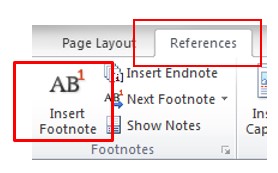
To add footnotes to your Word document:
- Position your cursor where the footnote should go in your Word document
- Click on the References tab
- Click on Insert Footnote
- Type in the reference for the source following the guidelines
Pinpoint citations
A pinpoint is a reference to a specific page or paragraph. A pinpoint to a page should appear as a number, while a pinpoint to a paragraph should appear as a number in square brackets. The pinpoint is placed at the end of the reference and for most resource types it should come after a space. For example:
HLA Hart, The concept of Law (Clarendon Press, 1970) 15.
For some resource types such as journal articles and cases you are need to place a comma before the pinpoint. For example:
Gordon Goldberg, ‘Confusions Concerning Common Count’ [2000] Restitution Law Review 189, 67.
Common resource types which need a comma before the pinpoint:
- Cases
- Journal articles
- Chapter in an edited book
- Gazettes
- Parliamentary debates
- Written correspondence
Always check the examples provided for your resource type to see if a comma is needed or not.
Quotations within the text
Short quotations (of three lines or less) should be written inside single quotation marks. For example:
Priestley JA stated that ‘there is a close association of ideas between the terms unreasonableness, lack of good faith and unconscionability.’12
Long quotations (of four lines or more) should appear indented from the left margin, in a smaller font size and without quotation marks. Legislative and treaty extracts, regardless of length may also appear this way. For example:
The Judge stated:
Thus elaborating, the first question is whether a financial benefit is given within the meaning of s 229 of the Corporations Act (in relation to the prohibition on related party benefits without member approval). The second question is whether the exception for arm’s length terms in s 210 of the Corporations Act is made out…23
Omissions, alterations and significant errors in quotes:
- Omissions from a quotation should be indicated by an ellipsis (…).
- If you need to alter a quotation in any way include the alteration in square brackets.
- If there is a significant error in the quotation you may use [sic].
Citing quoted material
AGLC prefers you to cite the original text if it is available. If this is impossible, then give as full a reference to the original text as you can and use the words ‘quoted in,’ ‘cited in,’ or ‘discussed in’ and give a full reference to the secondary text. For example:
Mason v Freedman [1958] SCR 483, quoted in Shelanu Inc v Print Three Franchising Corporation (2003) 64 OR (3d) 533, 556. Bibliographies
The first step is to check with your lecturer whether they require you to produce a bibliography. It may be the case that footnotes are enough. A bibliography includes not only all the sources you have cited in your assessment (which is the role of footnotes) but also the sources you have consulted and relied on while researching your assignment.
If you are required to include a bibliography, you must list all sources you used to complete your assignment alphabetically under the following headings. These headings are centered on the page and printed in italics:
A Articles / Books / Reports
B Cases
C Legislation
D Treaties
E Other
References in your bibliography should be set out as in your footnotes with the following four exceptions:
- The first author’s name (only) should be inverted and separated by a comma (for example, Smith, John rather than John Smith)
- Do not include pinpoint references (these are for footnotes only)
- Do not include a full stop at the end of each reference
- If there is no author, list the source alphabetically by title. Case law & Legislation
Case law
Reported cases
Footnote components:
Case Name in Italics (Year) Volume Law Report Series Starting Page, Pinpoint.
--- **Footnote examples:** **_Law report organised by volume number_** _Johnson v Staskos_ (2015) 48 WAR 349, 13. **_Law report organised by year_** Bakker v Stewart [1980] VR 17, 22.Extra tips
- Cite only the first plaintiff and first defendant (see rule 2.1.1)
- Case names may be abbreviated for subsequent footnotes (see rule 2.1.14). If the case name appears in full within the text it may be left out in the footnote citation (see rule 2.1.15)
- If the volumes of the law report are organised by year, put the relevant year in square brackets: [ ]. If the reports are organised by volume number, put the year the case was decided in round brackets: ( )
- Where a law report series is organised by year, some years may have two or more volumes per year. For example, [2007] 1 Qd R is the first volume of the Queensland Reports for the year 2007
- Use the abbreviation for the name of the law report series, not the full title. The report itself should indicate the relevant abbreviation. Lists of law report series abbreviations can found in the Law guide in the Cases tab. Always cite an authorised version if possible (see rule 2.2.2 for preferred order)
- Use the page number the case report starts on. Some report series, including CCH, use a unique reference instead of a starting page number. In these cases, use the unique reference in place of the page number, e.g. ¶93-198
- For the pinpoint use the specific page number. The paragraph number may be added after the page number. If identifying the particular judge being cited, put their name in round brackets after the pinpoint.
Unreported decisions with a medium neutral citation
Footnote components:
Case Name in Italics [Year] Court identifier Judgment number, [Pinpoint].
--- **Footnote example:** _R v Landmeter_ [2015] SASFC 3, [16].Extra tips
- A case is unreported if it not published in a law report series. Always use a reported version if you can and always cite an authorised version if possible (see rule 2.2.2 for preferred order). To see if a case has been reported, you can check a case citator such as CaseBase (LexisNexis) or FirstPoint (WestLaw). If it is reported in an authorised series, use the authorised reports (for example: Commonwealth Law Reports, Federal Court Reports, Victorian Reports). If there is no reported version then use a medium neutral citation if one is available (this is a citation allocated by the court the case was heard in)
- Please note: cases in AustLii are unreported versions. Check a case citator to see if the case has been reported.
</div>
Unreported decision without a medium neutral citation
Footnote components:
Case Name in Italics (Court, Judge(s), Full judgment date) Pinpoint.
--- **Footnote example:** _Barton v Chibber_ (Supreme Court of Victoria, Hampel J, 29 June 1989) 3.</div>
US cases
Footnote components:
Parties’ Names in Italics, Volume Report Series and Series Number Starting Page, Pinpoint (Jurisdiction and Court Name, Year).
--- **Footnote example:** _Bush v Schiavo_, 885 So 2d 321, 336 (Fla, 2004).Extra tips
- See rule 25.1.5.2 for abbreviations for US states.
</div>
</div>
Legislation
Statutes (Acts of Parliament) and delegated legislation
Footnote components:
Title Year in Italics (Abbreviated Jurisdiction) Pinpoint.
--- **Footnote examples:** _**Act of Parliament**_ _National Health Act 1953_ (Cth) s 87. _**Delegated legislation**_ _Radiation Safety (General) Regulations 1983_ (WA) reg 22.Extra tips
- Most of the time, a principal Act rather than an amending Act should be cited (see rule 3.8 for exceptions)
- The pinpoint should identify the particular section, paragraph, part, schedule etc. (see rule 3.1.4 for the appropriate abbreviation)
- In repeat citations, an abbreviated form of the title (referred to as a short title) can be used. This must be followed by a cross reference (n) in parentheses. The title should always be included in the footnote (even if the title appears in the sentence accompanying the footnote)
- If you are citing an individual part of an Act ie: Competition Code within the Trade Practices Act give a short title to this part of the Act and use this short title for subsequent references. You must also include a cross reference (n).
Bills
Footnote components:
Title of Bill Year (Abbreviated Jurisdiction) Pinpoint.
--- **Footnote example:** Australian Border Force Bill 2015 (Cth) cl 26.Extra tip
- For pinpoint citations, ‘clause’ and ‘sub-clause’ are usually the appropriate classifiers.
</div>
Australian Constitutions
The Constitution of the Commonwealth of Australia may be cited as the Australian Constitution, the Commonwealth Constitution, or simply as the Constitution as long as there is no chance that your reader will mistake it for a different constitution:
Australian Constitution s 51(ii).
It may also be referred to within its enacting legislation:
Commonwealth of Australia Constitution Act 1900 (Imp) 63 & 64 Vict, c 12, s 9.
Constitutions of the Australian states should be cited as normal statutes:
Constitution Act 1889 (WA) s 2(1).
Explanatory memoranda
Footnote components:
Explanatory Memoranda, Title of Bill Year (Abbreviated Jurisdiction) Pinpoint.
--- **Footnote example:** Explanatory Memoranda, Health Legislation Amendment Bill (No 1) 2003 (Cth).Extra tip
- Explanatory Memoranda are sometimes known as Explanatory Statements or Explanatory Notes. If the reference includes one of these terms in the title, use that term instead of ‘Explanatory Memoranda’.
</div>
Parliamentary debates (Hansard) including second reading speeches
Footnote components:
Jurisdiction not abbreviated, Parliamentary Debates in Italics, Chamber of the House, Full date of Debate, Pinpoint (Name of Speaker, Position of Speaker).
--- **Footnote example:** Commonwealth, _Parliamentary Debates_, Senate, 3 May 2016, 3322 (Penny Wong).Extra tips
- If it is relevant, the position of the speaker may be included after their name, preceded by a comma
- Second reading speeches are sections of parliamentary debates and should be cited following rule 7.5.1.
</div>
Gazettes
Footnote components:
Jurisdiction not abbreviated, Gazette Title in Italics, No Gazette Number, Full Date, Pinpoint.
--- **Footnote examples:** Commonwealth, _Gazette: Special_, No s 489, 1 December 2004. Minister for Lands (WA), 'Land Acquisition and Public Works Act 1902- Native Title Act 1993 (Commonwealth) - Notice of Intention to Take Land for a Public Work' in Western Australia, _Western Australian Government Gazette_, No 27, 18 February 1997, 1142, 1143.Extra tips
- Where more than one notice appears in the same gazette or on the same page, the author and title of the notice (if available) should also be included in the format: Author, ‘Title of Notice’ in Jurisdiction, Gazette Title in Italics, No Gazette Number, Full Date, Starting Page, Pinpoint.
- If there is no author you may omit this
- Australian Government gazettes are considered quasi-legislative materials and contain a range of information about legislation, including proclamations and notices from government departments and courts.
</div>
Taxation rulings
Footnote components:
Instrumentality/Officer, Instrument Title in Italics, (Document Number, Full Date) Pinpoint.
--- **Footnote example:** Australian Taxation Office, _Income Tax: Business Related Capital Expenditure -Section 40-880 of the Income Tax Act 1997 Core Issues_, (TR 2011/6, 30 November 2011).Extra tips
- If you are using Officer only use their title (not their name) and include the jurisdiction in brackets after the name of the department or officer
- A document number should be included only if it appears on the instrument. Reproduce this exactly as it appears
- The full date is the date from which the instrument takes effect. You will find a reference to it in the contents page of the document.
</div>
Treaties
Footnote components:
Treaty Title in Italics, Parties’ Names (where applicable), Date Opened for Signature or Signed, Treaty Series (date of entry into force) Pinpoint.
--- **Footnote example:** _The Antarctic Treaty_, signed 1 December 1959, 402 UNTS 71 (entered into force 23 June 1961) art 1.</div>
US codes
Footnote components:
Statute Title in Italics, Title Chapter or Volume Number Abbreviated Code Name Pinpoint (Publisher’s Name, Year of Code, Supplement).
--- **Footnote example:** _Trade Act of 2002_, 19 USC § § 3803-5 42 (2006).Extra tips
- Not all elements will appear in every citation
- See rule 25.2.3 for abbreviated code names.
</div>
</div>
Secondary sources
Author variations
Author variations apply to all secondary source reference types (books, journal articles, reports etc.).
- List the author’s first name followed by their family name, for example, John Smith. If the first name is not given on the publication, then use the author’s initial(s) with no spaces between e.g. JA Smith
- See rule 4.1 for more details such as how to include honorific/peerage titles.
One author
Examples
Scott Grattan, ‘Revisiting Restraints on Alienation: Public and Private Dimensions’ (2015) 41(3) Monash University Law Review 67, 84.
Paul Latimer, Australian Business Law (Oxford University Press, 35th ed, 2016) 36.
Two authors
- List both in the reference joined by ‘and’
Examples
Ronald Dworkin and Ross Redford, Law’s Empire (Harvard University Press, 1968) 18.
Jacob Greber and Andrew Tillett, ‘Donald Trump Nominates Australian Ambassador’, Financial Review (online at 6 November 2018) <https://www.afr.com/news/politics/donald-trump-nominates-australian-ambassador-20181106-h17kx5>.
Three authors
- List all authors in the reference joining the last two authors with ‘and’
Examples
Sarah Joseph, Jenny Schultz and Melissa Castan, The International Covenant on Civil and Political Rights: Cases, Materials and Commentary (Oxford University Press, 2nd ed, 2004).
Bronwyn Naylor, Julie Debeljak and Anita Mackay, ‘Introduction: Implementing Human Rights in Closed Environments’ (2015) 31(1) Law in Context 1, 6.
Four or more authors
- List only the first author followed by ‘et al’ (meaning and others)
Examples
Paul Rishworth et al, The New Zealand Bill of Rights (Oxford University Press, 2003).
Martin Dockray et al, ‘Why Do We Need Adverse Possession?’ [1985] (Spring) Conveyancer and Property Lawyer 272, 275.
Corporate author
- Omit company suffixes such as Pty, Ltd, Co., and Inc. from company names
- Omit ‘The’ when it appears at the beginning of a company name
- When a government department is the author and includes several levels of subdivisions, use the most specific subdivision as the author, unless this would cause confusion. For example, for Government of Western Australia, Department of Health, Royal Perth Hospital, use Royal Perth Hospital as the author
- If the jurisdiction is not clear from the name, include the abbreviated jurisdiction in brackets after the department name, for example, Department of Health (WA).
Examples
Qantas Airways, Qantas Annual Report 2017: Positioning for Sustainability and Growth (Report, 2017) 12.
Department of Education (Cth), Department of Education 2018-19 Annual Report: Opportunity Through Learning (Report, 2019) 56.
Journal and news articles
Journal article
Footnote components:
Author First Name or Initial(s) Author Surname, ‘Title of Article’ (Year) Volume number(Issue number) Full Journal Title in Italics First Page of Article, Pinpoint .
--- **Footnote examples:** Scott Grattan, 'Revisiting Restraints on Alienation: Public and Private Dimensions' (2015) 41(3) _Monash University Law Review_ 67, 84 \<https://heinonline.org/HOL/P?h=hein.journals/monash41&i=75\>. Bronwyn Naylor, Julie Debeljak and Anita Mackay, 'Introduction: Implementing Human Rights in Closed Environments' (2015) 31(1) _Law in Context_ 1, 6 \<https://heinonline.org/HOL/P?h=hein.journals/lwincntx31&i=9\>. Martin Dockray et al, 'Why Do We Need Adverse Possession?' [1985] (Spring) _Conveyancer and Property Lawyer_ 272, 275. Anusha Pirani, 'Cryptocurrency: A Magical Bubble or the Future of Currency' (2018) 5(8) _Court Uncourt_ 29: 29-31, 30 \<https://heinonline.org/HOL/P?h=hein.journals/counco5&i=325\>. Andrew Sherrill et al, 'Understanding How Grammatical Aspect Influences Legal Judgment' (2015) 10(10) _PLOS One_ e0141181: 1-19, 15 \<https://journals.plos.org/plosone/article?id=10.1371/journal.pone.0141181\>.Extra tips
- If a case name or statute name appears in the article title, italicise the case or statute name. See Rule 4.2 for further guidance.
Year, volume number, issue number:
- If the journal is organised by year, place the year of publication in square brackets, followed by the issue number in round brackets, preceded by a space: [2019] (1). No volume number is included
- If the journal is organised by volume, place the year of publication in round brackets, followed by the volume number and issue number: (2018) 40(1).
- If the issue identifier is not a number, place it in round brackets, preceded by a space. For example: [2019] (Summer) or (2019) 31 (Winter)
- For newsletters or magazines where the issue is identified by a month or season rather than a volume, issue or year, see Rule 7.11.3.
Journal title
- Omit ‘The’ when it appears at the beginning of a journal title
- Omit subtitles unless doing so would create ambiguity (see Rule 5.5).
Pinpoint references
- Provide the exact page being referenced, preceded by a comma and a space
- If the pinpoint page is also the first page of the article, repeat the page number
- If the article is available as a PDF, include the article page range after the starting page number and before the pinpoint reference (see the fourth example)
- If the article has an article number or other identifier, use that identifier instead of the starting page number (see the fifth example).
URL
- A \ may be included to assist readers in locating the article
- Place the URL at the end of the citation, after the pinpoint reference and before any short title
Advance or forthcoming journal article
Footnote components:
Author First Name or Initial(s) Author Surname, ‘Title of Article’ (Year) Volume number(Issue number) Full Journal Title in Italics (advance).
--- **Footnote examples:** Shiri Krebs, Ingrid Nielsen and Russell Smyth, 'What Determines the Institutional Legitimacy of the High Court of Australia?' (2019) 43(2) _Melbourne University Law Review_ (advance). Virginia Mantouvalou, 'Welfare-to-Work, Structural Injustice and Human Rights' (2020) _Modern Law Review_ (advance).</div>
Newspaper article
Footnote components:
Reporter First Name or Initial(s) Reporter Surname, ‘Title of Article’, Italicised Newspaper Title (Place of Publication, Full Date) Pinpoint.
--- **Footnote examples:** Tomio Geron, 'As Market Softens, Startups Work Harder to Compete for Talent', _Wall Street Journal_ (New York, 20 June 2016), 12. Jacob Greber and Andrew Tillett, 'Donald Trump Nominates Australian Ambassador', _Financial Review_ (online, 6 November 2018) \<https://www.afr.com/news/politics/donald-trump-nominates-australian-ambassador-20181106-h17kx5\>.Extra tips
- Include ‘The’ at the beginning of a newspaper title if it appears in the newspaper’s masthead, e.g. The West Australian
- If an article is published in a separately paginated section with its own title, include the section title before the newspaper title, e.g. Saturday Extra, The Age
- Give the place of publication as the city where the newspaper is headquartered. Include the state or country if the city name could be unclear or shared by multiple locations, e.g. London, Ontario
- Include a pinpoint reference only if the article has pages or paragraphs
- For online newspaper articles, omit the place of publication and insert the word online before the date (see the second example) After the full date, include the \ (or place it after any pinpoint reference, if one is provided).
</div>
</div>
Books
Book
Footnote components:
Author First Name or Initial(s) Author Surname, Title of Book in Italics (Publisher, edition ed, Year) Pinpoint.
--- **Footnote examples:** Paul Latimer, _Australian Business Law_ (Oxford University Press, 35th ed, 2016) 36. Sarah Joseph, Jenny Schultz and Melissa Castan, _The International Covenant on Civil and Political Rights: Cases, Materials and Commentary_ (Oxford University Press, 2nd ed, 2004). Paul Rishworth et al, _The New Zealand Bill of Rights_ (Oxford University Press, 2003). Justin Healey (ed), _Drug Law Reform Debate_ (Spinney Press, 2014) 123.Extra tips
- Omit ‘The’ if it appears at the start of a publisher’s name. Also omit company abbreviations such as Ltd, Co, and similar terms
- Use ‘rev ed’ when referring to a revised edition
- If the author’s name and the publisher’s name are the same, do not include the publisher’s name. See rule 6.3.1 for further details
- For pinpoint references, provide the exact page cited. If citing a specific paragraph, include the paragraph number in square brackets. If citing a specific chapter, use the abbreviation ‘ch’ followed by the chapter number
- For an edited book, include (ed) or (eds) after the name(s).
Chapter in an edited book
Footnote components:
Chapter Author First Name or Initial(s) Chapter Author Surname, ‘Chapter Title’ in Editor First Name or Initial(s) Editor Surname, Title of Book in Italics (Publisher, edition ed, Year) Starting page of chapter, Pinpoint.
--- **Footnote examples:** Frederick Hendrik Kistenkas, 'Sustainable Development: New Thoughts' in Volker Mauerhofer (ed), _Legal Aspects of Sustainable Development_ (Springer International Publishing, 2016) 535, 540. Paul James Cardwell and Tamara Hervey, 'Bringing the Technical into the Socio-Legal: The Metaphors of Law and Legal Scholarship of a Twenty-First Century European Union' in David Cowan and Daniel Wincott (eds), _Exploring the 'Legal' in Socio-Legal Studies_ (Palgrave Macmillan, 2016) 157.</div>
Dictionaries
Footnote components:
Dictionary Title in Italics (Edition Number ed, Publication Year) ‘Title of Entry’ (def Definition Number).
--- **Footnote examples:** **Print dictionary** _Macquarie Dictionary_ (5th ed, 2009) 'demise' (def 4). **Online dictionary** _Encyclopaedic Australian Legal Dictionary_ (online at 20 February 2018) 'default judgment' (def 1).Extra tip
- For an online dictionary replace the publication details with (online at Date of Retrieval).
</div>
Legal encyclopedias
Footnote components:
Publisher, Title of Encyclopedia in Italics, vol Volume Number (at Full date) Title Number Name of Title, ‘Chapter Number Name of Chapter’ [Paragraph].
--- **Footnote examples:** _**Print encyclopedia**_ LexisNexis, _Halsbury's Laws of Australia_, vol 15 (at 25 May 2009) 235 Insurance, '2 General Principles' [235-270]. **Online encyclopedia** WestLaw AU, _The Laws of Australia_ (online at 15 February 2018) 2 Administrative Law, '2.3 Access to Information' [2.3.10].Extra tip
- For an online encyclopedia include (online at Date of Retrieval) after the title and omit the Volume Number and (at Full Date).
</div>
Looseleaf services
Footnote components:
Publisher, Title in Italics, vol Volume Number (at most recent service number for pinpoint or Date of last update) [Pinpoint].
--- **Footnote examples:** _**Print looseleaf**_ Niel J Williams, LexisNexis Butterworths, _Civil Procedure: Victoria_, vol 1 (at service 231) [21.01.1]. _**Online looseleaf**_ CCH Australia, _Australian Intellectual Property Commentary_ (online at 20 February 2018) ¶7-000.Extra tips
- If a looseleaf service clearly identifies an author, include the author’s name before the publisher’s name, followed by a comma
- For online looseleaf include (online Date of Retrieval) after the title. Omit the Volume Number and (at most recent service number for pinpoint or Date of last update)
- Pinpoints should be given to paragraphs and placed in square brackets [ ], unless the ¶ symbol is used, in which case square brackets are omitted.
</div>
Theses and dissertations
Footnote components:
Author First Name or Initial(s) Author Surname, ‘Title’ (Type of Thesis, Institution, Year) Pinpoint.
--- **Footnote example:** Michelle Evans, 'The Use of the Principle of Subsidiarity in the Reformation of Australia's Federal System of Government' (PhD Thesis, Curtin University, 2012) 17.Extra tip
- A \ may be included at the end of the citation, where its inclusion will help the reader locate the item.
</div>
Conference papers
Footnote components:
Author First Name or Initial(s) Author Surname, ‘Title’ (Conference Paper, Name of Conference, Full Date) Pinpoint.
--- **Footnote example:** Jessica Almqvist, 'Global Judicial Governance of Cultural Diversity: The Role of the European Judge' (Conference Paper, European Society of International Law Annual Conference, 31 December 2015).Extra tips
- Do not include the ordinal number of a conference, e.g. 5th or 12th
- A \ may be added at the end of the citation if it will help readers locate the paper
- If a conference paper has been published in a journal or a book, cite it following the rules for a journal article or book.
</div> </div>
Reports
Report
Footnote components:
Author, Title of Report in Italics (Document Type/Series No Document Number, Full Date) Pinpoint.
--- **Footnote examples:** Community Law Australia, _Unaffordable and Out of Reach: The Problem of Access to the Australian Legal System_ (Report, July 2012). Qantas Airways, _Qantas Annual Report 2017: Positioning for Sustainability and Growth_ (Report, 2017) 12.Extra tips
- If a report does not clearly identify an author, do not include an author in the citation
- If the report is not part of a numbered series, omit the document number
- Where a full date is not available, include as much information as the source provides e.g. September 2018 or 2018
- A \ may be included at the end of the footnote if it will help readers locate the report.
Royal Commission reports and Law Reform Commission publications
Footnote components:
Author, Title of Report in Italics (Document Type/Series No Document Number, Full Date) Pinpoint.
--- **Footnote examples:** _Royal Commission into Trade Union Governance and Corruption_ (Final Report, December 2015) vol 2. Australian Law Reform Commission, _Elder Abuse_ (Discussion Paper No 83, December 2016). Victorian Law Reform Commission, _Civil Justice Review_ (Report No 14, March 2008) 4.Extra tips
- If a report does not clearly identify an author, do not include an author in the citation
- If the report is not part of a numbered series, omit the document number
- Where a full date is not available, include as much information as the source provides, e.g. September 2018 or 2018
- A \ may be included at the end of the footnote if it will help readers locate the report
- For submissions to royal commissions see rule 7.5.2
- For Law Reform Commission publications, include the publication type as the document type (Report, Discussion Paper, Issues Paper, Consultation Paper, Interim Report).
</div>
Australian Bureau of Statistics
Footnote components:
Australian Bureau of Statistics, Title of Report in Italics (Catalogue Number, Full Date) Pinpoint.
--- **Footnote examples:** Australian Bureau of Statistics, _Prisoners in Australia, 2019_ (Catalogue No 4517.0, 5 December 2019).Extra tips
- Where a full date is not available, include as much information as the source provides, e.g. September 2018 or 2018
- A \ may be included at the end of the footnote if it will help readers locate the report.
</div>
Parliamentary papers, committee reports, bills digests and other digests
Footnote components:
Committee, Legislature, Title in Italics (Document Type/Series No Document Number, Full Date) Pinpoint.
--- **Footnote examples:** Environment and Natural Resources Committee, Parliament of Victoria, _Inquiry into the Environment Effects Statement Process in Victoria_ (Parliamentary Paper No 59, September 2011). Senate Legal Constitutional References Committee, Parliament of Australia, _Inquiry into Alternative Dispute Resolution and Restorative Justice_ (Final Report, May 2009) 26. Department of Parliamentary Services (Cth), _Bills Digest_ (Digest No 75 of 2008-09, 27 January 2009) 8.</div>
</div>
Websites & social media
Webpages, blog posts and online forums
Footnote components:
Author, ‘Document Title’, Webpage Title in Italics (Document Type, Full Date) Pinpoint .
--- **Footnote examples:** Peter Ryan, 'Global Bank HSBC Owns Up to Potential Anti-Money Laundering Law Breaches, _ABCNews_ (Web Page, 8 April 2020) \<https://www.abc.net.au/news/2020-04-08/banking-giant-hsbc-flags-potential-money-laundering-breaches/12132454\>. Jeremy Gans, 'News: Five New Special Leave Grants Bring the Yearly Total to 35', _Opinions on High_ (Blog Post, 15 December 2018) \<http://blogs.unimelb.edu.au/opinionsonhigh/2018/12/15/news-five-special-leave-grants-bring-the-yearly-total-to-35\>.Extra tips
- Include an author only if one is identified on the webpage. If the author name is the same as the webpage title, omit the author
- Include the document type, e.g. Blog Post, Forum Post etc. If the document type is unclear, use Web Page
- Include the full date the webpage was last updated. If this is not available, use the date the content was created. Where only a partial date is provided, include all available date information. If no date is given, omit the date element. The date of access is not required
- For pinpoints, use page numbers if the source is a PDF. For webpages in HTML format, use the paragraph number or section number in square brackets
- Include the full URL whenever possible. However, if the URL is very long and the content can be easily located from the website’s homepage, you may cite the homepage URL instead.
Social media posts
Footnote components:
Username, ‘Title’ (Social Media Platform, Full Date, Time) .
--- **Footnote examples:** @AustLii, (Twitter, 10 December 2018, 8.26pm) \<https://twitter.com/austlii/status/1072333780755591169\>. VictoriaLegalAid, 'Australia's Legal System - What's the Law? Australian Law for New Arrivals' (YouTube, 24 October 2011) 00:00:10-00:01:50 \<https://www.youtube.com/watch?v=RO5bBEulP68\>.Extra tips
- The username should appear as it does on the social media platform (capitalisation should not be altered)
- For X (Twitter) accounts, @ should be included in the username
- If the author’s name is not clear from their username, you may include their name in brackets after the username, preceded by a space
- If the post does not have a title, omit this from the footnote
- When citing YouTube videos, any pinpoint references should identify the relevant point in the recording using a timestamp or timespan in the format Hours:Minutes:Seconds.
</div>
</div>
Other sources
Films
Footnote components:
Film Title in Italics (Version details, Studio/Production Company/Producer, Year) Pinpoint.
--- **Footnote examples:** _Legally Blonde_ (Metro Goldwyn Mayer, 2001) 1:12:00. _To Kill a Mockingbird_ (Brentwood Productions, 1962) 0:30:05.Extra tips
- Include a shortened form of the studio or production company’s name. Omit ‘The’ if it appears at the start of the name, as well as information relating to corporate status (e.g. Pty or Ltd) and geographic location. If multiple studios or production companies are listed, include only the first one
- Include version information when citing a non-standard release, e.g. Director’s Cut or Extended Version
- Where a pinpoint is given, provide it as a timestamp in the format Hours:Minutes:Seconds.
TV series episode
Footnote components:
‘Episode Title’, Series Title in Italics (Studio/Production Company/Producer, Year) Pinpoint.
--- **Footnote examples:** 'Episode Three', _When They See Us_ (Netflix, 2019). 'Accounts Payable', _Suits_ (Open 4 Business Productions, 2016) 0:29:03.Extra tips
- Include a shortened form of the studio or production company’s name. Omit ‘The’ if it appears at the start of the name, as well as information relating to corporate status (e.g. Pty or Ltd) and geographic location. If multiple studios or production companies are listed, include only the first one
- If the episode has no title and is numbered consecutively, include Episode Number in place of the title (see first example). If numbered by season, include Season Number before the Episode Number e.g. ‘Season 9, Episode 7’
- Where a pinpoint is given, provide it as a timestamp in the format Hours:Minutes:Seconds.
</div>
Radio or podcast segment
Footnote components:
‘Episode Title’, Series Title in Italics (Version details, Studio/Production Company/Producer, Full Date of Broadcast) Pinpoint.
--- **Footnote example:** 'Family Violence Killing Found to be a Workplace Death', _The Law Report_ (ABC National Radio, 21 July 2020) \<https://www.abc.net.au/radionational/programs/lawreport/family-violence-killing-found-to-be-aworkplace-death/12448338\>.Extra tips
- Include a shortened form of the studio or production company’s name. Omit ‘The’ if it appears at the start of the name, as well as information relating to corporate status (e.g. Pty or Ltd) and geographic location. If multiple studios or production companies are listed, include only the first one
- For radio segments, the Studio will usually be the radio station where the segment aired
- For podcasts, use the title that appears on the podcast listening platform
- Where a pinpoint is given, provide it as a timestamp in the format Hours:Minutes:Seconds.
</div>
Written correspondence
Footnote components:
Type of Correspondence from Author to Recipient, Full Date, Pinpoint.
--- **Footnote examples:** Email from Vanessa Li to Samantha Jones, 4 November 2015. Letter from Sir Peter Cosgrove to Malcolm Turnbull, 3 July 2016 \<http://gg.gov.au/sites/default/files/files/gg/2016/Election%20Letters%20PM%20GG.pdf\>, archived at \<https://perm.cc/59PC-V4YW\>.Extra tips
- Use for letters, faxes, emails or email attachments
- The position of the correspondents may be included after their names
- If the correspondence is contained in an archive, the details of the archive should be included in brackets after the date.
</div>
Speeches and lectures
Footnote components:
Author, ‘Title’ (Speech, Institution/Forum, Full Date) Pinpoint.
--- **Footnote examples:** Chief Justice Robert French, 'Legal Change - the Role of Advocates' (JD Lecture Series, Melbourne Law School, 22 June 2016). Justice Dyson Heydon, 'Threats to Judicial Independence: The Enemy Within' (Speech, Inner Temple, 23 January 2012).Extra tips
- If the speech is a named lecture, the lecture name should be included in the place of ‘Speech’. If the name starts with ‘The’ do not include this
- If the speech is part of a lecture series, do not include its ordinal number
- If no specific forum is indicated, the city or town in which the speech was delivered should be included
- A \ may be included
- If a speech has been published in a journal or book it should be cited as this.
</div>
Interviews
Footnote components:
Interview with Name of Interviewee (Name of Interviewer, Forum or Form of Interview, Full Date).
--- **Footnote examples:** Conversation with Chief Justice John G Roberts Jr, Chief Justice of the Supreme Court of the United States (Carolyn Evans, Melbourne Law School, The University of Melbourne, 20 July 2017).Extra tips
- ‘Interview’ may be replaced with the appropriate format of the source being cited e.g. ‘Conversation’
- The position of the interviewee may be included after their name, preceded by a comma
- A \ may be included
- If an interview has been published in a journal or book, it should be cited as this. If it is has been televised, it should be cited as an audiovisual recording.
</div>
Generative Artificial Intelligence (GenAI)
Before using GenAI tools in your assessment, check the unit outline or assessment guidelines, or speak with your unit coordinator to confirm whether GenAI use is permitted.
If you use a GenAI tool, such as ChatGPT, Claude, or Copilot, when completing an assessment, it is recommended to declare your use. Additionally, if you have used GenAI to create content that you include in your work, you must reference this use as a source of information. Referencing is a standardised way of acknowledging sources such as books, articles, and websites to show that your work is based on credible evidence. **GenAI must be cited** if used as an information source. This is required in the same way as any other information you include in your work that comes from an external source. It is important to understand that AI-generated content is considered a **non-recoverable source**. This means that the content produced is usually not accessible to anyone other than the person who generated it. Unless the GenAI tool provides a shareable link to the chat, other people cannot be directed to the exact location where the content was created. This makes it difficult to verify claims in the same way as traditional sources. GenAI tools are also **not considered scholarly sources** at this time. Their responses are created from large training datasets, and the original source of the information is often unknown. For this reason, GenAI outputs should be used with care in academic work. If the GenAI text discusses theories or specific ideas, you should include additional sources to support them with scholarly research. If you are allowed to use GenAI in your work, it is good practice to include: * **A written declaration** You should follow your Unit Coordinator’s instructions or use the [Library’s declaration template](https://uniskills.library.curtin.edu.au/study/gen-ai/reference/#how-to-declare-and-reference-gen-ai-use) to clearly explain how GenAI supported your work. You may also wish to include the prompts you used as a list or by sharing a link to the chat. * **A footnote** This is required if the generated text has been quoted, paraphrased or summarised in your written work. ---Footnote
AGLC has provided interim advice that content generated from an AI tool should be referenced as Written Correspondence (Rule 7.12).
Footnote components:
Output from Software, Creator to Recipient, Day Month Year.
</div></div> </div> About UniSkills
UniSkills was created and is maintained by Curtin University Library. To report issues with UniSkills contact Library Help.
Twemoji icons by Twitter, Inc and other contributors, licensed under a CC-BY 4.0 licence.
Except where otherwise noted, UniSkills content in all it’s forms (website, PDFs etc) are licensed under a Creative Commons Attribution ShareAlike 4.0 International Licence. We ask that you attribute any use of the content as created by Curtin University Library with a link to the Library website.
This license does not extend to other Curtin University and Curtin University Library webpages, or to Curtin branding and trademarks. Curtin University’s copyright information is available on the Curtin website.