
Numeracy-fundamentals-printable-guide-UniSkills.pdf
Numeracy fundamentals
Table of Contents
Introduction
Welcome to the Numeracy fundamentals module. As the name suggests, this module covers the fundamentals of key numerical concepts that may be required as part of your studies (and in your everyday life). You might find that some of the content is a refresher of things you have previously learnt, while some introduces you to concepts you have never learnt. Either way, the module is designed to provide you with an understanding not only of how to perform calculations, but of how the different concepts can be applied to real world examples.
You may wish to work your way through the entirety of the module in the order provided, or you may wish to jump to certain pages or sections of the module. There are also separate modules on Algebra, Geometry and trigonometry and Statistics if you wish to delve deeper into any of these topics.
Your feedback on this module is very welcome and can be provided at any time on the feedback page, or alternatively for any questions about the module please contact Library-UniSkills@curtin.edu.au
What you will learn
- How to use BIMDAS to solve problems involving multiple operations; round decimal numbers; perform calculations involving percentages, fractions, ratios, proportions and rates; and calculate simple averages.
- How to write and apply simple algebraic formulas.
- How to convert between units of measurement; solve problems using diagrams; perform calculations involving time and speed; and interpret directions.
- How to calculate the perimeter, area and volume of simple shapes.
- How to calculate and interpret key statistics for categorical and continuous data; interpret graphs; and write and interpret Excel formulas.
- How to calculate probabilities and create sample spaces to solve probability problems. Number & algebra
This page takes you through some important concepts on the topics of number and algebra, with activities to consolidate your knowledge along the way. For more sample questions on these concepts, in particular if you are preparing for the Literacy and Numeracy Test for Initial Teacher Education (LANTITE), you may like to visit the LANTITE page. Alternatively, if you would like to build up some more advanced skills on the topic of algebra, you may like to visit the Algebra module.
As you work through the content keep in mind that there are often different ways of solving the same problem. While in some cases alternative methods have been explained, for many examples just one method of working is provided. If you already know a different technique for solving the problem then that’s great (provided it is also correct, of course). Don’t feel you need to change your method - the important thing is that you use a technique that makes sense to you.
In brief, this page covers how to do the following:
- Use BIMDAS to solve problems involving multiple operations
- Round decimal numbers
- Perform calculations involving percentages
- Carry out calculations involving fractions
- Perform calculations involving ratios, proportions and rates
- Calculate averages
- Write and apply simple algebraic formulas
</div>
Order of operations (BIMDAS)
Knowing what order to perform operations in is essential in order to obtain a correct answer for any problem involving multiple operations. Similarly, it is important to know how to use the order of operations to write expressions correctly so that others (including your calculator!) will evaluate them as you intended. The rule for this is known by a few different acronyms, one of which is BIMDAS. This stands for:
- Brackets - Do whatever is in brackets first when evaluating, and add in brackets when writing expressions to ensure the operation is evaluated first if it otherwise wouldn’t be (if in doubt, add the brackets in anyway as it doesn’t hurt).
- Indices - Next work out any indices/exponents (these are not covered here, but if you are interested in learning about them have a look at the Algebra module).
- Multiply, Divide - Next work out any multiplication or division. Note that these operations are considered equal, so work from left to right and do whichever comes first.
- Add, Subtract - Finally work out any addition and subtraction. Note again that these operations are considered equal, so work from left to right and do whichever comes first.

Example: Michelle the maths teacher would like to purchase a licence for some maths software for her students to use for a ten week term. The licence has a \(\$5\) registration fee per student, and then costs \(\$2\) a week per student. How much would it cost in total for Michelle’s class of \(27\) students?
Solution: One way to figure this out is to consider that for each student, it is going to cost \(\$5\) plus \(\$2\) per week for \(10\) weeks. So writing this as a formula, we have \(5 + 2 \times 10\) (note that no brackets are needed here, as BIMDAS tells us that the multiplication will happen first as required).
Next we need to multiply the cost per student by \(27\) as there are \(27\) students in the class. This requires brackets to make sure that the cost per student is calculated first, and therefore the final formula should be \(27 \times (5 + 2 \times 10)\)
Plugging this into a calculator (or you could always solve it without the aid of a calculator if wished, but this almost certainly wouldn’t be a requirement), and the answer for the total cost is \(\$675\)
Alternatively, another possible formula for the total cost is \(27 \times 5 + 27 \times 2 \times 10 = \$675\)
</div>
Once you have worked through the example above, have a go at using BIMDAS to evaluate the problems in the following activity:
Decimal numbers
A decimal number is a number with two parts; the whole number part is the part to the left of the decimal point, while the part to the right is the fractional part.
Note that if the whole number part of a decimal number is \(0\) you would usually put \(0\) in front of the decimal point to avoid confusion, as in \(0.35\) (for example). On the other hand, if the fractional part of a decimal number is \(0\) you would usually omit the decimal point and write the number as a whole number. For example you would usually write \(2.0\) simply as \(2\)
Being able to round decimal numbers is important as often it is impractical and unnecessary to state them in their entirety. Furthermore, in the case of irrational numbers like \(\pi\) (Pi) it is in fact impossible to state them in their entirety as there is an infinite number of decimal places without repetition. In both cases the number of decimal places to round to may depend on the context (i.e. using two decimal places for monetary amounts, using three decimal places in a solution for which values in the question are given to three decimal places, or using common sense and rounding to the nearest whole number when calculating values such as numbers of people), or it may be stated (i.e. you may be asked to give a solution rounded to two decimal places).
Note however that when solving a problem involving multiple operations you should retain all accurate values as you work and not round until your final answer, in order to avoid an inaccurate solution.
When rounding a decimal number to a certain number of decimal places, or to the nearest whole number, you should follow these steps:
-
Find the relevant ‘round-off place’ in your number. In general, if you are rounding to \(n\) decimal places then your round-off place is the number in the \(n^{th}\) decimal place. If you are rounding to the nearest whole number, then your round-off place is simply the number to the left of the decimal point.
-
Determine the number that is one place to the right of your round-off place.
-
If this number is greater than or equal to \(5\) you should increase the number in the round-off place by \(1\) and remove all digits to the right of it. In other words, you should round up. On the other hand, if this number is less than \(5\) you need to round down. So in this case the number in the round-off place remains the same, and again you need to remove all digits to the right of it.
Example: Suppose you want to round \(4.576\) to two decimal places.
Solution: Following the steps above, we have:
-
Since we are rounding to two decimal places the round-off place is the number in the second decimal place, which in \(4.576\) is \(7\)
-
The number one place to the right of this round-off place is the number in the third decimal place, which is \(6\)
-
Since \(6\) is greater than \(5\) we increase the number in the round-off place from \(7\) to \(8\) and remove all digits to the right. So we round up to \(4.58\)
</div>
Once you have worked through the example above, have a go at the rounding problems in the following activity:
Percentages
A percentage refers to the number of something out of \(100\) and is shown by the \(\%\) symbol. For example, a tax rate of \(30\%\) indicates that you need to pay \(\$30\) out of every \(\$100\) you earn in tax. Some other facts about percentages are as follows:
-
You can calculate a percentage of a given quantity (including determining percentage increase and decreases), and you can also express one quantity as a percentage of another.
-
In certain situations, such as when finding a percentage increase or when expressing one quantity as a percentage of another, it is possible for the percentage to be more than \(100\%\)
Percentages are commonly used to analyse and compare data, and to express things such as sales discounts, commissions and interest rates.
Calculating percentages
Since a percentage represents an amount out of \(100\) to calculate a percentage of a given quantity you just need to divide the percentage in question by \(100\) and multiply by the quantity.
Example: Suppose that \(15\%\) of the students in a particular school are likely to need extra help with their numeracy each year. Given there are \(360\) students in the school this year, how many students are likely to need extra help?
Solution: To calculate \(15\%\) of \(360\) you need to divide \(15\) by \(100\) and multiply by \(360\) as follows:
\(15 \div 100 \times 360 = 54\)
Hence \(54\) students are likely to need extra help with their numeracy. Alternatively, you can always do the operations in a different order if you prefer, as long as it gives you the correct answer and makes sense to you.
</div>
As an extension of this, often you may wish to calculate the result of a percentage increase or decrease. For example, the new price of an item after a \(20\%\) discount, or the amount of money in your bank account after \(3\%\) interest has been added. You can find the new value once a percentage has been applied in one of two ways:
-
First calculate the specified percentage of the original value, as described previously, then either add (for an increase) or subtract (for a decrease) this value from the original value; or
-
First add (for an increase) or subtract (for a decrease) the specified percentage from \(100\%\) and then calculate this new percentage of the original value (as described previously).
Example 1: Suppose you want to find the total cost of a \(\$350\) computer, once \(10\%\) GST has been added.
Solution: One way of calculating this would be as follows:
\(10 \div 100 \times \$350 = \$35\) and then \(\$350 + \$35 = \$385\)
So the total cost of the computer is \(\$385\)
Example 2: Suppose you’d like to buy a TV, and you find one that has a \(25\%\) off deal. If the TV was originally priced at \(\$799\) how much will the sale price be?
Solution: One way of calculating this would be as follows:
\(100 - 25 = 75\) and then \(75 \div 100 \times \$799 = \$599.25\)
So the new price of the TV will be \(\$599.25\)
</div>
Alternatively, sometimes you may be required to calculate an original value before a percentage was applied, given a new value. For example, calculating the original price of an item before a \(20\%\) discount given the new price, or calculating the original bank balance before \(3\%\) interest is added given the current balance.
You can do this by adding (for an increase) or subtracting (for a decrease) the specified percentage to or from \(100\%\) then dividing the new value by this and multiplying by \(100\)
Example: Suppose you know that the cost including GST of a tablet is \(\$451\) and you want to calculate the cost before \(10\%\) GST was added.
Solution: To calculate this you would do:
\(100 + 10 = 110\) and \(\$451 \div 110 \times 100 = \$410\)
So the original price of the tablet was \(\$410\)
</div>
Once you have worked through the examples above, have a go at the percentage problems in the following activity:
Calculating percentages without a calculator
While you can generally use a calculator to evaluate percentages using the formulas above, it is also good to have an understanding of how to approximate percentages without a calculator. You can do this by performing combinations of the following as required, using rounding to aid in the calculations when needed:
-
To calculate \(1\%\) of a number: divide by \(100\) by moving the decimal place two places to the left (which is the same as removing two zeroes from a whole number if applicable)
-
To calculate \(10\%\) of a number: divide by \(10\) by moving the decimal place one place to the left (which is the same as removing one zero from a whole number if applicable)
-
To calculate \(25\%\) of a number: divide by \(4\) (or divide by \(2\) and \(2\) again if easier)
-
To calculate \(33\%\) of a number: divide by \(3\)
-
To calculate \(50\%\) of a number: divide by \(2\)
Example: Approximate \(21\%\) of \(619300\)
Solution: You could do this as follows:
\(10\%\) of \(619300\) is \(61930 \approx 62000\) so \(20\%\) of \(619300 \approx 62000 + 62000 \approx 124000\)
\(1\%\) of \(619300\) is \(6193 \approx 6200\)
So \(21\%\) of \(619300 \approx 124000 + 6200 \approx 130200\)
</div>
Once you have worked through the example above, have a go at completing the percentage problems in the following activity without the aid of a calculator:
Expressing one quantity as a percentage of another
Another way you might need to use percentages is to express one quantity as a percentage of another. To do this, you simply need to divide the first quantity by the second and then multiply by \(100\)
Example: Suppose that a student scored \(34\) out of \(40\) on a test, and you want to give them their result as a percentage.
Solution: To calculate what percentage \(34\) is of \(40\) you would do:
\(34 \div 40 \times 100 = 85\%\)
So the student scored \(85\%\) on the test.
</div>
Finally, sometimes you may wish to calculate a percentage change; for example the percentage change on a power bill from the previous bill amount to the current bill amount. To do this you should first subtract one value from the other to find the difference, then divide this by the original amount and finally multiply the result by \(100\) to convert it to a percentage.
Example: Suppose a student obtains a mark of \(72\) in a standardised test one year and a mark of \(81\) the next. What is the percentage change in the student’s mark?
Solution: To calculate the percentage change from \(72\) to \(81\) you would do:
\(81\) (new amount) \(- 72\) (original amount) \(= 9\)
\(9 \div 72\) (original amount) \(\times 100 = 12.5\%\)
So the student’s mark has increased by \(12.5\%\)
</div>
Once you have worked through the examples above, have a go at the percentage problems in the following activity:
Fractions
A fraction is just part of a whole number. The bottom number of the fraction (the denominator) tells you how many parts the whole is divided into, while the top number (the numerator) tells you how many parts you have.
An understanding of fractions is required for many every day concepts, from cooking, to telling the time, reading maps, calculating discounts and more. Furthermore, knowledge of how to work with fractions is a vital skill required for many other mathematical concepts, from ratio and proportion to algebra, geometry and statistics.
Some of the things you may commonly be required to do with fractions are to simplify them, convert them to equivalent fractions, add or subtract them and multiply or divide with them. While many of these operations can be performed using the fractions feature on a calculator, it is also good to have an understanding of how to evaluate them manually - and this section details how. First though, some important things to note about fractions are as follows:
-
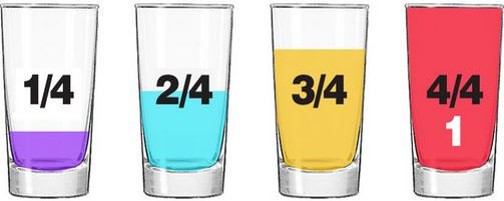
If the numerator of a fraction is smaller than the denominator, the fraction is less than \(1\) and is called a proper fraction. For example \(\frac{1}{4}\) is a proper fraction.
-
If the numerator of a fraction is bigger than the denominator, the fraction is greater than \(1\) and is called an improper fraction. For example \(\frac{5}{4}\) is an improper fraction. These kind of fractions can also be expressed as mixed numbers (where a whole number and a fraction are together) or just as whole numbers as relevant. For example \(\frac{5}{4}\) can also be expressed as \(1\frac{1}{4}\) (since \(5\) divided by \(4\) gives \(1\) with \(1\) left over), while \(\frac{8}{4}\) can also be expressed as \(2\) (since \(8 \div 4 = 2\) with no remainder). Unless otherwise stated, you would generally give answers as mixed or whole numbers rather than improper fractions.
-
If the denominator of a fraction is \(1\) the fraction is just equal to the whole number numerator. For example \(\frac{4}{1} = 4\)
-
If the numerator and denominator are the same, the fraction is equal to \(1\) and we generally write it as such. For example \(\frac{4}{4} = 1\)
Simplifying fractions
Unless otherwise stated, fractions should always be given in their simplest form - that is, using the smallest numbers possible. You can convert a fraction to simplest form by following these steps:
-
Determine the highest common factor of the numerator and denominator (i.e. the largest number that divides into both a whole number of times). Note that you may need to list out all the factors of both the numerator and denominator in order to find this, as unfortunately there is no ‘magic’ way of doing it. Alternatively, rather than trying to find the highest common factor you can use any common factor of the numerator and denominator (i.e. any number that divides into both a whole number of times). This just means you will need to repeat these steps until there are no more common factors. Note that when doing this it is generally easiest to look for ‘easy’ factors such as \(2, 3, 5\) or \(10\) first.
-
Divide both the numerator and denominator by this highest common factor or a factor to obtain a new numerator and denominator. If the latter is used, repeat as necessary until there are no more factors.
Example: If \(8\) out of \(12\) participants who responded to a survey are female, what is this as a fraction in simplest form?
Solution: Following the steps above, we have:
-
The factors of \(8\) are \(1, 2, 4, 8\) and the factors of \(12\) are \(1, 2, 3, 4, 6, 12\)
Since the largest number on both these lists is \(4\) it means the highest common factor is \(4\) -
Dividing the numerator of \(8\) by this highest common factor gives \(8 \div 4 = 2\) and dividing the denominator of \(12\) by this highest common factor gives \(12 \div 4 = 3\)
So \(\frac{8}{12}\) simplifies to \(\frac{2}{3}\)
</div>
Finding equivalent fractions
The fractions \(\frac{8}{12}\) and \(\frac{2}{3}\) from the previous example are equivalent fractions, which means that they are equal in value. While often you will determine an equivalent fraction by simplifying as above, other times you may need to find an equivalent fraction with a specified new denominator (or less frequently, a numerator) - perhaps for the purpose of comparing, adding or subtracting fractions with different denominators. You can determine an equivalent fraction with a specified denominator by following these steps (or vice versa for determining an equivalent fraction with a specified numerator):
-
Divide the denominator of your incomplete fraction by the denominator of your complete fraction.
-
Multiply the numerator of your complete fraction by the value obtained previously.
Note that you can always do the division in the first step the other way around if you prefer, in which case you will need to divide in the second step instead of multiplying (if you are ever in doubt about whether to multiply or divide in the second step, take note of the fractions and whether it would make sense for the new denominator, or numerator, to be bigger or smaller than for the original fraction).
Alternatively, you may want to work out the unknown value by multiplying the known value in the incomplete fraction (e.g. the denominator) by the ‘opposite’ value in the complete fraction (e.g. the numerator), and then dividing by the remaining value (e.g. the denominator of the complete fraction).
Example: If a student scores \(\frac{32}{40}\) on a test, but the test only counts for \(15\) marks of her final grade, what is her mark out of \(15\) as an equivalent fraction?
Solution: Following the steps above, we have:
-
The denominator of the incomplete fraction is \(15\) and the denominator of the complete fraction is \(40\)
So \(15 \div 40\) gives \(0.375\) -
The numerator of the complete fraction is \(32\)
So \(32 \times 0.375\) gives \(12\) and the equivalent fraction is \(\frac{12}{15}\)

Alternatively, you could multiply \(15\) and \(32\) (the ‘opposite’ values in the two fractions) and divide by the remaining value of \(40\)
</div>
Once you have worked through the examples above, have a go at the fraction problems in the following activity:
Adding and subtracting fractions
When it comes to adding or subtracting fractions, there are two different types of problems you need to consider. The first is when the fractions have like denominators (i.e. the same denominators). When this is the case, adding or subtracting them is straightforward as you just add or subtract the numerators of the fractions, and keep the denominator of your answer the same as the original fractions.
Example: Nick eats \(\frac{1}{8}\) of a pizza while his brothers Jo and Ryan each eat \(\frac{3}{8}\) of the pizza. What fraction has been eaten altogether?
Solution: Adding the three fractions simply requires adding the numerators, as follows:
\[\frac{1}{8} + \frac{3}{8} + \frac{3}{8} = \frac{1 + 3 + 3}{8} = \frac{7}{8}\]So \(\frac{7}{8}\) of the pizza has been eaten altogether.
</div>
Adding or subtracting fractions with unlike, or different, denominators requires more work, as you need to convert the fractions to equivalent fractions with like denominators first before you can add or subtract them. You can do this by following these steps:
-
Determine the lowest common denominator of all fractions in the problem (i.e. the smallest number that all the denominators can divide into a whole number of times). If you can’t find this you can always just use the product of the denominators, which is always a common denominator but may not be the lowest.
-
Convert each fraction in the problem to an equivalent fraction with denominator as specified.
-
Once your fractions all have the same denominator, you can add or subtract them as usual.
-
Simplify your result if necessary.
Example: David has a big pile of assignments to mark, which he spreads over a number of days. He marks \(\frac{1}{4}\) of the assignments on Monday, \(\frac{1}{3}\) of the assignments on Tuesday and \(\frac{2}{5}\) of the assignments on Wednesday. What fraction of the assignments has he marked over the three days?
Solution: Following the steps above, we have:
-
The three denominators in the problem are \(4, 3\) and \(5\) so the lowest common denominator is \(60\) (which in this case is the same as the product of \(4, 3\) and \(5\) since \(4 \times 3 \times 5 = 60\))
-
The fractions can be converted to equivalent fractions with denominators of \(60\) as follows:
\(\frac{1}{4} = \frac{15}{60}\) since \(60 \div 4 = 15\) and \(1 \times 15 = 15\)
\(\frac{1}{3} = \frac{20}{60}\) since \(60 \div 3 = 20\) and \(1 \times 20 = 20\)
\(\frac{2}{5} = \frac{24}{60}\) since \(60 \div 5 = 12\) and \(2 \times 12 = 24\) -
The sum now becomes \(\frac{15}{60} + \frac{20}{60} + \frac{24}{60} = \frac{15 + 20 + 24}{60} = \frac{59}{60}\)
-
This fraction cannot be simplified, so the fraction of assignments marked is \(\frac{59}{60}\)
</div>
Multiplying and dividing fractions
Sometimes you may be required to find a fraction ‘of’ some number, such as \(\frac{2}{3}\) of another fraction, or \(\frac{2}{3}\) of an integer. Either way, this requires you to multiply the fraction by the number.
To do this when the number in question is also a fraction, you can multiply the two fractions together by simply multiplying the two numerators and the two denominators to make a new fraction (simplifying as required). On the other hand, if the number to multiply by is an integer then you can simply multiply the integer by the numerator of the fraction and divide by the denominator, in whichever order is easiest to calculate and makes sense to you.
Example: Suppose you are considering taking a job that is part-time, and you would be working \(\frac{4}{5}\) of a normal load. If the full time salary is \(\$60000\) what would your part-time salary be?
Solution: This requires you to calculate \(\frac{4}{5}\) of \(\$60000\) which is the same as multiplying \(\frac{4}{5}\) and \(\$60000\)
You can do this in a number of ways (note it doesn’t matter which way around you write the numbers being multiplied, so do it in a way that makes sense to you). For example:
Method 1: \(\$60000 \times \frac{4}{5} = \$60000 \times 4 \div 5 = \$240000 \div 5 = \$48000\)
Method 2: \(\$60000 \times \frac{4}{5} = \$60000 \div 5 \times 4 = \$12000 \times 4 = \$48000\)
Method 3: \(\frac{4}{5} \times \$60000 = 4 \div 5 \times \$60000 = 0.8 \times \$60000 = \$48000\)
So your part-time salary would be \(\$48000\)
</div>
Furthermore, if you can multiply with fractions then you are already halfway there (no pun intended!) when it comes to dividing with fractions, as dividing by a fraction with a certain numerator and denominator is the same as multiplying by the same fraction with the two values switched around (i.e. by the reciprocal). This works because multiplication and division are opposite operations.
Example: Suppose you have a piece of string that is \(30\)m long, and you want to cut it into lengths that are \(\frac{3}{4}\)m each. How many pieces will you end up with?
Solution: This requires you to divide \(30\) by \(\frac{3}{4}\) which is the same as multiplying \(30\) by \(\frac{4}{3}\)
You can do this in any of the ways detailed above, for example:
\(30 \times \frac{4}{3} = 30 \times 4 \div 3 = 120 \div 3 = 40\)
So you would end up with \(40\) pieces of string.
</div>
Once you have worked through the examples above, have a go at the fraction problems in the following activity:
Ratios, rates and proportions
Like fractions and percentages, a ratio is a way of comparing two or more numbers. For example, if a class contains \(17\) male and \(13\) female students then the ratio of males to females can be expressed as \(17:13\) or as \(17\) to \(13\) or as \(\frac{17}{13}\) (either way, note that the crucial thing is to match up the order of the items being expressed in the ratio with their respective numbers).
Ratios such as this compare values that are in the same units, and therefore the units are excluded from the ratio as we are comparing the numbers only. A rate, on the other hand, is a special type of ratio that compares two quantities with different units of measurement. When describing a rate, the word ‘per’ is used between the two measurements; for example the price of a particular food stuff may be \(\$6\) per \(2\) kg.
Just as fractions are usually expressed in simplest form, ratios are usually expressed in lowest terms. For example, if there are \(10\) male and \(20\) female students then the ratio would typically be expressed as \(1:2\) rather than \(10:20\)
Similarly, rates are typically expressed as unit rates, where the second term in the rate is one. For example, the cost of the same food stuff as a unit rate is \(\$3\) per kg. Note you can simplify ratios and rates like these in the same way as simplifying fractions.
When two ratios or rates are equivalent, we say that they are in proportion. For example, the ratios \(1:2\) and \(10:20\) you saw previously are in proportion as they represent the same relationship, and so too are the rates \(\$6\) per \(2\) kg and \(\$3\) per kg.
Finding unknown values to ensure ratios or rates are in proportion is a common requirement, and this can be done in much the same way as finding unknown values in equivalent fractions (as detailed in the Fractions section). The key thing to remember is that in order to be in proportion, the numbers in the ratios or rates need to be multiplied or divided by the same value.
Example: Consider that an excursion is planned for a year two class of \(30\) students. Given that there is a requirement for a ratio of one adult to every \(6\) students, how many adults are required on the excursion?
Solution: To calculate this, first note that there is one complete ratio (\(1:6\)) and one incomplete ratio (\(?:30\))
To find the missing value so that the ratios are in proportion, one way is to write the ratios on separate lines:
\(1:6\)
\(?:30\)
This way it is easy to see that you need to divide the two numbers that are above one another to find out the relationship between the ratios, and then apply this relationship to the other side of the ratios.
So in this case \(30 \div 6 = 5\) meaning the second ratio is five times the first, and therefore that \(1 \times 5 = 5\) adults are required:

Alternatively, you could multiply \(1\) and \(30\) (the ‘opposite’ values in the two ratios) and divide by the remaining value of \(6\) which also gives \(5\)
</div>
Once you have worked through the example above, have a go at the ratio, rate and proportion problems in the following activity:
Averages
Sometimes you may be required to calculate a simple average given a total and a number of people or things. To do this, you simply need to divide the total by the number of people or things.
Example: Suppose that in a school reading challenge a class of \(22\) students reads \(99\) books. What was the average number of books read by each individual student?
Solution: To calculate the average books per student when \(99\) books are read by \(22\) students you would do:
\[99 ÷ 22 = 4.5\]So the average number of books read per student is \(4.5\) books.
</div>
Once you have worked through the example above, have a go at the average problems in the following activity:
Algebra
Having an understanding of some basic algebra is handy in order to solve problems involving unknown values. This section details how to write simple equations and how to substitute values in order to solve them. If you would like to learn more about algebra, including techniques for rearranging in order to solve equations, please refer to the Algebra module.
Writing a simple algebraic equation involves using letters or symbols to represent unknown values (called variables) and putting these together in an equation, complete with an equals sign and the relevant mathematical operations, to represent the relationship between them.
Example: Suppose you are a teacher planning a school incursion. You investigate prices and find an incursion you like which costs \(\$5\) per student, plus an additional one-off booking fee of \(\$50\) for the event. What is an equation that represents the cost of the incursion for different numbers of students?
Solution: In this case our unknown values are the number of students and the total cost. We could use the letter \(s\) (for example) to represent the number of students, and the letter \(t\) (for example) to represent the total cost. Two examples of equations to represent the total cost (\(t\)) of the incursion for \(s\) students are then as follows:
-
\(t = 5 \times s + 50\) \((\)or you can omit the \(\times\) sign and just write \(t = 5s + 50)\)
-
\(t = 50 + 5 \times s\) \((\)or you can omit the \(\times\) sign and just write \(t = 50 + 5s)\)
</div>
Generally, the purpose of writing algebraic equations is to solve them to find out unknown values. While this can be done for more than one variable at a time, note that this is more complex and requires the equivalent number of equations which is not covered here. Instead, we will focus on using one algebraic equation to find one unknown value, and in particular at how to do this by substituting values in for any other variables so that the only remaining variable is by itself on one side of the equals sign.
Example: Consider the equation from the previous example. If there are \(20\) students in the class, how much would the incursion cost?
Solution: You can solve to find the total cost by substituting (i.e. replacing) the \(s\) with \(20\) which gives:
\[t = 5 \times 20 + 50 = 100 + 50 = 150\]So the equation becomes \(t = 150\) and this tells us that the total cost of the incursion for \(20\) students would be \(\$150\)
</div>
Alternatively, if you wanted to find out how many students could attend the incursion given a set budget, this would involve rearranging the equation so that the \(s\) was by itself on one side of the equals sign. For details on rearranging equations please refer to the Algebra module.
Once you have worked through the examples above, have a go at the algebra problems in the following activity:
Are you a Curtin student who would like to work through a module and gain a certificate for learning more about key numerical skills? Access the Maths 4 University module.
</div> Measurement & geometry
This page takes you through some important concepts on the topics of measurement and geometry, with activities to consolidate your knowledge along the way. For more sample questions on these concepts, in particular if you are preparing for the Literacy and Numeracy Test for Initial Teacher Education (LANTITE), you may like to visit the LANTITE page. Alternatively, if you would like to build up some more advanced skills on the topic of geometry, you may like to visit the Geometry and trigonometry module.
As you work through the content keep in mind that there are often different ways of solving the same problem. While in some cases alternative methods have been explained, for many examples just one method of working is provided. If you already know a different technique for solving the problem then that’s great (provided it is also correct, of course). Don’t feel you need to change your method - the important thing is that you use a technique that makes sense to you.
In brief, this page covers how to do the following:
- Convert units of measurement
- Draw diagrams to help solve problems involving measurement
- Solve problems involving time
- Use distance and time to calculate speed
- Interpret directions
- Calculate perimeter, area and volume of simple shapes
</div>
Converting between units
The metric system of measurement is an international system of units of measurement which is based on the decimal (or base \(10\)) number system. The system uses two kinds of units; base units and derived units. The base unit of measurement for three common types of measurement are as follows:
| Measurement | Unit | Abbreviation |
|---|---|---|
| Length | metre | m |
| Volume | litre | L |
| Weight | gram | g |
From these base units of measurement, other units of measurement are derived to show smaller or larger multiples of the base unit. This is done by way of an appropriate prefix which is added to the base unit to indicate how it has been altered. The most commonly used are:
| Metric prefix | Relation to base unit | Abbreviation | Derived units |
|---|---|---|---|
| kilo | 1000 times bigger | k | kilometre (km), kilolitre (kL), kilogram (kg) |
| centi | 100 times smaller | c | centimetre (cm) |
| milli | 1000 times smaller | m | millimetre (mm), millilitre (mL), milligram (mg) |
When solving a problem involving measurements, you need to ensure that all measurements of the same type are in the same unit. If they aren’t, you can convert from one unit to another by making use of the relationships detailed in the table above.
Example: Suppose you wish to tile the floor of a room that is \(3\textrm{m}\) wide with small tiles of width \(50\textrm{mm}\). How many tiles will you need to cover the width of the room?
Solution: To solve this you first need both measurements to be in the same unit. If you wish to have them both in metres, for example, you could convert the measurement that is in millimetres to metres by dividing by \(1000\):
\(50\textrm{mm} \div 1000 = 0.05\textrm{m}\)
Alternatively, if you wish to have them both in millimetres you could convert the measurement that is in metres by multiplying it by \(1000\):
\(3\textrm{m} \times 1000 = 3000\textrm{mm}\)
Once the measurements are both in the same unit, you can simply divide one by the other:
Method 1: \(3\textrm{m} \div 0.05\textrm{m} = 60\)
Method 2: \(3000\textrm{mm} \div 50\textrm{mm} = 60\)
Either way, \(60\) tiles are required.
</div>
Some other common equivalent measurements you may need to convert between are:
- \(1\textrm{cm} = 10\textrm{mm}\)
- \(1\textrm{ metric tonne} = 1000\textrm{kg}\)
- \(1\textrm{ hectare} = 10000\textrm{m}^2\)
- \(1\textrm{ hectare} \approx 2.471\textrm{ acres}\) (an imperial measurement)
If you ever forget whether to divide or multiply when converting, just think about the relative size of the different units and whether the conversion makes sense (millimetres are much smaller than metres, for example, so you need a lot of them to make a small amount of metres). You can also use your knowledge of rates and proportion to ensure the conversion is correct (refer to the Ratios, rates and proportions section if required).
Example: Suppose you are considering purchasing a property that is listed as being \(5\) acres. How big is the property in hectares?
Solution: If you wish to convert this to the metric unit of hectares, you have the following complete and incomplete rates:
\[\begin{aligned} 1 \textrm{ hectare} &= 2.471 \textrm{ acres} \\\ ? \textrm{ hectares} &= 5 \textrm{ acres} \end{aligned}\]Therefore, since \(5 \div 2.471 \approx 2.023\), it follows that \(5\textrm{ acres}\) is equivalent to \(2.023\textrm{ hectares}\).
</div>
Once you have worked through the examples above, have a go at the conversion problems in the following activity:
Drawing diagrams
Never underestimate the power of a simple diagram to assist you with solving a measurement problem, as they can be really helpful.
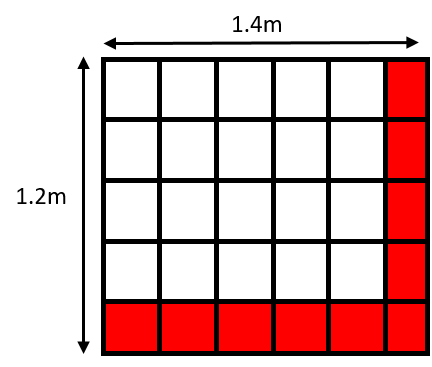
Example: Suppose you have a piece of cardboard measuring \(1.4\textrm{m}\) by \(1.2\textrm{m}\) and you want to cut it into squares of size \(25\textrm{cm} \times 25\textrm{cm}\) for a craft activity. You need \(23\) squares - will you be able to cut enough, or will you require some extra cardboard?
Solution: The first thing to do here is to convert the measurements to have them all in the same unit. Having all lengths in metres only requires one conversion, so doing this gives:
\(25\textrm{cm} \div 100 = 0.25\textrm{m}\)
Next, you might be tempted to find the area of the card and divide it by the area of the pieces you want to cut - but this doesn’t take into account the fact that you might have some unused strips of paper at the sides. A diagram illustrates this, and shows that instead you need to treat the length and width separately:
Doing this gives:
\(1.4 \div 0.25 = 5.6\), meaning \(5\) pieces can be cut from the length
\(1.2 \div 0.25 = 4.8\), meaning \(4\) pieces can be cut from the width
(Note you need to truncate - cut off - rather than round in both instances.)
Therefore \(5 \times 4 = 20\) pieces can be cut altogether, so you will need some extra cardboard.
</div>
Once you have worked through the example above, have a go at using diagrams to solve the problems in the following activity:
Time
Another concept you may need to work with measurements for is time. Some common calculations you might need to perform involving time include finding the duration of events and determining differences between times. There are a couple of different ways of doing this.
Example: Suppose you are timing a race, and the times for the first three competitors in minutes and seconds are \(23\):\(56\), \(24\):\(01\) and \(25\):\(12\). How much slower was the third placed competitor compared to the first?
Solution: There are a few different methods to find out the difference in minutes and seconds between \(23\):\(56\) (first) and \(25\):\(12\) (third).
For example, one approach is to convert both times to seconds by multiplying the minutes by 60 and adding the existing seconds, as follows:
\(23 \times 60 + 56 = 1436\textrm{ seconds}\), and \(25 \times 60 + 12 = 1512\textrm{ seconds}\)
You can then calculate the difference in seconds, which is:
\(1512 – 1436 = 76 \textrm{ seconds}\)
Finally, you can convert this difference back to minutes and seconds by dividing through by \(60\). When you do this the whole number part gives the number of minutes, while the decimal part can be multiplied by \(60\) again to give the number of seconds, as follows (note that the dot over the \(6\) indicates that the decimal is recurring - meaning it repeats forever):
\(76 \div 60 = 1.2\dot{6}\), and \(0.2\dot{6} \times 60 = 16\)
So the answer is \(1 \textrm{ minute}\) and \(16 \textrm{ seconds}\).
Another approach is to work it out in stages. For example, first of all you could calculate how many seconds are between \(23\):\(56\) and \(24\):\(00\), by subtracting \(56\) from \(60\) (i.e. \(60 – 56 = 4 \textrm{ seconds}\)). Then you could work out how many minutes are between \(24\):\(00\) and \(25\):\(00\) (i.e. \(25 – 24 = 1 \textrm{ minute}\)), and finally you could add on the extra \(12 \textrm{ seconds}\) from \(25\):\(12\) to give \(4 + 12 = 16 \textrm{ seconds}\).
So again the answer is \(1 \textrm{ minute}\) and \(16 \textrm{ seconds}\).
</div>
Once you have worked through the example above, have a go at the time problems in the following activity:
Speed
Once you are familiar with distance and time, you can use them to calculate the rate at which a distance is being travelled; otherwise known as speed. You can do this using the following formula:
\[\textrm{speed} = \frac{\textrm{distance}}{\textrm{time}}\]Example: Suppose you have just started a new job that is \(18\textrm{km}\) from your house, and you plan to ride your bike there. If you need to be at work at \(8\textrm{am}\) and you plan to leave your house at \(7.15\textrm{am}\), what will be the average speed you need to ride in kilometres per hour?
Solution: To calculate this, first note that you need to work out how much time you have in hours. Since you leave at \(7.15\textrm{am}\) and need to arrive by \(8\textrm{am}\) this gives a total time of \(45 \textrm{ minutes}\), and \(45 \div 60 = 0.75 \textrm{ hours}\).
Therefore your average speed will need to be: \(\frac{18}{0.75} = 24 \textrm{ km/hr}\)
Alternatively, \(\frac{18}{45} = 0.4 \textrm{ km/min}\) and \(0.4 \times 60 = 24 \textrm{ km/hr}\)
</div>
Once you have worked through the example above, have a go at the speed problem in the following activity:
Directions
Being able to read maps and interpret directions is an important skill. The two types of directions you may need to interpret are the four cardinal directions (north, east, south and west), and left and right directions.
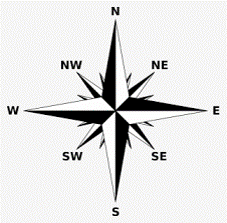
When interpreting cardinal directions on a map, there is often an arrow indicating which way is north (in the absence of this, it is safe to assume that north is at the top of the map). Once you know which way is north, there are different mnemonics you can use to remember the rest of the directions. For example, the letters in N ever E at S oggy W eetbix indicate that the clockwise order of the directions are N orth E ast S outh W est.
There are also intermediate directions located halfway between these directions, as illustrated:
In terms of left and right, it can be helpful to try and imagine yourself orientated in the direction you are ‘travelling’ on the map (or actually reorient yourself or turn the map if possible!), as left and right will vary accordingly. And if you forget left and right, just hold both hands up in front of you and try to make an ‘L’ shape with your fingers and thumb- the one that looks correct is your left hand.
Example: Suppose you are travelling south down Conway St and turn left on Allen St on the map shown. Will you make it to the shopping centre?
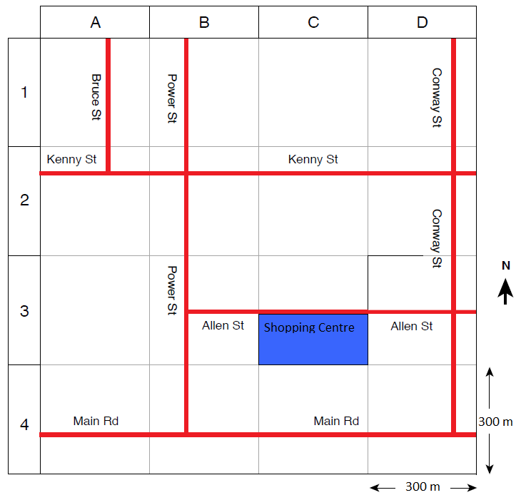
Solution: To figure this out, first note that north is at the top of the map, which means that south is at the bottom and that if you are travelling south down Conway St you are travelling ‘down’ the map. So try to imagine that when you get to Allen St you are coming at it from the ‘top’ side, facing downwards, and therefore that if you go left, you would go off the map and not towards the shopping centre.
Alternatively, you might like to try and remember that if you are travelling ‘down’ the map, the directions will be the opposite of what they would be if you were travelling ‘up’. So while it looks like the shopping centre is to the left of Conway St, actually you would need to turn right.
</div>
Once you have worked through the example above, have a go at the direction problems in the following activity:
Perimeter
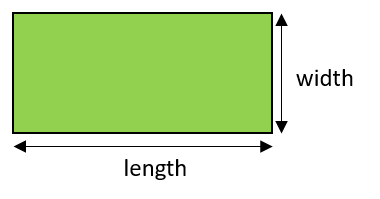
The perimeter of a shape is the distance around the outside. For example, the perimeter of a rectangle is just the sum of the \(4\) sides, which equates to \(2\) times the length plus \(2\) times the width. \(\textrm{Perimeter of rectangle} = 2 \times \textrm{length} + 2 \times \textrm{width}\)
You may also need to find the perimeter of irregular shapes. Sometimes this might require adding up the lengths of all the different sides, while at other times there may be a shortcut way of calculating the perimeter based on the perimeter of the shape or shapes the irregular shape is adapted from.
Example: What is the perimeter of the following shape?

Solution: One way of calculating the perimeter of this shape is to start by calculating the total perimeter of both the squares, which is \(12\textrm{cm} \times 4 + 12\textrm{cm} \times 4 = 96\textrm{cm}\)
Next, since both squares have been pushed together, there is a small part of the perimeter of each square that needs to be subtracted from this total. From the \(9\textrm{cm}\) distance on the diagram, we can work out that the distance that needs to be subtracted is two lots of \(3\textrm{cm}\) (since \(12\textrm{cm} - 9\textrm{cm} = 3\textrm{cm}\))
Therefore the perimeter of the irregular shape is \(96\textrm{cm} - 3\textrm{cm} - 3\textrm{cm} = 90\textrm{cm}\)
</div>
Once you have worked through the example above, have a go at the perimeter problems in the following activity:
Area
The area of a shape is the space inside the boundary. The most common area you will likely be required to work out is that of a rectangle, which simply requires multiplying the length by the width: \(\textrm{Area of rectangle} = \textrm{length} \times \textrm{width}\)
If you need to calculate the area of a triangle, this is simply half the base times the height: \(\textrm{Area of triangle} = \frac{1}{2} \times \textrm{base} \times \textrm{height}\)
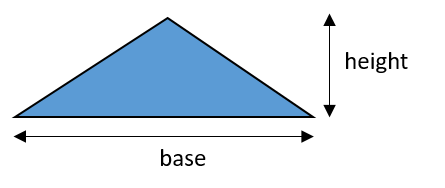
Example: What is the area of the following triangle?
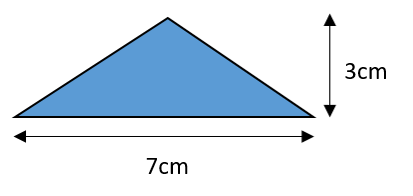
Solution: The area of this triangle is \(\frac{1}{2} \times 7\textrm{cm} \times 3\textrm{cm} = 10.5\textrm{cm}^2\)
</div>
Once you have worked through the example above, have a go at the area problems in the following activity:
Volume
The volume of a shape is the amount of 3D space inside it. Volume can be measured in cubic metres (or cubic centimetres, cubic millimetres, etc.), or it can be measured in litres (or millilitres, kilolitres, etc.). The relationship between these two kinds of measurements is as follows:
\(1 \textrm{litre} = 1000\textrm{cm}^3\)
Example: Suppose you have a rectangular fish tank that measures \(50\textrm{cm}\) long by \(30\textrm{cm}\) wide and \(40\textrm{cm}\) high. If you want to fill it three quarters of the way up, what would be the volume of water required in litres?
Solution: To do this you would first calculate the volume by multiplying the three measurements:
\(50\textrm{cm} \times 30\textrm{cm} \times 40\textrm{cm} = 60000\textrm{cm}^3\)
Next, three quarters of this volume is:
\(60000\textrm{cm}^3 \times \frac{3}{4} = 45000\textrm{cm}^3\)
Finally, you can convert to litres by dividing through by \(1000\):
\(45000\textrm{cm}^3 \div 1000 = 45 \textrm{ litres}\) required
</div>
Once you have worked through the example above, have a go at the volume problem in the following activity:
H5P interactive activity
Statistics & probability
This page takes you through some important concepts on the topics of statistics and probability, with activities to consolidate your knowledge along the way. For more sample questions on these concepts, in particular if you are preparing for the Literacy and Numeracy Test for Initial Teacher Education (LANTITE), you may like to visit the LANTITE page. Alternatively, if you would like to build up some more advanced skills on the topic of statistics you may like to visit the Introduction to statistics module, and if you would like to build up some more advanced skills on the top of Microsoft Excel you may like to visit the Microsoft Excel essentials module.
As you work through the content keep in mind that there are often different ways of solving the same problem. While in some cases alternative methods have been explained, for many examples just one method of working is provided. If you already know a different technique for solving the problem then that’s great (provided it is also correct, of course). Don’t feel you need to change your method - the important thing is that you use a technique that makes sense to you.
In brief, this page covers how to do the following:
- Calculate and interpret statistics for categorical data
- Calculate and interpret statistics for continuous data
- Interpret graphs
- Write and interpret Excel formulas
- Calculate probabilities and create sample spaces to solve probability problems
</div>
Statistics for categorical data
Statistics are what we use to summarise, display and describe data (observations and measurements). There are lots of different statistics, and the type of data determines the type of statistics used.
If the data is grouped into categories it is categorical data. This type of data is typically summarised using frequencies (counts) and/or percentages, and can also be displayed in a column graph or pie chart.
Example: Data relating to the favourite sports of students in a school can be summarised using the following frequency distribution table and column graph:
| Favourite Sports | Frequency |
|---|---|
| Netball | 55 |
| Football | 67 |
| Tennis | 32 |
| Basketball | 46 |
| TOTAL | 200 |
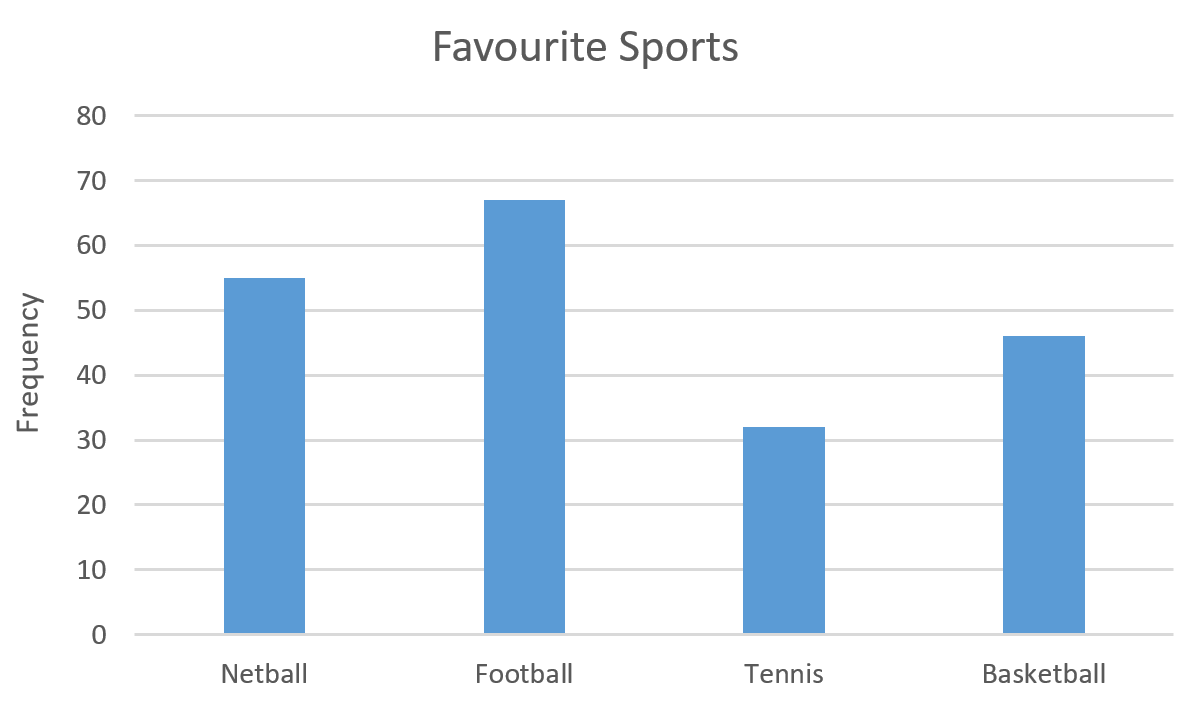
Use this information to determine the percentage of students who prefer tennis, as well as the most and least popular sports.
Solution: Using the data in the table we can determine that \(32 \div 200 \times 100 = 16\%\) of students prefer tennis. Using the graph or the table we can determine that football is the most and tennis is the least popular sport.
</div>
Once you have worked through the example above, have a go at analysing the categorical data in the following activity:
Statistics for continuous data
If data is measured on a continuous numerical scale it is continuous data (and in fact most numerical data is treated as continuous data, even if it is not measured on a continuous scale). This type of data is summarised using measures of central tendency and measures of dispersion, and displayed in graphs such as histograms and box plots.
Common measures of central tendency include the mean, median and mode, while common measures of dispersion include the range, interquartile range and standard deviation (although the latter two will not be covered here).
Continuous data can also be grouped into categories and displayed and analysed in the same way as categorical data. For example, data for ages can be grouped into age categories.
The mean
The mean (arithmetic average) of a set of values is calculated by summing all the values together and then dividing by the total number of values.
Example: Consider that the ages of ten education students are \(19\), \(20\), \(29\), \(28\), \(23\), \(18\), \(27\), \(22\), \(24\) and \(20\). What is the mean age of the students?
Solution: The mean age of the students can be calculated as follows:
\[\frac{19 + 20 + 29 + 28 + 23 + 18 + 27 + 22 + 24 + 20}{10} = 23\]</div>
Furthermore, sometimes the data may be presented in a frequency table, in which case you need to make use of the frequencies when calculating the mean.
Example: The following frequency distribution table shows the number of students who received different marks out of ten on a test (i.e. \(4\) students received a mark of \(6\), \(5\) students received a mark of \(7\), etc.):
| Marks (out of 10) | Frequency |
|---|---|
| 6 | 4 |
| 7 | 5 |
| 8 | 7 |
| 9 | 8 |
| 10 | 6 |
| TOTAL | 30 |
Based on the data in this table, what is the mean mark?
Solution: To calculate the mean in this case you again need to divide the total by the number of values, however in order to find the total you need to take into account the frequency of each value. You can do this by multiplying each value by its frequency before adding together, and hence the calculation should be as follows:
\[\frac{6 \times 4 + 7 \times 5 + 8 \times 7 + 9 \times 8 + 10 \times 6}{30} = \frac{247}{30} = 8.23\]</div>
Once you have worked through the examples above, have a go at calculating means in the following activity:
The median
The median is the middle value in an ordered set, or if there are an even number of values the median is the mean of the middle two. To find the median the data first needs to be put in ascending order (i.e. from smallest to largest).
Example: Consider that the ages of ten students are \(19\), \(20\), \(29\), \(28\), \(23\), \(18\), \(27\), \(22\), \(24\) and \(20\). What is the median age of the students?
Solution: The ages of the ten students in ascending order are \(18\), \(19\), \(20\), \(20\), \(22\), \(23\), \(24\), \(27\), \(28\) and \(29\). Since there are ten ages there are two middle values (the fifth and sixth ages), which are \(22\) and \(23\) respectively. Therefore the median age is \((22 + 23) \div 2 = 22.5\).
</div>
Again sometimes the data may be presented in a frequency table, in which case you need to calculate cumulative frequencies in order to determine the median.
Example: The following frequency distribution table shows the number of students who received different marks out of ten on a test (i.e. \(4\) students received a mark of \(6\), \(5\) students received a mark of \(7\), etc.):
| Marks (out of 10) | Frequency |
|---|---|
| 6 | 4 |
| 7 | 5 |
| 8 | 7 |
| 9 | 8 |
| 10 | 6 |
| TOTAL | 30 |
Based on the data in this table, what is the median mark?
Solution: Since there are \(30\) marks there are two middle values; the \(15\textrm{th}\) and \(16\textrm{th}\) marks. In order to find out what these are the cumulative frequencies (i.e. the sum of the frequencies to that point) should be calculated. It can be helpful to add another column to the table with these values, as follows:
| Marks (out of 10) | Frequency | Cumulative Frequency | |
|---|---|---|---|
| 6 | 4 | 4 | |
| 7 | 5 | 9 | |
| 8 | 7 | 16 | |
| 9 | 8 | 24 | |
| 10 | 6 | 30 | |
| TOTAL | 30 |
From these cumulative frequencies we can see that the \(10\textrm{th}\) through to the \(16\textrm{th}\) students all have a mark of \(8\), and therefore that the \(15\textrm{th}\) and \(16\textrm{th}\) students both have a mark of \(8\). Hence \(8\) is the median.
</div>
Once you have worked through the examples above, have a go at calculating medians in the following activity:
The mode
The mode in a set of scores is the one that appears most frequently. This may not necessarily be anywhere near the middle of the data set, but it is useful when we want the ‘most common’ value. If there are two or more values that are equally the most common then the set has multiple modes (they should not be averaged).
Example: Consider that the ages of ten students are \(19\), \(20\), \(29\), \(28\), \(23\), \(18\), \(27\), \(22\), \(24\) and \(20\). What is the mode of the students’ ages?
Solution: The only age that occurs more than once in the list is \(20\), which occurs twice. Hence \(20\) is the mode.
</div>
If the data is in a frequency table it is even easier to identify the mode.
Example: The following frequency distribution table shows the number of students who received different marks out of ten on a test (i.e. \(4\) students received a mark of \(6\), \(5\) students received a mark of \(7\), etc.):
| Marks (out of 10) | Frequency |
|---|---|
| 6 | 4 |
| 7 | 5 |
| 8 | 7 |
| 9 | 8 |
| 10 | 6 |
| TOTAL | 30 |
Based on the data in this table, what is the mode mark?
Solution: The mode is \(9\), as that is the mark that occurs most frequently.
</div>
Once you have worked through the examples above, have a go at the following activity:
The range
The range is simply the difference between the highest and lowest values in a data set.
Example: Consider that the ages of ten students are \(19\), \(20\), \(29\), \(28\), \(23\), \(18\), \(27\), \(22\), \(24\) and \(20\). What is the range of the students’ ages?
Solution: The oldest person is \(29\) and the youngest is \(18\), so the range is \(11\) (i.e \(29 - 18\)).
</div>
Once you have worked through the example above, have a go at the following activity:
Interpreting graphs
Being able to interpret and make comparisons using different kinds of graphs, including pie charts, column graphs, histograms, box plots and line graphs, is an important skill. When doing this, make sure you read the question carefully and, if applicable, focus in on the portion of the graph that is relevant.
Example 1: The following clustered column graphs compare the percentage of students who earned marks in four different ranges in a standardised test, for two different classes over two years:
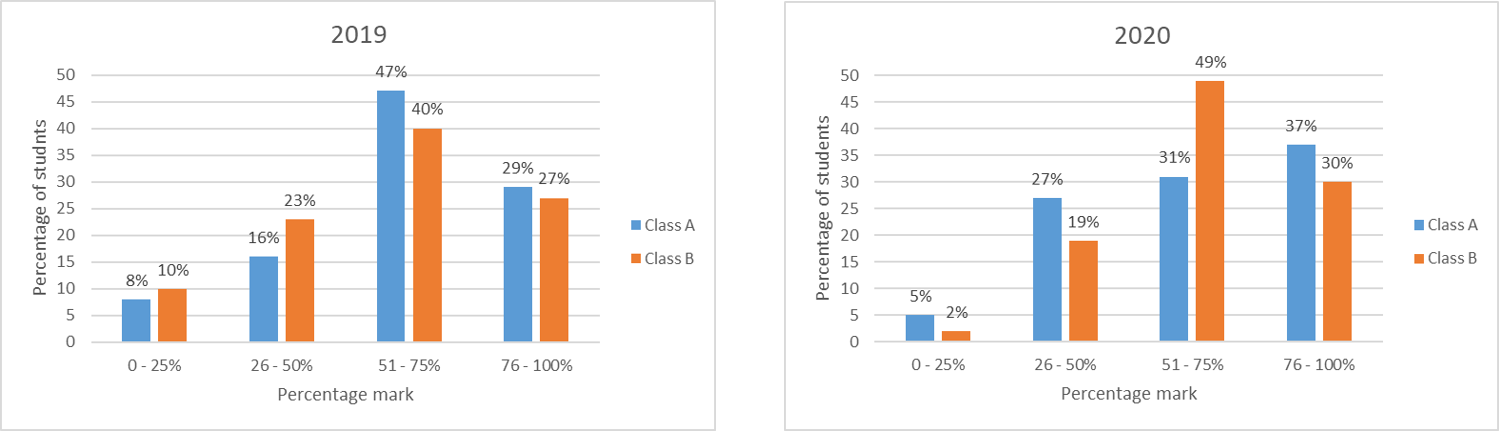
Are the following statements true or false?
- In \(2019\) more than three-quarters of students in class \(\textrm{A}\) had a mark over \(50\%\).
- The distribution of marks was more similar for the classes in \(2019\) than in \(2020\).
- The percentage of students who scored between \(26\%\) and \(50\%\) increased by \(11\%\) between \(2019\) and \(2020\) for Class \(B\).
Solution: Working and answers are as follows:
- True. Since the question asks about \(2019\), we can focus on the first graph and ignore the second for this question. Furthermore, since it refers to Class \(\textrm{A}\) we can just look at the blue columns. The question asks whether more than three-quarters of the relevant students had a mark over \(50\%\), which equate to students in the third and fourth ranges on the graph (i.e. \(51 - 75\%\) and \(76 - 100\%\)). Adding the percentage of students in each of these columns together gives \(47\% + 29\% = 76\%\), which is just over three-quarters (since three-quarters is equivalent to \(75\%\)).
- True. The column pattern for Class \(A\) and Class \(B\) is the same for \(2019\), but not for \(2020\).
- False. This is true of Class \(A\), but the percentage of students for Class \(B\) actually decreased by \(4\%\).
</div>
Example 2: The following graph shows NAPLAN student achievement for years \(3\), \(5\), \(7\) and \(9\):
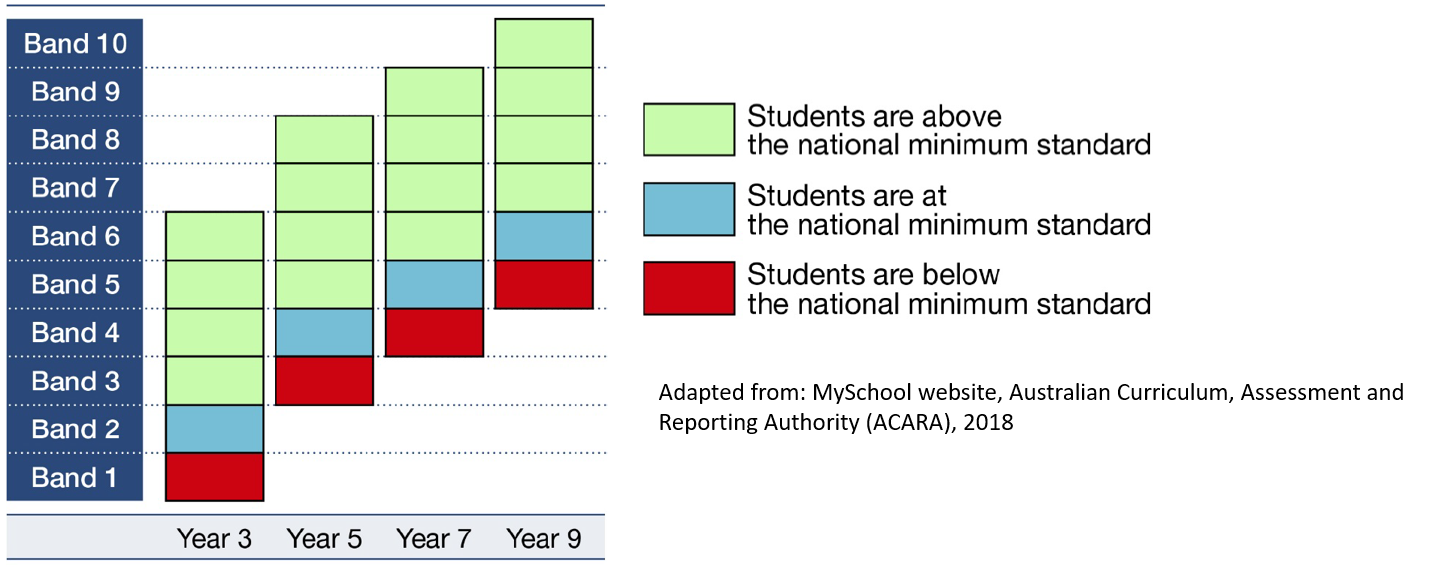
- For how many year groups is Band \(6\) above the national minimum standard?
- A student scores in Band \(5\), and is at the national minimum standard. What year must they be in?
- How many bands are reported in common for years \(3\) and \(9\)?
Solution: Working and answers are as follows:
- Looking at Band \(6\) in the graph we can see that it is green for three of the year groups, and the key indicates that green means that students are above the minimum standard. So Band \(6\) is above the national minimum standard for three year groups (years \(3\), \(5\) and \(7\)).
- From the key we can see that a blue cell indicates that students are at the national minimum standard. Looking at Band \(5\) in the graph we can see that the only year group with a blue cell is Year \(7\), indicating that the student must be in Year \(7\).
- Looking across at the different bands, we can see that there are only two reported in common for both years \(3\) and \(9\) (bands \(5\) and \(6\)).
</div>
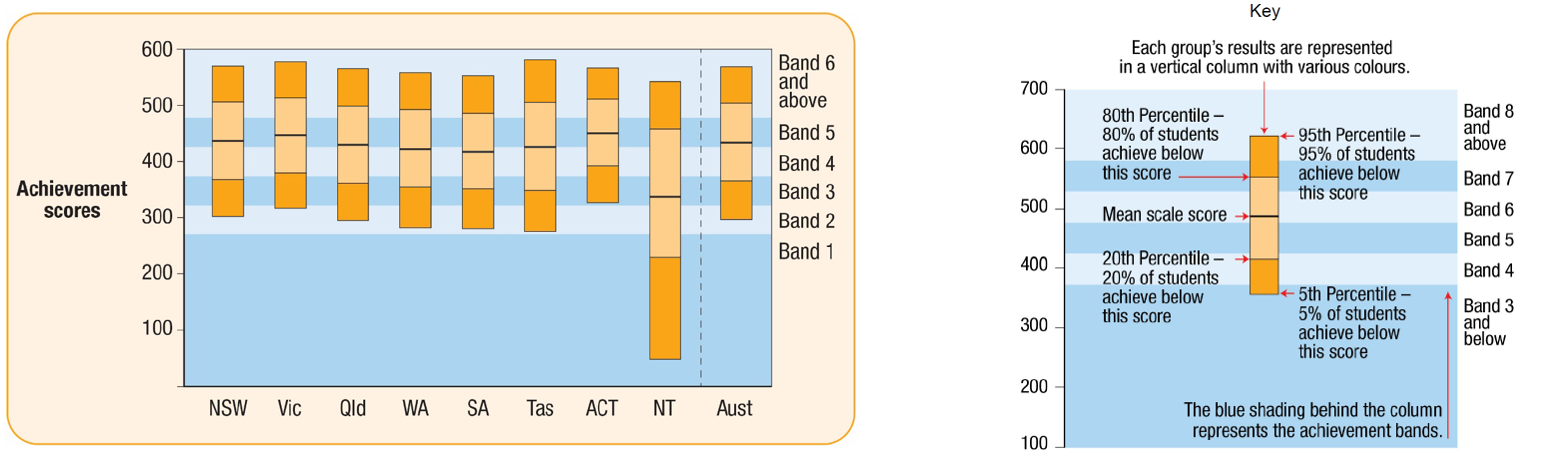
Example 3: The following graph shows NAPLAN \(2018\) Reading results for year \(3\) students in eight states and territories and in Australia overall:
- For which state or territory were the scores of more than \(20\%\) of students below Band \(3\)?
- For how many states or territories were the scores of at least \(80\%\) of students at Band \(4\) or above?
Solution: Working and answers are as follows:
- In order for the scores of more than \(20\%\) of students to be below Band \(3\), the entire dark orange section at the bottom of the column (which indicates the bottom \(20\%\) percentile) needs to be below Band \(3\). This is only true of the Northern Territory.
- In order for the scores of at least \(80\%\) of students to be at Band \(4\) or above, the line indicating the \(20\textrm{th}\) percentile (the line above the the dark orange section at the bottom) must be in Band \(4\) or above. This is only true for Victoria and the ACT, so the answer is \(2\).
</div>
Once you have worked through the examples above, have a go at the following activity:
Calculations in Excel
Often it can be easiest to use a spreadsheet to perform calculations (as well as to create graphs).
Example : The following spreadsheet shows the marks obtained by six students in a class:
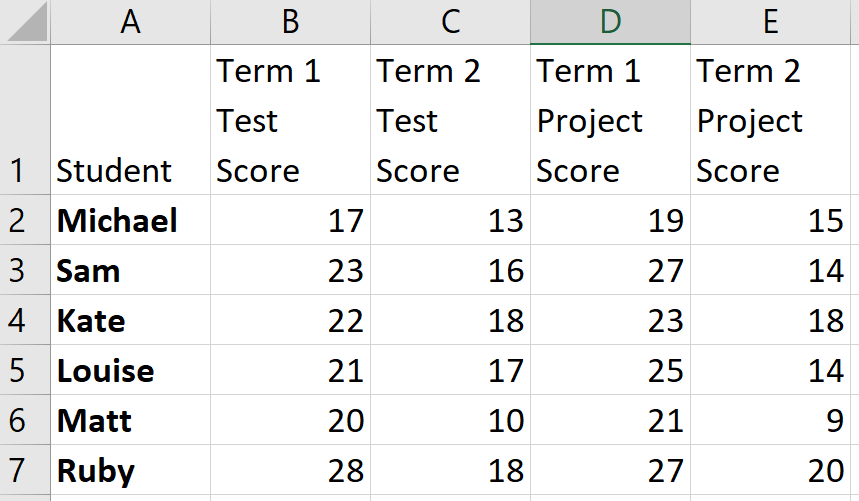
In a spreadsheet such as this:
- Each cell is referred to by the column letter and row number. For example, ‘Matt’ is in cell \(\textrm{A}6\).
- ‘*’ stands for multiplication and ‘/’ stands for division
- Each formula starts with an equals sign
You can therefore use different cell references to perform different calculations. For example \(=\textrm{B}2 + \textrm{C}2\) is the formula for Michael’s total test score, while \(=(\textrm{B}4 + \textrm{D}4)/2\) gives Kate’s term \(1\) average score.
</div>
Once you have read through the example above, have a go at the following activity:
Probability
The probability of an event is the chance of it occurring. This is measured as a value between \(0\) and \(1\), where \(0\) indicates that the event can never occur, and \(1\) indicates that the event is certain. One of the simplest examples of probability is when a single coin is tossed. When this is done there are two possible outcomes; either a head is tossed or a tail is tossed. These outcomes are both equally likely, and hence the probability of tossing a head is \(\frac{1}{2}\) and the probability of tossing a tail is \(\frac{1}{2}\).
In general, to calculate the probability of an event occurring you just have to divide the number of outcomes in which the event occurs, by the total number of possible outcomes:
\[\frac{\textrm{Number of outcomes in which event occurs}}{\textrm{Total number of possible outcomes}}\]Finally, simplify the fraction if required (or state the probability as a decimal, depending on what is requested).
Example: What is the probability of rolling an even number when a die is rolled?
Solution: To calculate this consider that there are \(3\) outcomes in which an even number occurs (i.e. when a \(2\), \(4\) or \(6\) is rolled), and that there are \(6\) possible outcomes in total. So this gives a probability of \(\frac{3}{6}\), which should then be simplified to \(\frac{1}{2}\).
</div>
If the probability calculation is a bit more complex, you may need to create what is known as a sample space. This shows all the possible outcomes, and can be in the form of a list, a table or even a tree diagram (the latter is most helpful when the possible outcomes are not equally likely). Creating a sample space allows you to easily determine both the number of possible outcomes, and the number of outcomes in which the event occurs.
Example: What is the probability that when two dice are thrown the faces sum to \(7\)?
Solution: To calculate this you could create a sample space in the form of a table, as follows:
| 1 | 2 | 3 | 4 | 5 | 6 | |
|---|---|---|---|---|---|---|
| 1 | 1, 1 | 1, 2 | 1, 3 | 1, 4 | 1, 5 | 1, 6 |
| 2 | 2, 1 | 2, 2 | 2, 3 | 2, 4 | 2, 5 | 2, 6 |
| 3 | 3, 1 | 3, 2 | 3, 3 | 3, 4 | 3, 5 | 3, 6 |
| 4 | 4, 1 | 4, 2 | 4, 3 | 4, 4 | 4, 5 | 4, 6 |
| 5 | 5, 1 | 5, 2 | 5, 3 | 5, 4 | 5, 5 | 5, 6 |
| 6 | 6, 1 | 6, 2 | 6, 3 | 6, 4 | 6, 5 | 6, 6 |
From this we can see that there are \(6\) possible outcomes where the faces sum to \(7\), out of a total of \(36\) equally likely outcomes. So the probability of the faces summing to \(7\) is \(\frac{6}{36}\), which simplifies to \(\frac{1}{6}\).
</div>
Once you have worked through the examples above, have a go at the probability problems in the following activity:
H5P interactive activity
Feedback
If you would like to provide feedback on this module please do so by answering some or all of the questions in the form below. Alternatively for any questions about the module please contact Library-UniSkills@curtin.edu.au
We review this feedback regularly, and take your suggestions on board to improve the module. Thank you for your feedback!
Explore more here
About UniSkills
UniSkills was created and is maintained by Curtin University Library. To report issues with UniSkills contact Library Help.
Twemoji icons by Twitter, Inc and other contributors, licensed under a CC-BY 4.0 licence.
Except where otherwise noted, UniSkills content in all it’s forms (website, PDFs etc) are licensed under a Creative Commons Attribution ShareAlike 4.0 International Licence. We ask that you attribute any use of the content as created by Curtin University Library with a link to the Library website.
This license does not extend to other Curtin University and Curtin University Library webpages, or to Curtin branding and trademarks. Curtin University’s copyright information is available on the Curtin website.