
Evidence-based-practice-printable-guide-UniSkills.pdf
Evidence based practice
Table of Contents
Introduction
This self-paced module introduces you to evidence based practice (EBP) in the health sciences. Work through step-by-step or if you are already familiar with EBP skip to the relevant section using the tabs above.
What you will learn
- What evidence based practice is and the essentials steps in the EBP process
- Developing an answerable research question
- Creating an efficient search strategy to find the best available evidence
- Sources to search for evidence
- Critically appraising the evidence
What is evidence based practice?
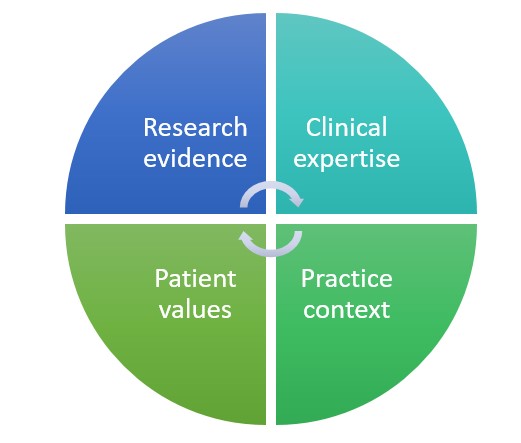
Evidence based medicine was first defined by Sackett et al. as “the conscientious, explicit, and judicious use of current best evidence in making decisions about the care of individual patients” (1996, p. 71). Evidence based medicine has since expanded to evidence based practice to apply more widely to other health professions (e.g. physiotherapy, social work, nursing etc.) and other disciplines (e.g. education and librarianship). It is the integration of best available research evidence, clinical expertise, and patient values and preferences. More recent models incorporate a fourth component, the clinical practice context (Hoffman et al., 2017).
The steps in EBP
There are five essential steps in EBP:
- Ask: Convert the patient problem into an answerable question
- Acquire: Find the best evidence to answer the question
- Appraise: Critically appraise the validity and applicability of the evidence
- Apply: Integrate the appraised evidence in the clinical setting
- Act: Evaluate the performance and success of the change
This module focuses on the first three steps in the cycle: developing an answerable question, finding the best evidence to answer the question, and appraising the quality of the evidence.
Ask a question
Develop a focused clinical question
There are two main types of questions that may arise from a patient dilemma:
-
Background questions address general queries about a particular disease, condition, test or treatment and can often be answered sufficiently using medical textbooks or point-of-care tools (e.g. UpToDate).
-
Foreground questions address aspects of care, therapy options or possible outcomes in relation to a specific patient or situation and require a more in-depth literature search to find the answer.
Answering foreground questions involves developing well-formed, focused clinical questions.
The PICO framework
The PICO framework is commonly used to translate and structure patient dilemmas into focused questions. Using PICO helps to identify the important concepts for your search strategy and makes searching for evidence easier and more time effective.
| Patient, population or problem | What are the characteristics of the patient or population (e.g. disease or condition, age, gender?) |
| Intervention or exposure | What is the main intervention of interest (e.g. drug or other treatment, diagnostic/screening test)? |
| Comparison | What is the alternative being considered (e.g. standard therapy, placebo, no treatment)? |
| Outcomes | What are the relevant outcomes (e.g. reduced risk or mortality, return to function, accurate diagnosis)? |
See a PICO example
Jack is a 40 year-old bricklayer who has been experiencing intermittent low back pain over the last few weeks. He has been taking Panadol to alleviate the pain but his friend who also experiences back pain suggested trying Ibuprofen instead. As his general practitioner (GP), Jack has asked you whether Ibuprofen is better than Panadol for back pain.
Step 1: Identify the PICO elements from the patient dilemma
P - Adult with low back pain
I - Ibuprofen
C - Panadol
O - Reduced back pain
Step 2: Use the PICO elements to formulate the clinical question
In adults with low back pain (P), is Ibuprofen (I) compared to Panadol (C) more effective in reducing back pain (O)
Types of studies
What type of study best fits your focused clinical question? The evidence pyramid is used to illustrate the evolution of the literature. It ranks study types based on the rigour (strength and precision) of their research methodology. As you move up the pyramid the amount of available literature decreases, but increases in its relevance to the clinical setting.
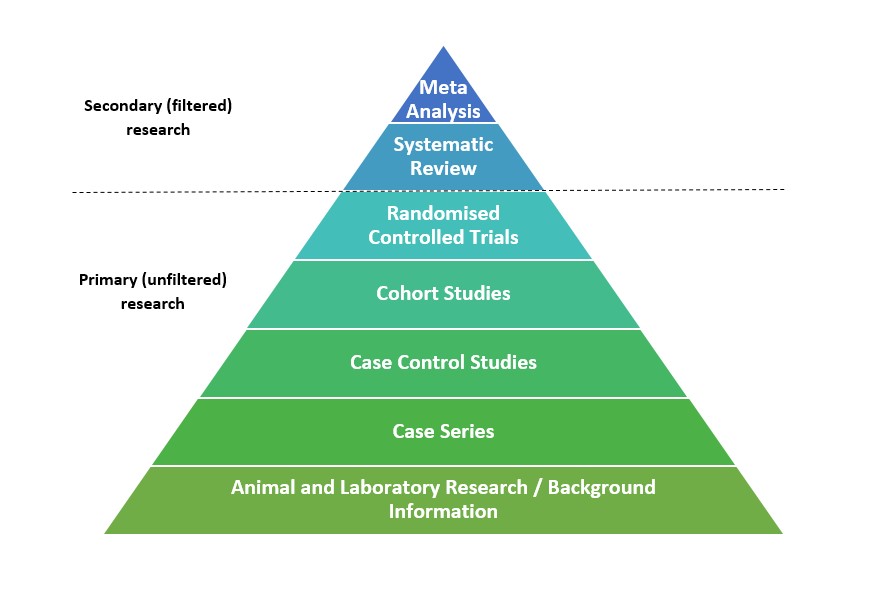
Secondary (filtered) research
-
A Meta-Analysis uses statistical methods to synthesise the data from individual studies in a systematic review.
-
A Systematic Review is a review based on a clearly formulated question. It uses systematic and reproducible methods to identify, select and critically appraise all relevant research, and to collect and analyse data from the studies that are included in the review.
Primary (unfiltered) research
-
Randomised Controlled Trials (RCTs) are study designs that randomly assign participants to an experimental group (receives a clinical intervention) or a control group (receives a placebo, the standard treatment or no intervention).
-
Cohort Studies are observational studies that identify two groups (cohorts) of patients, one which received the exposure of interest/intervention and one which did not, and follows them forward for the outcome.
-
Case Control Studies identify patients with a specific condition (cases) and patients without the condition (controls) and look back to see if they had an exposure of interest. They often rely on medical records and patient recall for data collection.
-
Case Series consist of a group or series of case reports involving patients with an outcome of interest. As they are reports of cases and use no control groups they have no statistical validity.
-
Animal and Laboratory Research/Background information includes animal research, and laboratory studies and testing.
Study design
PICO can be extended to PICOS where S stands for Study design. The following table outlines suitable study designs to answer a clinical question. Meta-analyses and systematic reviews where available, will often provide the best answers to clinical questions.
| Question type | Definition | Best study design |
|---|---|---|
| Therapy | The effect of an intervention/s on a patient | Randomised Controlled Trial (RCT) |
| Diagnosis | Ability of a test to differentiate between those with or without a condition | Prospective, blind comparison to a gold standard |
| Harm/etiology | The effect of potentially harmful agents | Cohort study or Case control study |
| Prognosis | The likely progression, outcome or survival time for a condition | Cohort study |
| Prevention | Reducing chance of a disease by changing risk factors or early diagnosis & treatment | RCT |
For the clinical question In adults with low back pain, is Ibuprofen compared to Panadol more effective in reducing back pain we are looking at the effect of a drug on a patient. This is a therapy question; the best study design would be a RCT. </div>
PICo (Qualitative)
Qualitative questions look at people’s experiences, attitudes, beliefs, opinions, perceptions etc. A modified framework, PICo, can be used for these types of questions. PICo stands for Population, Interest and Context. For more information on answering qualitative questions, please see:
Acquire the evidence - how to search
Building a search strategy
Once you have developed your PICO and well-formed clinical question you can begin to build your search strategy by translating the significant concepts of the PICO into a concept grid.
In adults with low back pain, is Ibuprofen compared to Panadol more effective in reducing back pain
| Concept 1: Low back pain | Concept 2: Ibuprofen |
|---|---|
It is recommended to start with a broad search using the Population and Intervention elements of the PICO. If your search requires further refinement, you may consider including the Comparator and then limit your results to the Study design.
Alternative (similar) keywords
Authors often use different terms to describe the same concept. When searching it is important to consider alternative terms (synonyms) and spelling variations which may be used. Think about:
- Medical vs. Common terms e.g. Varicella Zoster / Chicken pox
- Acronyms/Abbreviations e.g. COPD / Chronic Obstructive Pulmonary Disease
- Generic vs. Brand name drugs e.g. Acetaminophen / Panadol
- English vs. American terminology e.g. Tumour / Tumor
- Broader vs. Narrower terms e.g. Obesity surgery / Bariatric surgery
Similar terms can be added to the grid beneath the relevant concept:
| Concept 1: Low back pain | Concept 2: Ibuprofen |
|---|---|
| Low back pain Lower back pain Back pain Backache Lumbago Lumbar pain |
Ibuprofen Nurofen Advil Brufen |
Combining search terms
You can structure your search using AND and OR to combine your keywords:
-
AND is used to combine different concepts and narrows your search by instructing the database that you are only interested in articles that contain both of your terms. For example, a search for low back pain AND ibuprofen will only return records containing both the terms low back pain and ibuprofen.
-
OR is used to combine similar concepts and broadens your search by instructing the database that you are interested in articles that contain either of your terms. For example, a search for ibuprofen OR nurofen will locate all records containing either the terms ibuprofen or nurofen.
Database search tips
Truncation
Truncation (usually an asterisk *) can be used to find alternate endings of a word e.g. educat* for educate, educated, education, educational etc.
Phrase searching
Phrase searching (“ “) can be used to search for two or more terms as a phrase rather than individually e.g. “chronic obstructive pulmonary disease”
Wildcards
Wildcards (usually ?) can be used for spelling variations e.g. tumo?r for tumour and tumor
PICO search strategy worksheet
The following worksheet can be used to help in developing your search strategy:
Acquire the evidence - where to search
Primary sources
Primary (unfiltered) sources provide evidence concerning a topic under investigation. These generally appear in peer-reviewed journals and are mainly found by searching databases. It is important to be able to access primary sources, particularly if your clinical question cannot be answered from filtered sources or there are newer studies not included in the sources you have found.
Enter your search terms then refine using the Clinical Queries, Randomized Controlled Trials or Evidence Based Practice limits.
Perform a search for your topic and then click on Additional Limits and filter your search by: Clinical trials, EBM-Evidence Based Medicine or Clinical Queries.
Search for your topic then select the filters on the search results page under Type of Article (Clinical Trial, Randomized Controlled Trial etc.). You can also select PubMed Clinical Queries which is a tool for clinicians to quickly find evidence on clinical or disease-specific topics without performing a comprehensive search strategy. It is especially useful for therapy and diagnosis queries.
To limit your PsycINFO search, click on Additional Limits to choose Methodology (study types) or Clinical Queries.
Secondary sources
Secondary (filtered) sources are summaries and analyses of the evidence derived from and based on primary sources. They provide an appraisal of the quality of studies and often make recommendations for practice. Systematic reviews, meta-analyses and clinical practice guidelines fall under this category.
Cochrane Library is a database of systematic reviews in health and social care which present summaries of the findings of the best studies.
JBI provides a wide range of summarised and appraised evidence for nursing and healthcare topics.
Provides abstracts of clinical practice guidelines, randomised controlled trials and systematic reviews in physiotherapy.
Provides abstracts of systematic reviews and randomised controlled trials in occupational therapy.
Provides details of systematic reviews, randomised controlled trials, case series, and single subject design studies in speech pathology.
Clinical practice guidelines
This portal provides links to guidelines from countries around the world, including guidelines developed for use in Australian health care settings.
Database of Australian evidence-based therapeutic guidelines.
A comprehensive database of evidence‐based clinical practice guidelines and related documents produced by the Agency for Health Care Research and Quality, in partnership with the American Medical Association and the American Association of Health Plans.
This provides national guidance on promoting good health and preventing and treating ill health in the UK.
Point-of-care tools
Point-of-care tools summarise the best available evidence based information about specific clinical problems.
UpToDate is an evidence-based, physician-authored clinical decision support database which assists clinicians in making appropriate point-of-care decisions. Current health and medical information is synthesized into evidence based recommendations to improve the quality of patient care.
PEN provides guidance on food and nutrition, and offers evidence-based answers and summaries to support decision making for clinicians, educators, public health and community practitioners.
Appraise the evidence
Critical appraisal is an integral process in evidence based practice that seeks to identify the strengths and limitations of the studies found.
Criteria for appraisal of studies:
- Is the study relevant to my query?
- Does the study provide any new evidence?
- How current is the study?
- Was the trial of sufficient size to reach a meaningful conclusion?
- What role did the funder(s) play?
- Was there any bias in the methodology or selection of the subjects in the study?
- were the subjects randomly selected?
- blinding - were researchers and subjects unaware of who was in the intervention or control group?
- were individuals treated equally through the trial?
The RAMMbo mnemonic may be helpful for critical appraisal of a study:
Recruitment - were all patients selected representative of the target population; have inclusion/exclusion criteria been taken into account
Allocation - was there randomisation
Maintenance - were all patients treated equally except for the intervention and was the allocation concealed
Measurements were:
- blinded
- objective
</div>
Critical appraisal tools
There are a number of tools available to assist you with appraising the quality of the article(s) you have found.
CASP helps people to find and interpret the best available evidence from health research.
The Centre for Evidence-Based Medicine in Oxford (UK) provides tools and downloads for the critical appraisal of medical evidence. Sample appraisal sheets are provided together with several helpful examples.
Provides access to critical appraisal tools for different types of studies including systematic reviews and RCTs.
About UniSkills
UniSkills was created and is maintained by Curtin University Library. To report issues with UniSkills contact Library Help.
Twemoji icons by Twitter, Inc and other contributors, licensed under a CC-BY 4.0 licence.
Except where otherwise noted, UniSkills content in all it’s forms (website, PDFs etc) are licensed under a Creative Commons Attribution ShareAlike 4.0 International Licence. We ask that you attribute any use of the content as created by Curtin University Library with a link to the Library website.
This license does not extend to other Curtin University and Curtin University Library webpages, or to Curtin branding and trademarks. Curtin University’s copyright information is available on the Curtin website.