
Reading-and-note-taking-printable-guide-UniSkills.pdf
Reading and note-taking
Table of Contents
Introduction
Reading and note-taking are important parts of writing an assessment. They help you turn the information you find during research into knowledge that you understand and can explain in your own words.
What you will learn
After completing this module, you should better understand:
- Reading strategies: Learn how to understand the parts of a journal article, skim and scan effectively, and use intensive reading. The module also gives advice on how to read difficult texts.
- Critical reading: Learn how to evaluate sources and use lateral reading to make sure you choose high-quality information for your assessments.
- Note-taking: Discover strategies for taking clear, useful notes and explore different note-taking methods.
- GenAI tips: Learn how to use generative AI tools to support your reading and note taking strategies.
Resources
For more information on reading and note-taking, you can sign up to a workshop or have a look at the workshop slides below.
Test your knowledge
Unsure where to start? Discover your reading and note taking strengths and weaknesses.
Not what you're looking for?
I want to:
- Learn how to paraphrase, summarise and synthesise information
- Improve my academic writing skills
- Find more relevant sources
- Better understand what my assignment is asking me to do
- Better understand if I have met the marking criteria
Assignment process
Assignments are not always a linear journey, but usually you’ll have to complete the following steps:
Reading strategies
You won’t have time to read every source you find in full detail, so it’s important to use smart reading strategies to save time. These strategies help you understand your topic overall and focus on the important details when needed.
In brief:
- Navigating a journal article - journal articles are often used at university. A good reading strategy is to look at different parts of the article to find what you need.
- Skimming and scanning - skimming means quickly looking through a text to check if it is useful for your topic and fits your assessment requirements. Scanning means searching for specific information in the text that relates to your assessment.
- Intensive reading - only read a text intensively and in detail if you are sure it is worth your time.
- Reading difficult texts - some texts you will want to use might be difficult to read, but there are some strategies that can make reading them easier.
- Gen AI and reading - Gen AI tools can be helpful for organising your ideas and supporting your understanding as you read
</div>
Navigating a journal article
Assessments often ask you to include academic research. Most of the time, this research comes from journal articles. Learning how to read these texts quickly is a useful skill. Most articles follow a similar format and use the same headings. This makes it easier to know which parts to focus on, so you don’t always need to read the whole article. Most articles have the following sections (though some of the headings might be slightly different):
Abstract (a summary of the article)
This is a short summary of the article. It includes how the research was done, what was found, and what the results might mean for the wider topic or field.
Read this:
- to quickly understand what the article is about. If it does not fit your assessment question, you can skip the rest of the article.
Introduction (why was the research done)
This section introduces the topic, explains why it matters, and shares the research question (what the authors are trying to find out) and the hypothesis (what they expect to find). It may also include a summary of past research and any background information that helps the reader understand the context of the research.
Read this:
- to understand why the research was done, what the authors were investigating, and to get an overview of the project
- together with the conclusion to get a quick summary of the article.
Literature Review/background (what is already known) This section explains what other researchers have already discovered about the topic. This helps you understand the context of the study, common questions or problems in the field, and past findings that the current study builds on. Sometimes this section does not have a heading, but you can usually spot it because it includes lots of references to other studies.
Read this if:
- you want to know what earlier research the article is based on
- you are looking for other articles on the same topic.
Methods (how was the project done)
This section explains how the research was carried out. It includes how the data was collected (for example, through surveys, interviews, or experiments), how the data was analysed, and any problems the researchers faced. This information helps the reader to judge the quality of the research, its strengths and weaknesses. It also helps researchers to repeat the study, for example in a different country or with different participants.
Read this to:
- learn how the research was done
- compare the article with other studies that used different methods, for example, maybe they looked at health issues in a different country, or conducted an experiment in a different temperature setting
- check if the authors collected the right kind of data to answer their research question (sometimes that is not the case).
Results (what was discovered)
This section shows what the researchers found. The results can be shown in different ways, such as tables, graphs, written explanations, or quotes from interviews.
Read this to:
- find out what the research discovered.
Discussion (what it means)
This section explains what the results mean. It discusses whether the findings answer the research question and support the hypothesis.
Read this:
- to understand what the authors think their results mean, what the effects might be, and how things could or should change because of their findings
- to learn about any weaknesses or limits of the study
- if you are looking for ideas for your own research or want to know what questions still need to be answered.
Conclusion (summary and what happens next)
This section explains how the research fits into the bigger picture. It describes the strengths and weaknesses of the study and suggest ideas for future research. Sometimes this section also gives recommendations or suggest actions.
Read this:
- along with the introduction to get a quick overview of the article.
References
This is a list of all the literature the authors used and cited in the article.
Read this to:
- find other researchers who have studied the same or similar topics
- see if the article includes research from different fields (multidisciplinary research), or to check how recent the sources are by looking at the publication dates.
Skimming and scanning
Skimming is a reading strategy where you look over a text quickly without reading every word. It helps you focus on the main idea of the text instead of closely reading the entire text. Skimming is useful when you are searching for useful sources or trying to decide if a text is relevant to your assessment. It is likely that you will mostly use research articles for your assessment and that you will be skimming those, but this strategy also works for book chapters, books, webpages, and other materials you are finding in your literature searching.
Focus on these parts when skimming a research article:
- The abstract or summary
- The introduction or first few paragraphs of the text
- Headings and subheadings
- Any lists or bolded words
- Images, tables, or graphs
- The discussion or conclusion section
- Table of contents (for longer texts, books or book chapters)
These parts will help you quickly understand what the article is about and whether it is useful for your assessment. If your assessment requirements tell you that you need to use recent literature, or literature within a given timeframe, make sure you also check the publication date of the article.
Scanning is similar to skimming. It means looking over a text quickly without reading every word, but with a clear purpose. When you scan, you search for specific keywords or ideas from your assignment question and focus only on the parts that are most useful to you.
For example, scanning can help you quickly find out:
- if the research was done in Australia
- if a certain metal was used in an experiment
- if a specific research method was used
- or if the text includes other ideas that your assessment focuses on.
You can use CTRL + F (or Command + F on a Mac) to search for specific words in a document or on a website. This is a fast and easy way to check if the text contains what you are looking for.
Intensive reading
Intensive reading means reading very carefully so you understand the important ideas and the author’s argument. This is different from skimming or scanning. When you read intensively, you should read the whole source to get the complete picture. However, depending on the argument you want to make in your assignment, you might focus more on key parts like the introduction, conclusion, and sections about results or discussion.
As you read, remember your assessment question and thesis statement, if you have one. Think actively about what the text is saying and how it connects to your work.
When you ready an article intensively, you should also take notes from the text. For note taking tips, see the Note taking page in this guide. Reading intensively also means reading critically, see the reading critically page in this guide on how to do this.
Reading difficult texts
Sometimes, you will come across journal articles that are hard to read and understand. This can feel frustrating, and you might think it means you are not smart enough. However, it is more likely that the article is not well written, which makes it harder to understand. Even experienced researchers and scholars sometimes struggle with reading journal articles. Most of the time, you will need to read an article more than once to fully understand it. Reading it just once, even carefully, is usually not enough.
Here are some tips to help you read journal articles and other challenging texts:
Build background knowledge
If the topic of the research article is new to you, start by reading something simpler. This could be a basic article, a Wikipedia page, a textbook chapter, a blog post, or a news article. These sources can give you the background information you need to understand the more complex journal article. They can also help you feel more confident before you begin reading the harder text.
Read aloud or use text-to-speech
Listening to the article being read aloud can help you stay focused and understand it better. Many devices and internet browsers have built-in text-to-speech tools that can read PDFs or websites out loud for you.
Read with a friend or in a study group
Talking about the article with someone else can help you understand it more clearly. You can take turns explaining different parts or summarising sections. If you are working alone, imagine you are explaining the article to a friend. You could also pretend you are writing them an email, explaining what you have understood and what you are still unsure about. This can help you understand the article better when you read it again.
Understand complex sentences or paragraphs
If a sentence or paragraph is confusing, try rewriting it in your own words. You can also break it into smaller parts. Ask yourself questions like: What is the author trying to say here? and Why is this important? Writing things down in your own words can help you understand the meaning more clearly.
Focus on visuals
Graphs, tables, images, and figures can sometimes explain the article’s ideas more clearly than the written text. Try to understand what each visual is showing before reading the text.
Use annotation tools
Digital tools like Hypothesis, OneNote, or PDF editors let you highlight, write comments, and ask questions directly on the article. This kind of active reading helps you stay engaged and remember more. You can also do this on paper using highlighters and sticky notes. See our note taking guide for more ideas.
Create a mind map or flowchart
You can use a mind map or flowchart to show how the article’s ideas are connected. Write down the main points you understand and draw lines to show how they relate to each other. You can also include any questions you still have. This makes the article easier to follow and less overwhelming.
Set a time limit
Give yourself a set amount of time, such as 20 minutes, to read and take notes. This helps you stay focused and reduces stress. After a break, you can return to the article with fresh eyes and a clearer mind.
Critical reading
Critical reading means reading to understand and evaluate the information. It is an important step when choosing sources for your assignment. You need to make sure you use strong, reliable evidence, and this starts with selecting high-quality sources.
In brief, critical reading involves:
- Evaluating the source. You can use the CRAAP method for this, which provides you with questions so you can look at the article more closely, and decide whether you should use it or not.
- Use lateral reading. This is especially important if something in the source seems surprising or does not match the rest of your research.
</div>
Evaluating sources
CRAAP stands for currency, relevancy, authority, accuracy and purpose. It is a method you can use to evaluate sources you are planning to use for your assessment. CRAAP provides you with questions you can ask, so you can make sure you use good quality and relevant sources.
Currency: When was it written/published?
- When was the information published or last updated?
- Is it recent enough for your needs, or is it outdated?
- Does your Unit Outline say how recent the research for your assessment should be?
- What was happening when the work was created? Were there local or global events that might have influenced the author’s point of view (e.g., COVID-19, Black Lives Matter, regional/global instability)?
Tip: If you cannot find a publication date or you are unsure if statistics or case studies are current, do a quick Google search to find other sources that confirm this information.
**Example** You are writing about mental health impacts of COVID-19. You find an article published in 2018. The date shows it was written before the pandemic, so it may not include COVID-related data. You need to decided if that is a problem for your assessment, and if it is, search for newer studies from 2021 onwards to make sure your evidence is current.Relevancy: Is it what you need?
- Does the information relate to your topic?
- Is it suitable for your assessment?
Tip: Read the abstract or introduction to confirm the source matches your topic and level.
**Example** You are researching the causes of World War I. You find a blog post aimed at general readers. The language is simple and lacks references, so it is not academic. Your Unit Outline specifically states that you are meant to use only academic sources for your assessment, so you look for a journal article or a university-level textbook instead.</div>
Authority: Who wrote it?
- Who wrote the information and who published it? Can you confirm their credentials?
- Does the information fall within their area of expertise?
- Where was it published? For example, an article on wellbeing in a psychology journal will be different from one in a marketing journal.
Tips:
- Look up the author or organisation on LinkedIn, ResearchGate, or Twitter (X) to confirm their credentials and interest in the topic.
- A Google search may show interviews, blogs, affiliations, research grants, or controversies. This helps you check credibility, and work out why the author has written the text.
</div>
Accuracy: Is it reliable, true and correct?
- Are the views, opinions, or theories supported by valid research (evidence, facts, or citations)?
- Can you verify the information in other sources? (See lateral reading below.)
- Is the language objective, or is it biased?
- Confirm any key statistics or surprising information, using lateral reading techniques.
Tip: Do a Google search to confirm specific information. Has the research been cited in other studies? Have the statistics appeared in news or organisational reports? If they have, do other sources agree or dispute the information?
**Example** You find an article claiming that “renewable energy now provides 30% of global electricity.” To check this, you search Google for “percentage of global electricity from renewable energy.” You find reports from the International Energy Agency and the World Bank confirming that the figure is close to 30%. This shows the original claim is accurate and the source is trustworthy.</div>
Purpose: Why was it created?
- Is the information meant to inform, teach, persuade, entertain, or sell?
- Is the point of view objective, or is it biased? If it only gives one side or uses emotional language, it may be trying to persuade or manipulate.
- Is it fact, opinion, or propaganda?
Tip: Look for signs of bias, such as emotional language or lack of evidence. Check if the source is from a company trying to sell a product or an organisation promoting a cause.
**Example** You find an article about renewable energy on a solar panel company's website. The article promotes solar panels and ignores other renewable options. You decide to use a peer-reviewed journal article instead, as it provides a balanced view.</div> </div>
Lateral reading
When you evaluate a source using the CRAAP method, you can use a technique called lateral reading. This means checking the author’s claims and conclusions by looking for confirmation from other sources. To do this, you search for facts, arguments, or background information from the original source using a search engine like Google. If other reliable sources confirm the information, you can be more confident that it is trustworthy. Websites like Wikipedia, credible news organisations, and reports from trusted organisations can be helpful when doing lateral reading.
Some examples for credible organisations:
- Government organisations, for Australia that is websites ending with .gov.au
- ABC News
- SBS News
- The Sydney Morning Herald
- The Guardian Australia
- The Conversation
- World Health Organization (WHO)
- United Nations (UN)
- OECD (Organisation for Economic Co-operation and Development)
- Australian Bureau of Statistics (ABS)
- Australian Policy Online (APO) - Provides access to policy papers and research reports from government and academic sources. [apo.org.au]
- The Australia Institute: Research Reports - Publishes independent research on economics, governance, and environmental issues.
Watch the video below to learn more about how lateral reading can help you evaluate information.
Note taking
Note-taking is an important part of successful study and learning. It helps you organise what you read or hear and turn it into your own understanding. Good note-taking makes it easier to move between reading and writing because you can capture key ideas in your own words and connect information from different sources.
In brief, to take good notes, you should:
- Use effective note-taking strategies to turn information from sources into knowledge you can use in your assignments.
- Write notes in your own words using techniques like Cornell note-taking, mind-mapping or outlining which reduces the risk of accidental plagiarism.
- Use your notes to find links between readings so you can synthesise information and plan the structure of your assignment.
</div>
Always keep accurate records of what you read for referencing. Include details like the author, date, title and source. One way to do this is by using a reference management tool such as EndNote.
Strategies
Good notes are useful notes. They help you move from the information you get in lectures and readings to showing your knowledge in an assignment.
So, how do you take good, useful notes? It depends on your learning style. There are many ways to take notes. We will explain a few methods, but if these do not suit you, check out #studyspo for more ideas and inspiration.
All note-taking styles share some common features. When you record your notes:
- Keep your assignment question and thesis statement (if you have one) in mind as you read and take notes. This will help you focus on the most useful information.
- Write notes in your own words instead of copying word for word from the source. This helps you understand the content and helps with paraphrasing later, reducing the risk of accidental plagiarism. Your notes are for you only, so they don’t need to be in perfect academic English.
- Think about other sources you have read and note any links or disagreements between them. This will help you synthesise in your writing.
- Always record the details of the source for your reference list (and so you can find it again).
Watch this short video for 10 tips!
Let’s look at three note-taking strategies: Cornell note taking, mind mapping, and the outlining method.
Cornell note-taking
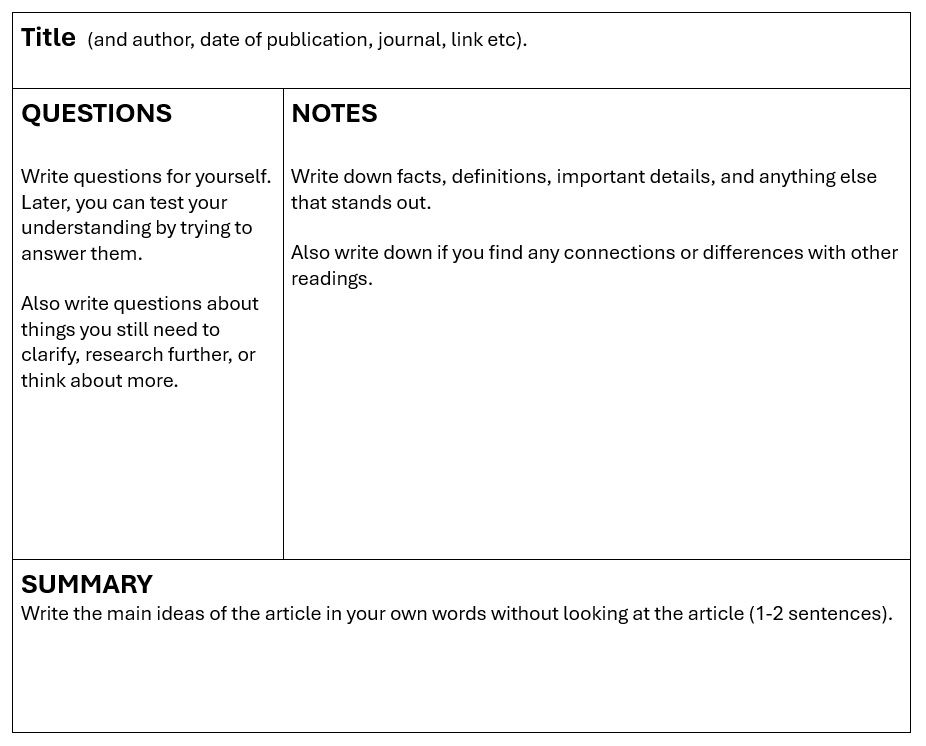
The Cornell note-taking method focuses on an individual source, and provides structure to the note-taking process. It gives you the opportunity to record key information from the source, pose questions to yourself and write a summary in your own words.
Method:
- You need a piece of paper (see example below), a whiteboard, or use our Word template: Cornell template [DOCX, 16kB]
- Divide your space into three sections: an area for Notes, a smaller area for Questions, and a section for a Summary.
- Use the Notes section to write down facts, definitions, important details, and anything else that stands out. Also write down if you find any connections or differences with other readings.
- Use the Questions section to write questions for yourself. Later, you can test your understanding by covering your notes and trying to answer these questions. You can also write down questions about things you still need to clarify, research further, or think about more.
- Use the Summary section to write the main ideas of the article in your own words without looking at the article. Try to only write a few sentences. This helps make sure that you are using your own words and that you understand the article.
Example:
Mind mapping
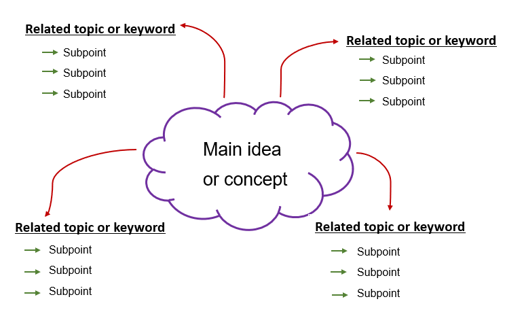
Mind mapping is a way of taking notes visually which shows how ideas are connected. You can use it to record notes from one source or to link ideas from several sources. Mind mapping is useful for planning assessments because it helps you identify the main ideas for your paragraphs and the readings that you can use as evidence to support those ideas.
Method (for notes for one article):
- Write the main idea from an article in the centre of a blank page and draw a circle around it.
- Find the main concepts and write them around the main idea. Draw lines to connect them back to the centre.
- Under each concept, write important facts, definitions, or anything else related to that concept.
- Show links between ideas by drawing lines to connect them.
Method (for summarising multiple sources)
- Write your assignment question in the centre of the page and draw a circle around it.
- Around this circle, write the main ideas or concepts you want to include in your assignment. Draw circles around these too.
- Under each idea, write important facts, supporting sources, and any statistics or research you plan to use.
Example:
The outline method
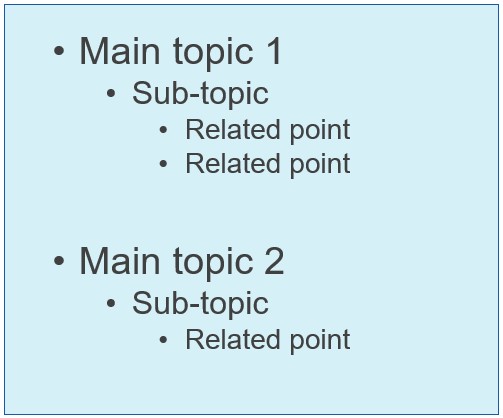
The outline method is a structured way to take notes. It organises information into main ideas and supporting details using formatting on the page. Your notes will look like this:
- Main idea or topic
- Sub-topic or idea that supports the main topic
- Supporting fact, evidence or thought related to the main idea.
- Supporting fact, evidence or thought related to the main idea.
- Supporting fact, evidence or thought related to the main idea.
- Another sub-topic or idea that supports the main topic
- …
- Sub-topic or idea that supports the main topic
Method:
- Read the source carefully before you start taking notes. This helps you find the main points.
- Write your first main idea as a bullet point.
- Add supporting ideas underneath, using a new bullet point for each one. Move these points further from the left margin so you can easily see which are main ideas and which are supporting ideas. Keep notes short—about one sentence per point. It does not need to be a full sentence, just write what works for you.
- Add more details if needed, always moving each new level further from the left margin.
Example:
Synthesising
Good notes also help you with synthesising information.
Note-taking strategies help you find information from a source that is useful for your assignment. They allow you to focus on the most relevant details and start changing the author’s words into your own. These strategies also help you see the bigger picture by combining what you have read with what you learned in lectures and your own ideas. This process of putting information together is called synthesising. It helps you make connections and build a more complete understanding of the topic.
When you synthesise, you look for connections in the research, such as common findings or ideas. You also notice where there are differences or contrasting views. Making these connections is an important step as you prepare to write your assignment. For more details, see the writing guide.
Planning your assignment
Good notes also help you with planning your assessment.
You can use your notes to start bringing your information together. As you notice how your sources connect, begin thinking about how they will fit together in your assignment. You can start planning the structure and create an outline using your notes.
Your notes can help you consider:
- How many paragraphs your assignment might need
- The number of sections required
- Any quotes or statistics you may want to include
As you organise your ideas and make your plan, you can also start writing the main elements of your assignment, such as your introduction or topic sentences for your paragraphs.
GenAI tips
GenAI for reading and note taking
Gen AI tools can be helpful for organising your ideas and supporting your understanding but remember, the goal is for you to do your own reading and note-taking. Gen AI should be used as a tool that helps you learn, not one that does the work for you.
In brief:
- Do not use Gen-AI tools to do your reading or note‑taking for you.
- Do not upload copyrighted or licenced material (e.g. library articles) into Gen‑AI tools.
- Use Gen‑AI in line with Curtin guidelines and only for assessments if permitted.
- Think critically about any output you receive.
</div>
Using GenAI responsibly: What to avoid
Uploading licenced content
You should not share entire copyrighted material like journal articles with Gen-AI tools, unless they are Open Access (freely available to the public). If you find a journal article or similar text in a via a Curtin Library database (such as ProQuest, for example), you cannot upload it to a Gen-AI tool as that breaches the licencing requirements. You can find out more about privacy considerations and copyright in our Gen AI guide.
Getting GenAI to do the work for you
It can be tempting to use Gen‑AI to summarise articles or lectures, or to make notes for you. You might also want to use it to do your critical reading. But reading and taking your own notes are important parts of learning. If Gen-AI does this work for you, you miss the thinking needed to understand and remember the material, which means you learn less.
Remember, you can use Gen-AI as a student at Curtin:
- for study-related purposes
- for assessments if given written permission by a unit coordinator
- if you think critically about its output
- if you declare your use.
Using GenAI responsibly: Example prompts
If you choose to use Gen-AI for reading and note taking, have a look at our example prompts below. Change them to suit your context and always check any output you receive.
Example GenAI prompts for reading
Understanding difficult words/concepts
Act as a tutor who helps me learn. I am a university student studying [add what course you are in] and am reading a difficult journal article. Please help me understand the following concepts [add difficult words from the article, title or abstract]. Don’t do the work for me - just help me figure it out. Do not find the journal article and analyse or summarise it for me. Provide your answers in simple, informal language.
Getting background information before reading
Act as a tutor who helps me learn. I am a university student studying [add what course you are in] and am reading a difficult journal article. Based on the title of the article [copy/paste title], have a conversation with me about what the journal article might be about, so reading it will be easier for me. Don’t do the work for me - just help me figure it out. Do not find the journal article and analyse or summarise it for me. Provide your answers in simple, informal language.
Getting started by asking questions
Act as a tutor who helps me learn. I am a university student studying [add what course you are in] and am reading a difficult journal article. Based on the abstract of the article [copy/paste abstract], ask me some questions I should be thinking about as I read this article. Don’t do the work for me - just help me figure it out. Do not find the journal article and analyse or summarise it for me. Provide your answers in simple, informal language.
Getting help with critical reading
Act as a tutor who helps me learn. I am a university student studying [add what course you are in] and am reading a journal article with the title [copy/paste title]. Using the CRAAP method, have a conversation with me and ask me questions about the article that help me read it critically. Don’t do the work for me, just help me figure it out. Do not find the journal article and analyse or summarise it for me. Provide your answers in simple, informal language.
Example GenAI prompts for note taking
Splitting up the task into smaller chunks
Use Goblin tools or similar tools to split up tasks such as reading and note-taking. For example, you could enter “Read and take notes on Chapter 3 of my textbook” and ask the tool to break this into smaller steps. This helps you manage your workload without having the tool do your reading or note-taking.
Receiving feedback on your notes
Act as a tutor who helps me learn. I am a university student studying [add what course you are in]. I’ve written these notes for my assignment. The assessment is about [add a brief description]. Can you give me feedback on my notes and suggest improvements to make them more useful for writing my assessment. Don’t do the work for me - just help me figure it out. Provide your answers in simple, informal language.
Deciding on the structure of your assessment - option 1
Act as a tutor who helps me learn. I am a university student studying [add what course you are in]. I’ve written these notes for my assignment. The assessment is about [add a brief description]. Can you ask some guiding questions that help me decide on a structure for my assessment? Don’t do the work for me - just help me figure it out. Provide your answers in simple, informal language.
Deciding on the structure of your assessment - option 2
Act as a tutor who helps me learn. I am a university student studying [add what course you are in]. I’ve written these notes for my assignment. The assessment is about [add a brief description]. Suggest three ways that my notes could be organised so writing the assessment is easier. Don’t do the work for me - just help me figure it out. Provide your answers in simple, informal language.
Creating a note-taking template
Act as a tutor who helps me learn. I am a university student studying [add what course you are in]. I want to take some notes for my assessment. The assessment is about [add a brief description]. Can you provide me with a template and some guiding questions so I can take useful notes? Don’t do the work for me - just help me figure it out. Provide your answers in simple, informal language.
Creating a podcast
Use one of the many podcast Gen-AI tools available, and ask it to make a podcast on a topic that you are studying, to make reading and learning the topic easier, or ask it to make a podcast about a topic using your notes. This can work well if you are looking for different ways than reading to study.
Use your notes to study
Act as a tutor who helps me learn. I am a university student studying [add what course you are in]. I have taken notes from readings/lectures etc. Can you use my notes and generate questions so I can test my understanding of the topic? Don’t do the work for me - just help me figure it out. Provide your answers in simple, informal language.
About UniSkills
UniSkills was created and is maintained by Curtin University Library. To report issues with UniSkills contact Library Help.
Twemoji icons by Twitter, Inc and other contributors, licensed under a CC-BY 4.0 licence.
Except where otherwise noted, UniSkills content in all it’s forms (website, PDFs etc) are licensed under a Creative Commons Attribution ShareAlike 4.0 International Licence. We ask that you attribute any use of the content as created by Curtin University Library with a link to the Library website.
This license does not extend to other Curtin University and Curtin University Library webpages, or to Curtin branding and trademarks. Curtin University’s copyright information is available on the Curtin website.